CBSE Class 12 Maths 2023 Question Paper 65/1/1 with Solutions
All 45 questions from the CBSE Class 12 Mathematics board paper, Set 65/1/1 (2023),
with answers and step-by-step solutions. Total 80 marks. Tap “Show answer & solution” under any question.
The corner points of the feasible region in the graphical representation of a linear programming problem are (2, 72), (15, 20) and (40, 15). If z=18x+9y be the objective function, then :
(A)z is maximum at (2, 72), minimum at (15, 20)
(B)z is maximum at (15, 20), minimum at (40, 15)
(C)z is maximum at (40, 15), minimum at (15, 20)
(D)z is maximum at (40, 15), minimum at (2, 72)
Show answer & solution
Answer: (C) z is maximum at (40, 15), minimum at (15, 20)
Assertion (A) : The range of the function f(x)=2sin−1x+23π, where x∈[−1,1], is [2π,25π]. Reason (R) : The range of the principal value branch of sin−1(x) is [0,π].
(A)Both Assertion (A) and Reason (R) are true and Reason (R) is the correct explanation of the Assertion (A).
(B)Both Assertion (A) and Reason (R) are true, but Reason (R) is not the correct explanation of the Assertion (A).
(C)Assertion (A) is true and Reason (R) is false.
(D)Assertion (A) is false and Reason (R) is true.
Show answer & solution
Answer: (C) Assertion (A) is true and Reason (R) is false.
Assertion (A) : Equation of a line passing through the points (1, 2, 3) and (3,−1,3) is 2x−3=3y+1=0z−3. Reason (R) : Equation of a line passing through points (x1,y1,z1), (x2,y2,z2) is given by x2−x1x−x1=y2−y1y−y1=z2−z1z−z1.
(A)Both Assertion (A) and Reason (R) are true and Reason (R) is the correct explanation of the Assertion (A).
(B)Both Assertion (A) and Reason (R) are true, but Reason (R) is not the correct explanation of the Assertion (A).
(C)Assertion (A) is true and Reason (R) is false.
(D)Assertion (A) is false and Reason (R) is true.
Show answer & solution
Answer: (D) Assertion (A) is false and Reason (R) is true.
R is the standard two-point form, so R is true.
Direction ratios of the line are 3−1,−1−2,3−3, i.e. 2,−3,0.
The line is 2x−3=−3y+1=0z−3, not the one given, so A is false.
Solve graphically the following linear programming problem : Maximise z=6x+3y, subject to the constraints 4x+y≥80, 3x+2y≤150, x+5y≥115, x≥0,y≥0.
Show answer & solution
Answer: Maximum z=285 at x=40, y=15
Draw 4x+y=80, 3x+2y=150 and x+5y=115 in the first quadrant.
4x+y=80 and 3x+2y=150 meet at (2, 72); 4x+y=80 and x+5y=115 meet at (15, 20); 3x+2y=150 and x+5y=115 meet at (40, 15).
The feasible region is the triangle with corners (2, 72), (15, 20), (40, 15).
z at (2, 72) = 228; at (15, 20) = 150; at (40, 15) = 285.
Maximum z = 285 at (40, 15).
Q303 marksShort AnswerProbabilityNot in current syllabus
The probability distribution of a random variable X is given below : X: 1, 2, 3 P(X): 2k, 3k, 6k (i) Find the value of k. (ii) Find P(1≤X<3). (iii) Find E(X), the mean of X.
A relation R is defined on a set of real numbers R as R={(x,y):x⋅y is an irrational number}. Check whether R is reflexive, symmetric and transitive or not.
Show answer & solution
Answer: R is symmetric, but neither reflexive nor transitive.
Reflexive: 1⋅1=1 is rational, so (1,1)∈/R. R is not reflexive.
Symmetric: if (x,y)∈R, xy is irrational; yx=xy is irrational, so (y,x)∈R. R is symmetric.
Transitive: (1,2)∈R since 2 is irrational, and (2,2)∈R since 22 is irrational.
But 1⋅2=2 is rational, so (1,2)∈/R. R is not transitive.
Find the vector and the Cartesian equations of a line passing through the point (1,2,−4) and parallel to the line joining the points A(3,3,−5) and B(1,0,−11). Hence, find the distance between the two lines.
Show answer & solution
Answer:r=(i^+2j^−4k^)+λ(2i^+3j^+6k^); 2x−1=3y−2=6z+4; distance =7293 units
BA=2i^+3j^+6k^ gives the direction.
Line: r=(i^+2j^−4k^)+λ(2i^+3j^+6k^), i.e. 2x−1=3y−2=6z+4.
Line AB passes through A(3,3,−5) with the same direction b, ∣b∣=7.
Find the equations of the line passing through the points A(1, 2, 3) and B(3, 5, 9). Hence, find the coordinates of the points on this line which are at a distance of 14 units from point B.
Show answer & solution
Answer:2x−1=3y−2=6z−3; points (7, 11, 21) and (−1,−1,−3)
Direction ratios of AB: 2,3,6; magnitude 7.
Line: 2x−1=3y−2=6z−3, i.e. r=(i^+2j^+3k^)+λ(2i^+3j^+6k^).
A general point is P(2λ+1,3λ+2,6λ+3); BP2=(2λ−2)2+(3λ−3)2+(6λ−6)2=49(λ−1)2.
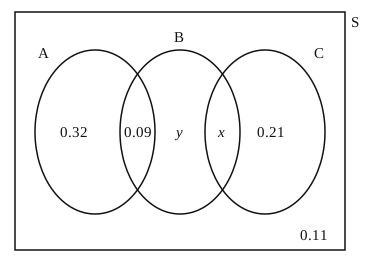
There are different types of Yoga which involve the usage of different poses of Yoga Asanas, Meditation and Pranayam as shown in the figure below : The Venn diagram below represents the probabilities of three different types of Yoga, A, B and C performed by the people of a society. Further, it is given that probability of a member performing type C Yoga is 0.44. On the basis of the above information, answer the following questions : (i) Find the value of x. (1) (ii) Find the value of y. (1) (iii) (a) Find P(BC). (2) OR (iii) (b) Find the probability that a randomly selected person of the society does Yoga of type A or B but not C. (2)
Show answer & solution
Answer: (i) x=0.23 (ii) y=0.04 (iii) (a) 3623 OR (b) 0.45
(i) P(C)=x+0.21=0.44⇒x=0.23.
(ii) Total probability is 1: 0.32+0.09+y+0.23+0.21+0.11=1⇒y=0.04.
(iii)(a) P(B)=0.09+0.04+0.23=0.36, P(B∩C)=0.23, so P(C∣B)=0.360.23=3623.
A tank, as shown in the figure below, formed using a combination of a cylinder and a cone, offers better drainage as compared to a flat bottomed tank. A tap is connected to such a tank whose conical part is full of water. Water is dripping out from a tap at the bottom at the uniform rate of 2 cm³/s. The semi-vertical angle of the conical tank is 45∘. On the basis of given information, answer the following questions : (i) Find the volume of water in the tank in terms of its radius r. (1) (ii) Find rate of change of radius at an instant when r=22 cm. (1) (iii) (a) Find the rate at which the wet surface of the conical tank is decreasing at an instant when radius r=22 cm. (2) OR (iii) (b) Find the rate of change of height ‘h’ at an instant when slant height is 4 cm. (2)
Show answer & solution
Answer: (i) V=31πr3 (ii) −4π1 cm/s (iii) (a) decreasing at 2 cm²/s OR (b) −4π1 cm/s
(i) Semi-vertical angle 45∘ gives h=r, so V=31πr2h=31πr3.
(ii) dtdV=πr2dtdr=−2; at r=22: 8πdtdr=−2⇒dtdr=−4π1 cm/s.
The equation of the path traced by a roller-coaster is given by the polynomial f(x)=a(x+9)(x+1)(x−3). If the roller-coaster crosses y-axis at a point (0,−1), answer the following : (i) Find the value of ‘a’. (2) (ii) Find f′′(x) at x=1. (2)
Show answer & solution
Answer: (i) a=271 (ii) f′′(1)=2720
(i) f(0)=a(9)(1)(−3)=−27a=−1⇒a=271.
(ii) f(x)=271(x3+7x2−21x−27), so f′(x)=271(3x2+14x−21) and f′′(x)=271(6x+14).