CBSE Class 12 Maths 2023 Question Paper 65/3/3 with Solutions
All 45 questions from the CBSE Class 12 Mathematics board paper, Set 65/3/3 (2023),
with answers and step-by-step solutions. Total 80 marks. Tap “Show answer & solution” under any question.
Assertion (A) : A line through the points (4, 7, 8) and (2, 3, 4) is parallel to a line through the points (−1,−2,1) and (1, 2, 5). Reason (R) : Lines r=a1+λb1 and r=a2+μb2 are parallel if b1⋅b2=0.
(A)Both Assertion (A) and Reason (R) are true and Reason (R) is the correct explanation of the Assertion (A).
(B)Both Assertion (A) and Reason (R) are true, but Reason (R) is not the correct explanation of the Assertion (A).
(C)Assertion (A) is true and Reason (R) is false.
(D)Assertion (A) is false and Reason (R) is true.
Show answer & solution
Answer: (C) Assertion (A) is true and Reason (R) is false.
Direction ratios of the first line: 4−2,7−3,8−4 = 2, 4, 4.
Direction ratios of the second line: 1−(−1),2−(−2),5−1 = 2, 4, 4.
They are proportional, so the lines are parallel. Assertion is true.
b1⋅b2=0 is the condition for perpendicular lines; parallel lines need b1=kb2. Reason is false.
Q263 marksShort AnswerProbabilityNot in current syllabus
A pair of dice is thrown simultaneously. If X denotes the absolute difference of numbers obtained on the pair of dice, then find the probability distribution of X.
Show answer & solution
Answer: X : 0, 1, 2, 3, 4, 5 with P(X) : 61,185,92,61,91,181
There are 36 equally likely outcomes; X can be 0, 1, 2, 3, 4, 5.
X = 0: 6 outcomes; X = 1: 10; X = 2: 8; X = 3: 6; X = 4: 4; X = 5: 2 (total 36).
There are two coins. One of them is a biased coin such that P (head) : P (tail) is 1 : 3 and the other coin is a fair coin. A coin is selected at random and tossed once. If the coin showed head, then find the probability that it is a biased coin.
Show answer & solution
Answer:31
Let E1: biased coin chosen, E2: fair coin chosen, A: head shows. P(E1)=P(E2)=21.
For the biased coin P(head) : P(tail) = 1 : 3, so P(A∣E1)=41; P(A∣E2)=21.
By Bayes' theorem, P(E1∣A)=21⋅41+21⋅2121⋅41=8381=31.
Find the value of b so that the lines 2x−1=3y−b=4z−3 and 5x−4=2y−1=z are intersecting lines. Also, find the point of intersection of these given lines.
Show answer & solution
Answer: b = 2; point of intersection (−1,−1,−1)
General point of line 1: (2λ+1,3λ+b,4λ+3); of line 2: (5μ+4,2μ+1,μ).
Equating x and z: 2λ+1=5μ+4 and 4λ+3=μ.
Substituting μ=4λ+3: 2λ+1=20λ+19, so λ=−1 and μ=−1.
Equating y: 3(−1)+b=2(−1)+1, so b=2.
Point of intersection: (5(−1)+4,2(−1)+1,−1)=(−1,−1,−1).
Find the equations of all the sides of the parallelogram ABCD whose vertices are A(4, 7, 8), B(2, 3, 4), C(– 1, – 2, 1) and D(1, 2, 5). Also, find the coordinates of the foot of the perpendicular from A to CD.
Show answer & solution
Answer: AB: 1x−4=2y−7=2z−8; BC: 3x−2=5y−3=3z−4; CD: 1x+1=2y+2=2z−1; DA: 3x−1=5y−2=3z−5; foot of perpendicular (928,956,983)
Direction ratios: AB: (2−4,3−7,4−8)=(−2,−4,−4), i.e. 1, 2, 2. BC: (−3,−5,−3), i.e. 3, 5, 3.
CD: (2,4,4), i.e. 1, 2, 2. DA: (3,5,3).
AB: 1x−4=2y−7=2z−8; BC: 3x−2=5y−3=3z−4.
CD: 1x+1=2y+2=2z−1; DA: 3x−1=5y−2=3z−5.
Any point on CD: P(t−1,2t−2,2t+1); AP=(t−5,2t−9,2t−7).
The area of the region bounded by the line y = mx (m > 0), the curve x2+y2=4 and the x-axis in the first quadrant is 2π units. Using integration, find the value of m.
Show answer & solution
Answer: m = 1
The line meets the circle where x2(1+m2)=4, i.e. at x0=1+m22, y0=1+m22m.
In order to set up a rain water harvesting system, a tank to collect rain water is to be dug. The tank should have a square base and a capacity of 250 m3. The cost of land is ₹ 5,000 per square metre and cost of digging increases with depth and for the whole tank, it is ₹ 40,000 h2, where h is the depth of the tank in metres. x is the side of the square base of the tank in metres. Based on the above information, answer the following questions : (i) Find the total cost C of digging the tank in terms of x. (1) (ii) Find dxdC. (1) (iii) Find the value of x for which cost C is minimum. (2) OR (iii) Check whether the cost function C(x) expressed in terms of x is increasing or not, where x > 0. (2)
Show answer & solution
Answer: (i) C=5000x2+x425×108 (ii) dxdC=10000x−x51010 (iii) x = 10 m OR (iii) Not increasing for all x > 0: C is decreasing on (0, 10) and increasing on (10,∞)
(i) x2h=250, so h=x2250.
Cost of land =5000x2; cost of digging =40000h2=40000⋅x462500=x425×108.
C=5000x2+x425×108.
(ii) dxdC=10000x−x51010.
(iii) dxdC=0 gives x6=106, so x=10.
dx2d2C=10000+x65×1010>0, so C is minimum at x = 10 m.
OR (iii) dxdC=x510000(x6−106).
For 0<x<10, dxdC<0 (C decreasing); for x>10, dxdC>0 (C increasing).
Q374 marksCase StudyProbabilityNot in current syllabus
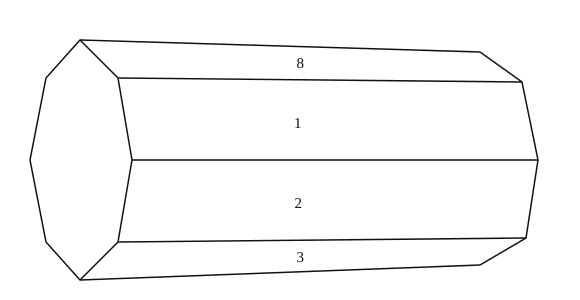
An octagonal prism is a three-dimensional polyhedron bounded by two octagonal bases and eight rectangular side faces. It has 24 edges and 16 vertices. The prism is rolled along the rectangular faces and number on the bottom face (touching the ground) is noted. Let X denote the number obtained on the bottom face and the following table give the probability distribution of X. X : 1, 2, 3, 4, 5, 6, 7, 8 P(X) : p, 2p, 2p, p, 2p, p2, 2p2, 7p2+p Based on the above information, answer the following questions : (i) Find the value of p. (1) (ii) Find P(X > 6). (1) (iii) Find P(X = 3m), where m is a natural number. (2) OR (iii) Find the mean E(X). (2)
Show answer & solution
Answer: (i) p=101 (ii) 10019 (iii) 10021 OR (iii) 4.06
(i) Sum of probabilities: p+2p+2p+p+2p+p2+2p2+7p2+p=10p2+9p=1.
(10p−1)(p+1)=0; since p≥0, p=101.
(ii) P(X>6)=P(7)+P(8)=2p2+7p2+p=1009+10010=10019.
(iii) X = 3m means X = 3 or 6: P=2p+p2=10020+1001=10021.
OR (iii) E(X)=1(p)+2(2p)+3(2p)+4(p)+5(2p)+6(p2)+7(2p2)+8(7p2+p).
A volleyball player serves the ball which takes a parabolic path given by the equation h(t)=−27t2+213t+1, where h(t) is the height of ball at any time t (in seconds), (t≥0). Based on the above information, answer the following questions : (i) Is h(t) a continuous function ? Justify. (2) (ii) Find the time at which the height of the ball is maximum. (2)
Show answer & solution
Answer: (i) Yes, h(t) is a polynomial function, so it is continuous for all t≥0. (ii) t=1413 seconds
(i) h(t) is a polynomial in t, and polynomial functions are continuous everywhere.
For any c≥0, limt→ch(t)=−27c2+213c+1=h(c), so h is continuous.
(ii) h′(t)=−7t+213; h′(t)=0 gives t=1413.
h′′(t)=−7<0, so the height is maximum at t=1413 seconds.