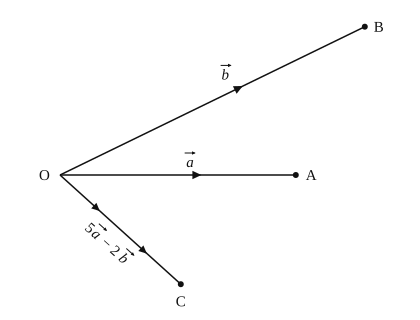
Three friends A, B and C move out from the same location O at the same time in three different directions to reach their destinations. They move out on straight paths and decide that A and B after reaching their destinations will meet up with C at his predecided destination, following straight paths from A to C and B to C in such a way that OA=a, OB=b and OC=5a−2b respectively. Based upon the above information, answer the following questions : (i) Complete the given figure to explain their entire movement plan along the respective vectors. (1) (ii) Find vectors AC and BC. (1) (iii) (a) If a⋅b=1, distance of O to A is 1 km and that from O to B is 2 km, then find the angle between OA and OB. Also, find ∣a×b∣. (2) OR (iii) (b) If a=2i^−j^+4k^ and b=j^−k^, then find a unit vector perpendicular to (a+b) and (a−b). (2)
Show answer & solution
Answer: (i) Join A to C and B to C, with arrows from A to C and from B to C (ii) AC=4a−2b, BC=5a−3b (iii) (a) 3π; ∣a×b∣=3 OR (iii) (b) ±171(3i^−2j^−2k^)
(i) A walks along AC and B along BC, so draw the segments AC and BC directed towards C.
An instructor at the astronomical centre shows three among the brightest stars in a particular constellation. Assume that the telescope is located at O(0, 0, 0) and the three stars have their locations at the points D, A and V having position vectors 2i^+3j^+4k^, 7i^+5j^+8k^ and −3i^+7j^+11k^ respectively. Based on the above information, answer the following questions : (i) How far is the star V from star A ? (1) (ii) Find a unit vector in the direction of DA. (1) (iii) Find the measure of ∠VDA. (2) OR (iii) What is the projection of vector DV on vector DA ? (2)
Show answer & solution
Answer: (i) 113 units (ii) 351(5i^+2j^+4k^) (iii) ∠VDA=cos−1(45211); OR projection =3511