CBSE Class 12 Maths 2024 Question Paper 65/4/1 with Solutions
All 46 questions from the CBSE Class 12 Mathematics board paper, Set 65/4/1 (2024),
with answers and step-by-step solutions. Total 80 marks. Tap “Show answer & solution” under any question.
The probability distribution of a random variable X is : X: 0, 1, 2, 3, 4 P(X): 0.1, k, 2k, k, 0.1 where k is some unknown constant. The probability that the random variable X takes the value 2 is :
Assertion (A) : The relation R={(x,y):(x+y) is a prime number and x,y∈N} is not a reflexive relation. Reason (R) : The number ‘2n’ is composite for all natural numbers n.
(A)Both Assertion (A) and Reason (R) are true and the Reason (R) is the correct explanation of Assertion (A).
(B)Both Assertion (A) and Reason (R) are true and Reason (R) is not the correct explanation of the Assertion (A).
(C)Assertion (A) is true, but Reason (R) is false.
(D)Assertion (A) is false, but Reason (R) is true.
Show answer & solution
Answer: (C) Assertion (A) is true, but Reason (R) is false.
For reflexivity we need (x,x)∈R, i.e. 2x prime, for every x∈N.
For x=2, 2x=4 is not prime, so (2,2)∈/R: R is not reflexive. Assertion is true.
For n=1, 2n=2 is prime, not composite. Reason is false.
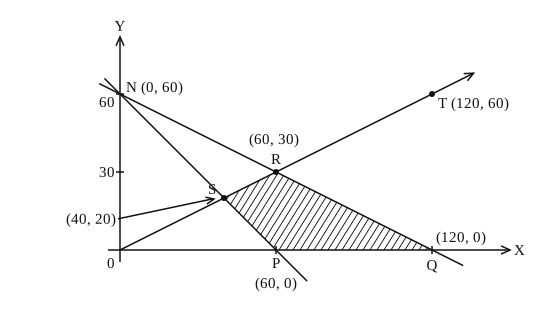
Assertion (A) : The corner points of the bounded feasible region of a L.P.P. are shown below. The maximum value of Z=x+2y occurs at infinite points. Reason (R) : The optimal solution of a LPP having bounded feasible region must occur at corner points.
(A)Both Assertion (A) and Reason (R) are true and the Reason (R) is the correct explanation of Assertion (A).
(B)Both Assertion (A) and Reason (R) are true and Reason (R) is not the correct explanation of the Assertion (A).
(C)Assertion (A) is true, but Reason (R) is false.
(D)Assertion (A) is false, but Reason (R) is true.
Show answer & solution
Answer: (B) Both Assertion (A) and Reason (R) are true and Reason (R) is not the correct explanation of the Assertion (A).
Corner points of the shaded region: S(40, 20), R(60, 30), Q(120, 0), P(60, 0).
Z = x + 2y: at S = 80, at R = 120, at Q = 120, at P = 60.
Maximum 120 occurs at both R and Q, hence at every point of segment RQ: infinitely many points. Assertion is true.
For a bounded feasible region the optimal value is always attained at a corner point. Reason is true.
But the reason does not explain why the maximum occurs at infinitely many points (that happens because Z is parallel to edge RQ). So (B).
A card from a well shuffled deck of 52 playing cards is lost. From the remaining cards of the pack, a card is drawn at random and is found to be a King. Find the probability of the lost card being a King.
Show answer & solution
Answer:171
Let E1: lost card is a King, E2: lost card is not a King, A: drawn card is a King.
P(E1)=524, P(E2)=5248.
P(A∣E1)=513, P(A∣E2)=514.
By Bayes' theorem, P(E1∣A)=524⋅513+5248⋅514524⋅513=12+19212=20412=171.
Q31 (OR) (OR)3 marksShort AnswerProbabilityNot in current syllabus
A biased die is twice as likely to show an even number as an odd number. If such a die is thrown twice, find the probability distribution of the number of sixes. Also, find the mean of the distribution.
Show answer & solution
Answer: X = 0, 1, 2 with P = 8149,8128,814; mean =94
Let each odd face have probability p; then each even face has 2p. 3p+6p=1, so p=91.
Check whether the relation S in the set of real numbers R defined by S={(a,b):where a−b+2 is an irrational number} is reflexive, symmetric or transitive.
Show answer & solution
Answer: S is reflexive, but neither symmetric nor transitive.
Reflexive: for any a∈R, a−a+2=2 is irrational, so (a,a)∈S. S is reflexive.
Symmetric: take a=2, b=0. a−b+2=22 is irrational, so (2,0)∈S.
But b−a+2=0 is rational, so (0,2)∈/S. S is not symmetric.
Transitive: take a=2, b=1, c=22.
a−b+2=22−1 (irrational) and b−c+2=1−2 (irrational), so (a,b),(b,c)∈S.
But a−c+2=0 is rational, so (a,c)∈/S. S is not transitive.
If the lines −3x−1=2ky−2=2z−3 and 3kx−1=1y−1=−7z−6 are perpendicular to each other, find the value of k and hence write the vector equation of a line perpendicular to these two lines and passing through the point (3,−4,7).
Show answer & solution
Answer:k=−2; r=3i^−4j^+7k^+λ(26i^−33j^−27k^)
Direction ratios: −3,2k,2 and 3k,1,−7.
Perpendicular: −9k+2k−14=0, so k=−2.
Directions become b1=−3i^−4j^+2k^ and b2=−6i^+j^−7k^.
A store has been selling calculators at ₹ 350 each. A market survey indicates that a reduction in price (p) of calculator increases the number of units (x) sold. The relation between the price and quantity sold is given by the demand function p=450−21x. Based on the above information, answer the following questions : (i) Determine the number of units (x) that should be sold to maximise the revenue R(x)=xp(x). Also, verify the result. (ii) What rebate in price of calculator should the store give to maximise the revenue ?
Show answer & solution
Answer: (i) 450 units (R′′(x)=−1<0, so maximum) (ii) ₹ 125
(i) R(x)=x(450−2x)=450x−2x2.
R′(x)=450−x=0 gives x=450.
R′′(x)=−1<0, so revenue is maximum when 450 units are sold.
An instructor at the astronomical centre shows three among the brightest stars in a particular constellation. Assume that the telescope is located at O(0, 0, 0) and the three stars have their locations at the points D, A and V having position vectors 2i^+3j^+4k^, 7i^+5j^+8k^ and −3i^+7j^+11k^ respectively. Based on the above information, answer the following questions : (i) How far is the star V from star A ? (1) (ii) Find a unit vector in the direction of DA. (1) (iii) Find the measure of ∠VDA. (2) OR (iii) What is the projection of vector DV on vector DA ? (2)
Show answer & solution
Answer: (i) 113 units (ii) 351(5i^+2j^+4k^) (iii) ∠VDA=cos−1(45211); OR projection =3511
Rohit, Jaspreet and Alia appeared for an interview for three vacancies in the same post. The probability of Rohit’s selection is 51, Jaspreet’s selection is 31 and Alia’s selection is 41. The event of selection is independent of each other. Based on the above information, answer the following questions : (i) What is the probability that at least one of them is selected ? (1) (ii) Find P(G∣H) where G is the event of Jaspreet’s selection and H denotes the event that Rohit is not selected. (1) (iii) Find the probability that exactly one of them is selected. (2) OR (iii) Find the probability that exactly two of them are selected. (2)
Show answer & solution
Answer: (i) 53 (ii) 31 (iii) 3013; OR 203
Let R, J, A be the events of selection: P(R)=51, P(J)=31, P(A)=41; complements 54,32,43.
(i) P(none) =54⋅32⋅43=52, so P(at least one) =1−52=53.