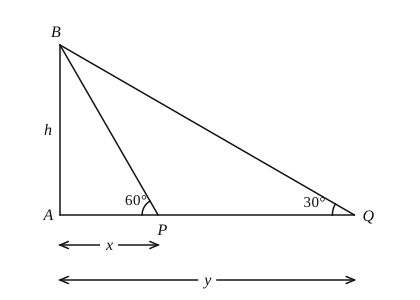
In Figure 2, the angles of elevation of the top of a tower AB of height ‘h’ m, from two points P and Q at a distance of x m and y m from the base of the tower respectively and in the same straight line with it, are 60∘ and 30∘, respectively. Prove that h2=xy.
Show answer & solution
Answer: Proved.
In right △BAP: tan60∘=APAB=xh, so h=3x ... (1)
In right △BAQ: tan30∘=AQAB=yh, so h=3y ... (2)
A tower stands vertically on the ground. From a point on the ground, which is 15 m away from the foot of the tower, the angle of elevation of the top of the tower is 60∘. Find the height of the tower.
Show answer & solution
Answer:153 m ≈25.98 m
Let AB be the tower and C the point on the ground, with BC = 15 m
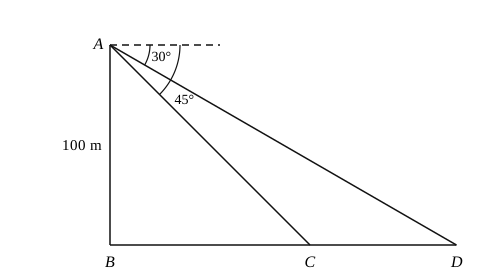
As observed from the top of a light house 100 m above sea level, the angle of depression of a ship, sailing directly towards it, changes from 30∘ to 45∘. Determine the distance travelled by the ship during this time. (Use 3 = 1.73)
Show answer & solution
Answer: 73 m
Let AB = 100 m be the light house, D and C the initial and final positions of the ship.
∠ADB=30∘ and ∠ACB=45∘ (alternate angles).
In △ABC: tan45∘=BCAB⇒BC=100 m.
In △ABD: tan30∘=BDAB⇒BD=1003=173 m.
Distance travelled CD = BD − BC = 173 − 100 = 73 m.
At a point on level ground, the angle of elevation of a vertical tower is, found to be α such that tanα=31. After walking 100 m towards the tower, the angle of elevation β becomes such that tanβ=43. Find the height of the tower.
Show answer & solution
Answer: 60 m
Let the height be h and the distance of the second point from the foot be x.
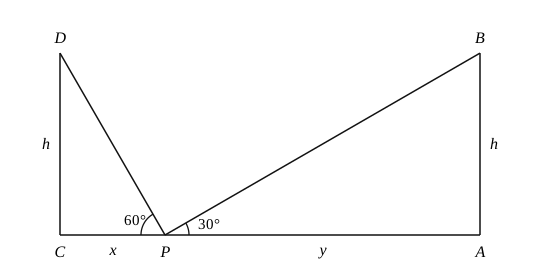
Two poles of equal heights are standing opposite each other on either side of the road of width 60 m. From a point P between them on the road, the angles of elevation of the top of the poles are 60∘ and 30∘ respectively, as shown in Figure 3. Find the height of the poles and distances of the point from the poles.
Show answer & solution
Answer: Height of each pole =153 m ≈25.98 m; distances of P from the poles are 15 m (from CD) and 45 m (from AB)
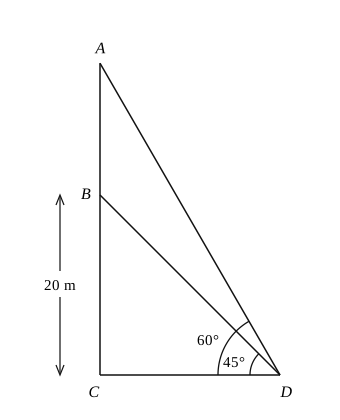
From a point on the ground, the angles of elevation of the bottom and the top of a transmission tower fixed at the top of a 20 m high building are 45∘ and 60∘ respectively as shown in Figure 3. Find the height of the transmission tower.
Show answer & solution
Answer: Height of tower =20(3−1) m ≈14.64 m
In right △BCD: tan45∘=CDBC⇒CD=BC=20 m
In right △ACD: tan60∘=CDAC⇒AC=203 m
Height of tower AB =AC−BC=203−20=20(3−1)≈20×0.732=14.64 m
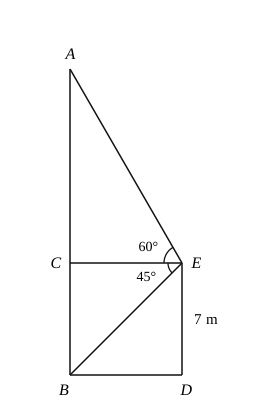
From the top of a 7 m high building, the angle of elevation of the top of a cable tower is 60∘ and the angle of depression of its foot is 45∘ as shown in Figure 3. Determine the height of the tower.
Show answer & solution
Answer: Height of tower =7(3+1) m ≈19.12 m
ED = 7 m is the building and AB the tower; CE ∥ BD, so BC = ED = 7 m.
Two poles of heights 25 m and 35 m stand vertically on the ground. The tops of two poles are connected by a wire, which is inclined to the horizontal at an angle of 30∘. Find the length of the wire and the distance between the poles.
Show answer & solution
Answer: Length of wire = 20 m; distance between poles =103 m ≈17.32 m
Difference in heights =35−25=10 m; this is the vertical side of a right triangle whose hypotenuse is the wire l.
The string of a kite is 100 metres long and it makes an angle of 60∘ with the horizontal. Find the height of the kite, assuming that there is no slack in the string. [Use 3=1.73]
Show answer & solution
Answer:503 m = 86.5 m
Let the height be h m; the string (100 m) is the hypotenuse.
The angle of elevation of the top of a building from the foot of the tower is 30∘ and the angle of elevation of the top of the tower from the foot of the building is 60∘. If the tower is 50 m high, then find the height of the building.
Show answer & solution
Answer:350 m =1632 m
Let the tower AB = 50 m and the building CD = h m, with feet B and D a distance d apart.
From a point on a bridge across a river, the angles of depression of the banks on opposite sides of the river are 30∘ and 45∘ respectively. If the bridge is at a height of 3 m from the banks, then find the width of the river.
Show answer & solution
Answer:3(1+3) m ≈8.19 m
Let P be the point on the bridge, 3 m above the banks, and A, B the banks on opposite sides; D is the point directly below P.
Angle of depression 30∘ to A: tan30∘=AD3⇒AD=33 m.
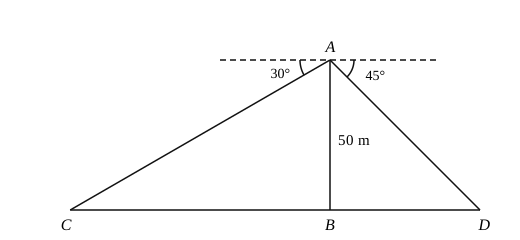
In Fig. 3, AB is tower of height 50 m. A man standing on its top, observes two cars on the opposite sides of the tower with angles of depression 30∘ and 45∘ respectively. Find the distance between the two cars.
Show answer & solution
Answer:50(3+1) m ≈136.6 m
Angles of depression equal the angles of elevation from the cars: ∠ACB=30∘, ∠ADB=45∘.
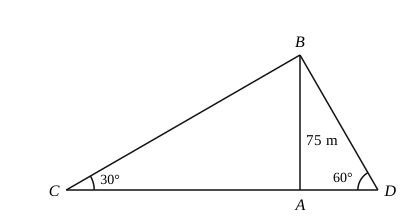
Two men on either side of a cliff 75 m high observe the angles of elevation of the top of the cliff to be 30∘ and 60∘. Find the distance between the two men.
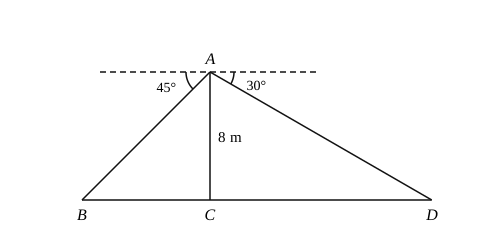
From a point on a bridge across a river, the angles of depression of the banks on opposite sides of the river are 30∘ and 45∘. If the bridge is at a height of 8 m from the banks, then find the width of the river.
Show answer & solution
Answer:8(1+3) m ≈21.86 m
Let A be the point on the bridge, AC = 8 m, and B, D the banks with ∠ABC=45∘, ∠ADC=30∘ (alternate angles).
The tops of two poles of heights 20 m and 28 m are connected with a wire. The wire is inclined to the horizontal at an angle of 30∘. Find the length of the wire and the distance between the two poles.
Show answer & solution
Answer: Length of wire = 16 m; distance between poles = 83 m ≈ 13.86 m
Difference in heights =28−20=8 m; this is the vertical side of a right triangle with the wire as hypotenuse.
A tree breaks due to storm and the broken part bends so that the top of the tree touches the ground making an angle of 30∘ with it. The height of the breaking point from the ground is 2 m. Find the total height of the tree.
Show answer & solution
Answer: 6 m
Let the broken part (hypotenuse) be L m; the standing part is 2 m.
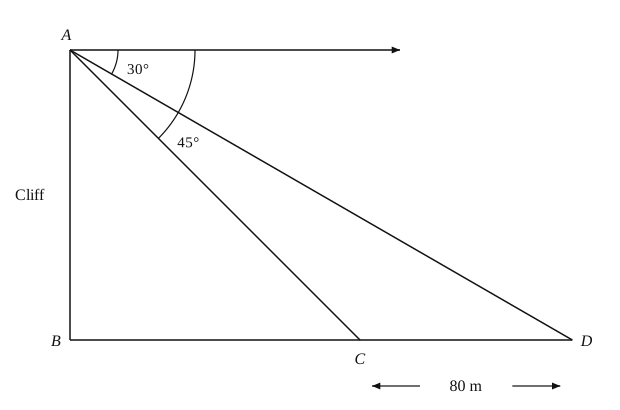
Two boats are sailing in the sea 80 m apart from each other towards a cliff AB. The angles of depression of the boats from the top of the cliff are 30∘ and 45∘ respectively, as shown in Figure 3. Find the height of the cliff.
Show answer & solution
Answer:40(3+1) m ≈ 109.28 m
Let AB=h. The angle of depression equals the angle of elevation from the boat.
An aeroplane when flying at a height of 3125 m from the ground passes vertically below another plane at an instant when the angles of elevation of the two planes from the same point on the ground are 30∘ and 60∘ respectively. Find the distance between the two planes at that instant.
Show answer & solution
Answer: 6250 m
Let the point on the ground be at horizontal distance d from the foot of the vertical line through the planes.
Lower plane (height 3125 m) has angle of elevation 30∘: tan30∘=d3125⇒d=31253 m.
Higher plane (height H) has angle of elevation 60∘: H=dtan60∘=31253×3=9375 m.
There is a small island in the middle of a 100 m wide river and a tall tree stands on the island. P and Q are points directly opposite to each other on two banks and in line with the tree. If the angles of elevation of the top of the tree from P and Q are respectively 30∘ and 45∘, find the height of the tree. (Use 3=1.732)
Show answer & solution
Answer: 36.6 m
Let the height of the tree be h m and its foot be at distances x from P and 100−x from Q.
An aeroplane at an altitude of 200 metres observes the angles of depression of opposite points on the two banks of a river to be 45∘ and 60∘. Find the width of the river. (Use 3=1.732)
Show answer & solution
Answer: 315.47 m (approx.)
Let the aeroplane be at A, 200 m vertically above point D on the line joining the banks B and C.
For the bank with depression 45∘: tan45∘=BD200⇒BD=200 m.
For the bank with depression 60∘: tan60∘=DC200⇒DC=3200=32003=3346.4≈115.47 m.