Circles: CBSE Class 10 Previous Year Questions
231 different questions from Circles (NCERT Chapter 10) asked in CBSE Class 10 Maths board exams 2022–2026.
8 of them came up in more than one year. Pick a mark group to practise, each with answers and step-by-step solutions.
Most asked Circles questions
Prove that the parallelogram circumscribing a circle is a rhombus.
Show answer & solution
Answer: Proved.
Let parallelogram ABCD touch the circle at P, Q, R, S on AB, BC, CD, DA. Equal tangents from external points: AP = AS, BP = BQ, CR = CQ, DR = DS Adding: AB + CD = AD + BC In a parallelogram AB = CD and AD = BC, so 2AB = 2AD, i.e. AB = AD. Thus AB = BC = CD = DA, so ABCD is a rhombus. Also asked in:
2025 Standard 30/2/1 ,
2025 Standard 30/2/2 ,
2025 Standard 30/2/3 ,
2025 Basic 430/4/2 ,
2024 Standard 30/4/1 ,
2024 Standard 30/4/2 ,
2024 Standard 30/4/3 ,
2024 Standard 30/5/1 ,
2024 Standard 30/5/2 ,
2024 Standard 30/5/3 ,
2024 Basic 430/5/1 ,
2024 Basic 430/5/2 ,
2024 Basic 430/5/3 ,
2023 Basic 430/2/2 ,
2023 Basic 430/2/3
Prove that the angle between the two tangents drawn from an external point to a circle is supplementary to the angle subtended by the line-segment joining the points of contact at the centre.
Show answer & solution
Answer: Proved.
Let PA and PB be tangents from external point P to a circle with centre O, touching it at A and B. A radius is perpendicular to the tangent at the point of contact, so ∠ O A P = ∠ O B P = 9 0 ∘ In quadrilateral OAPB, the angles add up to 36 0 ∘ ∠ A P B + ∠ A O B + 9 0 ∘ + 9 0 ∘ = 36 0 ∘ ∠ A P B + ∠ A O B = 18 0 ∘ Hence the angle between the tangents is supplementary to ∠ A O B
Prove that the tangents drawn at the ends of a diameter of a circle are parallel.
Show answer & solution
Answer: Proved.
Let AB be a diameter of a circle with centre O, and let PQ and RS be the tangents at A and B. The tangent at any point is perpendicular to the radius through that point, so OA ⊥ ⊥ So ∠ O A P = 9 0 ∘ ∠ O B S = 9 0 ∘ These are alternate angles made by the transversal AB with PQ and RS, and they are equal. Hence PQ ∥
Prove that opposite sides of a quadrilateral circumscribing a circle subtend supplementary angles at the centre of the circle.
Show answer & solution
Answer: Proved.
Let quadrilateral ABCD circumscribe a circle with centre O, touching AB, BC, CD, DA at P, Q, R, S. Join OA, OB, OC, OD, OP, OQ, OR, OS. In △ O A P △ O A S ∠ O P A = ∠ O S A = 9 0 ∘ ∠ A O P = ∠ A O S Similarly ∠ B O P = ∠ B O Q ∠ C O Q = ∠ C O R ∠ D O R = ∠ D O S The eight angles at O add up to 36 0 ∘ 2 ( ∠ A O P + ∠ B O P + ∠ C O R + ∠ D O R ) = 36 0 ∘ Thus ∠ A O B + ∠ C O D = 18 0 ∘ ∠ B O C + ∠ A O D = 18 0 ∘
Prove that a parallelogram circumscribing a circle is a rhombus.
Show answer & solution
Answer: Proved.
Let parallelogram ABCD touch the circle at P, Q, R, S on AB, BC, CD, DA respectively. Tangents from an external point are equal: AP = AS, BP = BQ, CR = CQ, DR = DS. Adding: (AP + BP) + (CR + DR) = (AS + DS) + (BQ + CQ), i.e. AB + CD = AD + BC. In a parallelogram AB = CD and AD = BC, so 2AB = 2AD, i.e. AB = AD. Thus all four sides are equal: AB = BC = CD = DA. Hence ABCD is a rhombus.
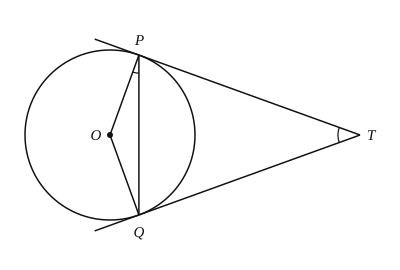
Two tangents TP and TQ are drawn to a circle with centre O from an external point T. Prove that ∠ P T Q = 2∠ O P Q
Show answer & solution
Answer: Proved.
Let ∠ P T Q = θ TP = TQ (tangents from an external point), so ∠ T P Q = ∠ T QP = 2 18 0 ∘ − θ = 9 0 ∘ − 2 θ OP ⊥ ∠ O P T = 9 0 ∘ ∠ O P Q = 9 0 ∘ − ∠ T P Q = 9 0 ∘ − ( 9 0 ∘ − 2 θ ) = 2 θ Hence ∠ P T Q = 2∠ O P Q
Prove that the opposite sides of a quadrilateral circumscribing a circle subtend supplementary angles at the centre of the circle.
Show answer & solution
Answer: Proved.
Let ABCD circumscribe a circle with centre O, touching AB, BC, CD, DA at P, Q, R, S. Join OA, OB, OC, OD, OP, OQ, OR, OS. △ O A P ≅ △ O A S ∠ A O P = ∠ A O S Similarly ∠ B O P = ∠ B O Q ∠ C O Q = ∠ C O R ∠ D O R = ∠ D O S Sum of angles at O: 2 ( ∠ A O P + ∠ B O P + ∠ C O R + ∠ D O R ) = 36 0 ∘ So ( ∠ A O P + ∠ B O P ) + ( ∠ C O R + ∠ D O R ) = 18 0 ∘ ∠ A O B + ∠ C O D = 18 0 ∘ Similarly ∠ B O C + ∠ A O D = 18 0 ∘
Prove that the lengths of tangents drawn from an external point to a circle are equal.
Show answer & solution
Answer: Proved.
Let PQ and PR be tangents from an external point P to a circle with centre O, touching it at Q and R. Join OQ, OR and OP. ∠ O QP = ∠ O R P = 9 0 ∘ In right triangles OQP and ORP: OQ = OR (radii) and OP = OP (common). So △ O QP ≅ △ O R P Hence PQ = PR (CPCT).
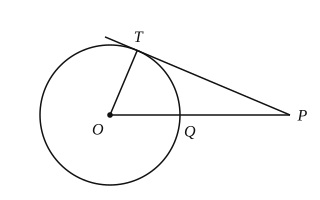
PT is tangent to the circle with centre O and radius 5 cm. OP intersects the circle at Q. If PQ = x P T 2
(A) x 2 + 5 x (B) x 2 + 10 x + 50 (C) x 2 + 10 x (D) x 2 − 25 Show answer & solution
Answer: (C) x 2 + 10 x
O T ⊥ P T P T 2 = O P 2 − O T 2 O P = O Q + QP = 5 + x P T 2 = ( 5 + x ) 2 − 25 = x 2 + 10 x
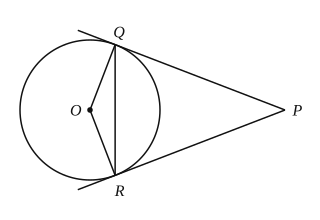
In the given figure, PQ and PR are two tangents drawn to a circle with centre O. If ∠ O R Q = 2 5 ∘ ∠ P QR
(A) 6 5 ∘ (B) 2 5 ∘ (C) 5 0 ∘ (D) 7 5 ∘ Show answer & solution
Answer: (A) 6 5 ∘
OQ = OR (radii), so ∠ O QR = ∠ O R Q = 2 5 ∘ ∠ O QP = 9 0 ∘ ⊥ ∠ P QR = 9 0 ∘ − 2 5 ∘ = 6 5 ∘
Practise smarter: chapter-wise revision, formula sheets and step-by-step NCERT solutions on
MonoMath CBSE →