CBSE Class 10 Maths Basic 2022 Question Paper 430/3/1 (Term 2) with Solutions
All 18 questions from the CBSE Class 10 Mathematics Basic board paper, Set 430/3/1 (2022, Term 2),
with answers and step-by-step solutions. Total 40 marks. Tap “Show answer & solution” under any question.
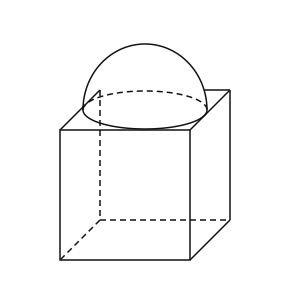
A cubical block of side 7 cm is surmounted by a hemisphere of largest possible diameter as shown in Figure 1. Find the total surface area of the solid.
Show answer & solution
Answer: 332.5 cm2
Largest hemisphere has diameter 7 cm, so r=3.5 cm.
TSA = surface area of cube − area of base circle of hemisphere + curved surface area of hemisphere
Q73 marksShort AnswerCirclesNot in current syllabus
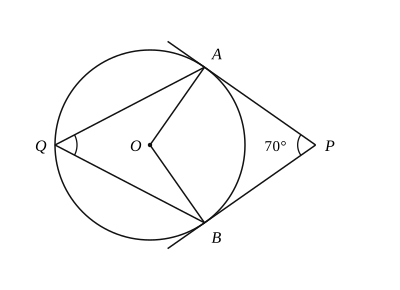
Draw a circle of radius 2.5 cm. From a point P lying outside the circle at a distance of 6 cm from the centre of the circle, construct tangents PA and PB to the circle.
Show answer & solution
Answer: Construction (each tangent =62−2.52=29.75≈5.45 cm)
Draw a circle with centre O and radius 2.5 cm; mark P with OP = 6 cm.
Draw the perpendicular bisector of OP; let it meet OP at M.
With M as centre and MO as radius, draw a circle cutting the given circle at A and B.
Join PA and PB; these are the required tangents.
Justification: ∠OAP=∠OBP=90∘ (angles in a semicircle), so PA and PB are tangents. Each measures 36−6.25≈5.45 cm.
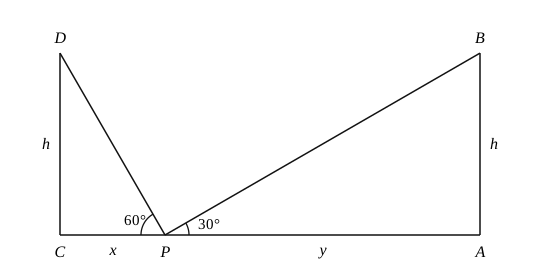
Two poles of equal heights are standing opposite each other on either side of the road of width 60 m. From a point P between them on the road, the angles of elevation of the top of the poles are 60∘ and 30∘ respectively, as shown in Figure 3. Find the height of the poles and distances of the point from the poles.
Show answer & solution
Answer: Height of each pole =153 m ≈25.98 m; distances of P from the poles are 15 m (from CD) and 45 m (from AB)
The mileage (km/l) of 50 cars was recorded by a dealer and tabulated as given below : Mileage (in km/l): 10–12, 12–14, 14–16, 16–18, 18–20 Number of Cars: 13, 18, 10, 7, 2 Find mean of the above distribution.
Show answer & solution
Answer: Mean mileage =13.68 km/l
Class marks xi: 11, 13, 15, 17, 19; fi: 13, 18, 10, 7, 2; ∑fi=50
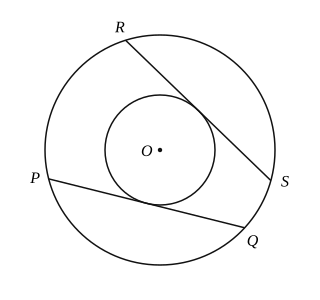
In Figure 5, two concentric circles are drawn with centre O. PQ and RS are two chords of the larger circle which are tangents to the smaller circle. Prove that PQ = RS.
Show answer & solution
Answer: Proved.
Let PQ touch the smaller circle at M and RS touch it at N; let the radii be R (larger) and r (smaller).
OM ⊥ PQ and ON ⊥ RS (radius is perpendicular to the tangent at the point of contact), and OM = ON = r.
The perpendicular from the centre to a chord bisects it, so PQ = 2PM and RS = 2RN.
In right △OMP: PM=OP2−OM2=R2−r2; similarly in right △ONR: RN=R2−r2
The angles of depression of the top and bottom of a 6 m tall building from the top of a multi-storeyed building are 30∘ and 45∘ respectively. Find the height of the multi-storeyed building and the distance between the two buildings. (Use 3=1.73)
Show answer & solution
Answer: Height of multi-storeyed building =(9+33) m =14.19 m; distance between the buildings =14.19 m
Let the multi-storeyed building be H m tall and the buildings be d m apart.
Angle of depression of the bottom is 45∘: tan45∘=dH⇒d=H
Angle of depression of the top is 30∘: tan30∘=dH−6⇒d=3(H−6)
The tradition of pottery making in India is very old. In fact, it is older than Indus Valley Civilization. The shaping and baking of clay articles has continued through the ages. The picture of a potter is shown below : A potter makes a certain number of pottery articles in a day. It was observed on a particular day the cost of production of each article (in ₹) was one more than twice the number of articles produced on that day. The total cost of production on that day was ₹ 210. (a) Taking number of articles produced on that day as x, form a quadratic equation in x. (2) (b) Find the number of articles produced and the cost of each article. (2)
Show answer & solution
Answer: (a) 2x2+x−210=0 (b) 10 articles; cost of each article ₹ 21
(a) Cost of each article =₹(2x+1), so x(2x+1)=210, i.e. 2x2+x−210=0.
The technique of Rainwater harvesting through Recharge pit is very useful. Rainwater is collected on the roof and then flowing through the Recharge pit it goes to the ground. Observe the picture given below : B (BREADTH) = 3 m D (DEPTH = 2 m L (LENGTH) = 3 m The surface area of the roof floor is 100 m2. The cuboidal pit measures 3 m × 3 m × 2 m. (a) Water standing on the roof is released into the cuboidal pit. If the cuboidal pit is filled completely by the roof water, then find the height of standing water on the roof. (2) (b) Instead of a cuboidal pit, if a cylindrical pit with diameter 3 m and height 2 m had been built, then which tank would hold more water ? (2)
Show answer & solution
Answer: (a) 0.18 m (18 cm) (b) The cuboidal pit (18 m3) holds more water than the cylindrical pit (≈14.14 m3)
(a) Volume of cuboidal pit =3×3×2=18 m3
Volume of water on roof =100×h; 100h=18⇒h=0.18 m =18 cm
(b) Cylinder: r=1.5 m, h=2 m; volume =πr2h=722×2.25×2≈14.14 m3
Since 18>14.14, the cuboidal pit would hold more water.