MonoMath CBSE
CBSE Maths › Class 10 PYQs › 2022

CBSE Class 10 Maths Basic 2022 Question Paper 430/2/1 (Term 2) with Solutions

All 18 questions from the CBSE Class 10 Mathematics Basic board paper, Set 430/2/1 (2022, Term 2), with answers and step-by-step solutions. Total 40 marks. Tap “Show answer & solution” under any question.

Set 430/1/1Set 430/1/2Set 430/1/3Set 430/2/1Set 430/2/2Set 430/2/3Set 430/3/1Set 430/3/2Set 430/3/3Set 430/4/1Set 430/4/2Set 430/4/3
Q12 marksVery Short AnswerQuadratic Equations

Find the nature of the roots of the quadratic equation :

Show answer & solution
Answer: The roots are real and distinct (unequal), since .
  1. Here , , .
  2. .
  3. Since , the equation has two distinct real roots.
  4. (As 41 is not a perfect square, the roots are irrational.)
Also asked in: 2022 Basic 430/2/3
Q22 marksVery Short AnswerArithmetic Progressions

Which term of the A.P. 3, 8, 13, 18, … is 78 ?

Show answer & solution
Answer: 16th term
  1. , .
  2. .
  3. So 78 is the 16th term.
OR
Q2 (OR) (OR)2 marksVery Short AnswerArithmetic Progressions

Find the common difference of an A.P. whose term is given by .

Show answer & solution
Answer: Common difference = 6
  1. , .
  2. .
  3. (In general .)
Q32 marksVery Short AnswerSurface Areas and Volumes

3 cubes each of 8 cm edge are joined end to end. Find the total surface area of the cuboid so formed.

Show answer & solution
Answer: 896 cm²
  1. Cuboid formed: cm, cm, cm.
  2. TSA
  3. cm².
Q42 marksVery Short AnswerCircles

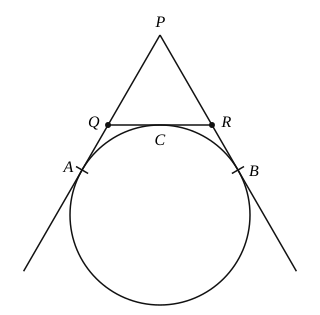
In Fig. 1, perimeter of is 20 cm. Find the length of tangent PA.

Diagram for CBSE 2022 Class 10 Maths question 4
Show answer & solution
Answer: PA = 10 cm
  1. Tangents from an external point are equal: QA = QC, RB = RC, PA = PB.
  2. Perimeter of = PQ + QR + PR = PQ + QC + CR + PR
  3. = PQ + QA + RB + PR = PA + PB = 2PA.
  4. So 2PA = 20, hence PA = 10 cm.
OR
Q4 (OR) (OR)2 marksVery Short AnswerCircles

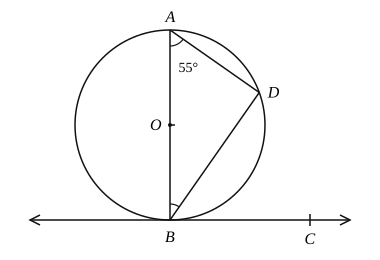
In Fig. 2, BC is tangent to the circle at point B of circle centred at O. BD is a chord of the circle so that . Find m.

Diagram for CBSE 2022 Class 10 Maths question 4 (OR)
Show answer & solution
Answer:
  1. AB passes through O, so AB is a diameter.
  2. (angle in a semicircle).
  3. In : .
  4. (radius OB tangent BC).
  5. .
Q52 marksVery Short AnswerStatistics

Find the mode of the following frequency distribution :
Class: 20–30, 30–40, 40–50, 50–60, 60–70
Frequency: 25, 30, 45, 42, 35

Show answer & solution
Answer: Mode ≈ 48.33
  1. Maximum frequency 45, so modal class is 40–50.
  2. , , , , .
  3. Mode
  4. .
Q62 marksVery Short AnswerArithmetic Progressions

Find the sum of the first fifteen multiples of 8.

Show answer & solution
Answer: 960
  1. Multiples: 8, 16, 24, …, 120 with , , .
  2. .
Q73 marksShort AnswerCirclesNot in current syllabus

Draw a circle of radius 2.5 cm. Construct a pair of tangents from a point P at a distance of 6 cm from the centre of the circle.

Show answer & solution
Answer: Construction (pair of tangents from P drawn; each tangent ≈ 5.45 cm).
  1. Draw a circle with centre O and radius 2.5 cm; mark P with OP = 6 cm.
  2. Bisect OP; let M be its midpoint.
  3. With M as centre and MO as radius draw a circle cutting the given circle at Q and R.
  4. Join PQ and PR; these are the required tangents.
  5. Justification: (angle in a semicircle), so PQ OQ; similarly PR.
  6. Length of each tangent cm.

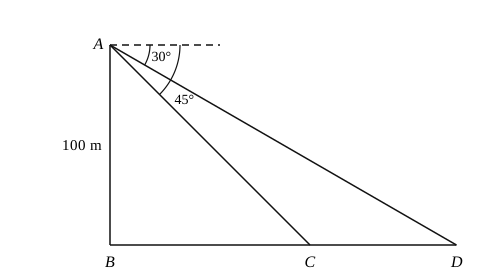
As observed from the top of a light house 100 m above sea level, the angle of depression of a ship, sailing directly towards it, changes from to . Determine the distance travelled by the ship during this time.
(Use = 1.73)

Diagram for CBSE 2022 Class 10 Maths question 8
Show answer & solution
Answer: 73 m
  1. Let AB = 100 m be the light house, D and C the initial and final positions of the ship.
  2. and (alternate angles).
  3. In : m.
  4. In : m.
  5. Distance travelled CD = BD − BC = 173 − 100 = 73 m.
OR
Q8 (OR) (OR)3 marksShort AnswerSome Applications of TrigonometryNot in current syllabus

At a point on level ground, the angle of elevation of a vertical tower is, found to be such that . After walking 100 m towards the tower, the angle of elevation becomes such that . Find the height of the tower.

Show answer & solution
Answer: 60 m
  1. Let the height be and the distance of the second point from the foot be .
  2. .
  3. .
  4. .
  5. Height of the tower = 60 m.
Q93 marksShort AnswerStatistics

Find the mean of the following frequency distribution :
Class: 10–15, 15–20, 20–25, 25–30, 30–35
Frequency: 4, 10, 5, 6, 5

Show answer & solution
Answer: Mean ≈ 22.17
  1. Class marks : 12.5, 17.5, 22.5, 27.5, 32.5.
  2. : 50, 175, 112.5, 165, 162.5.
  3. , .
  4. Mean (approx.).
Also asked in: 2022 Basic 430/2/2
Q103 marksShort AnswerStatistics

The median of following frequency distribution is 25. Find the value of .
Class: 0–10, 10–20, 20–30, 30–40, 40–50
Frequency: 6, 9, 10, 8,

Show answer & solution
Answer:
  1. .
  2. Median 25 lies in class 20–30: , , , .
  3. .
  4. Check: N = 40, N/2 = 20 lies in 20–30.
Also asked in: 2022 Basic 430/2/3
Q114 marksLong AnswerCircles

Prove that a parallelogram circumscribing a circle is a rhombus.

Show answer & solution
Answer: Proved.
  1. Let parallelogram ABCD circumscribe a circle, touching AB, BC, CD, DA at P, Q, R, S.
  2. Tangents from an external point are equal: AP = AS, BP = BQ, CR = CQ, DR = DS.
  3. Adding: (AP + BP) + (CR + DR) = (AS + DS) + (BQ + CQ), i.e. AB + CD = AD + BC.
  4. In a parallelogram AB = CD and AD = BC, so 2AB = 2BC, i.e. AB = BC.
  5. Hence AB = BC = CD = DA, so ABCD is a rhombus.
OR
Q11 (OR) (OR)4 marksLong AnswerCircles

Prove that the perpendicular at the point of contact to the tangent to a circle passes through the centre of the circle.

Show answer & solution
Answer: Proved.
  1. Let a circle with centre O touch tangent XY at P, and let PQ be perpendicular to XY at P.
  2. Suppose PQ does not pass through O. Join OP.
  3. The radius through the point of contact is perpendicular to the tangent, so .
  4. Also , so .
  5. This is possible only if O lies on PQ, contradicting our assumption.
  6. Hence the perpendicular at the point of contact passes through the centre.
Also asked in: 2022 Basic 430/2/3
Q124 marksLong AnswerQuadratic Equations

The sum of the ages of a boy and his sister (in years) is 25 and product of their ages is 150. Find their present ages.

Show answer & solution
Answer: 15 years and 10 years
  1. Let one age be years; the other is .
  2. .
  3. or .
  4. So their ages are 15 years and 10 years.
Also asked in: 2022 Basic 430/2/2

Qutub Minar, located in South Delhi, India, was built in the year 1193. It is 72 m high tower. Working on a school project, Charu and Daljeet visited the monument. They used trigonometry to find their distance from the tower. Observe the picture given below. Points C and D represent their positions on the ground in line with the base of tower, the angles of elevation of top of the tower (Point A) are and from points C and D respectively.
(1) Based on above information, draw a well-labelled diagram. (1)
(2) Find the distances CD, BC and BD. (use = 1.73) (3)

Show answer & solution
Answer: (1) Vertical tower AB = 72 m with C and D on the ground in line with B; , (2) BC = 41.52 m, BD = 72 m, CD = 30.48 m
  1. (1) Draw AB vertical (72 m), B on the ground line BCD with C nearer to B; mark and .
  2. (2) In : m.
  3. In : m.
  4. CD = BD − BC = 72 − 41.52 = 30.48 m.
Q144 marksCase StudySurface Areas and Volumes

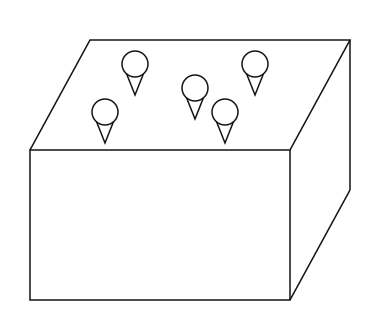
A solid cuboidal toy is made of wood. It has five cone shaped cavities to hold toy carrots.
The dimensions of the toy are cuboid – 10 cm × 10 cm × 8 cm.
Each cone carved out – Radius = 2.1 cm and Height = 6 cm.
(1) Find the volume of wood carved out to make five conical cavities. (2)
(2) Find the volume of the wood in the final product. (2)

Diagram for CBSE 2022 Class 10 Maths question 14
Show answer & solution
Answer: (1) 138.6 cm³ (2) 661.4 cm³
  1. (1) Volume of one cone cm³.
  2. Volume of five cones cm³.
  3. (2) Volume of cuboid cm³.
  4. Volume of wood left cm³.
← 2022 Basic 430/1/3 2022 Basic 430/2/2 →
Practise smarter: chapter-wise revision, formula sheets and step-by-step NCERT solutions on MonoMath CBSE →