CBSE Class 12 Maths 2026 Question Paper 65/1/1 with Solutions
All 45 questions from the CBSE Class 12 Mathematics board paper, Set 65/1/1 (2026),
with answers and step-by-step solutions. Total 80 marks. Tap “Show answer & solution” under any question.
Which of the following properties is/are true for two matrices of suitable orders ? (i) (A+B)′=A′+B′ (ii) (A−B)′=B′−A′ (iii) (AB)′=A′B′ (iv) (kAB)′=kB′A′ (k is a scalar)
Assertion (A): In an experiment of throwing an unbiased die, the probability of getting a prime number given that number appearing on the die being odd is 32. Reason (R): For any two events A and B, P(A∣B)=P(B)P(A∪B)
(A)Both Assertion (A) and Reason (R) are true and the Reason (R) is the correct explanation of the Assertion (A).
(B)Both Assertion (A) and Reason (R) are true, but Reason (R) is not the correct explanation of the Assertion (A).
(C)Assertion (A) is true and Reason (R) is false.
(D)Assertion (A) is false and Reason (R) is true.
Show answer & solution
Answer: (C) Assertion (A) is true and Reason (R) is false.
Odd outcomes: {1, 3, 5}. Prime among them: {3, 5}.
P(prime∣odd)=32, so A is true.
The correct formula is P(A∣B)=P(B)P(A∩B), not with A∪B, so R is false.
Assertion (A): Lines given by x=py+q,z=ry+s and x=p′y+q′,z=r′y+s′ are perpendicular to each other when pp′+rr′=1. Reason (R): Two lines r=a1+λb1 and r=a2+μb2 are perpendicular to each other if b1⋅b2=0.
(A)Both Assertion (A) and Reason (R) are true and the Reason (R) is the correct explanation of the Assertion (A).
(B)Both Assertion (A) and Reason (R) are true, but Reason (R) is not the correct explanation of the Assertion (A).
(C)Assertion (A) is true and Reason (R) is false.
(D)Assertion (A) is false and Reason (R) is true.
Show answer & solution
Answer: (D) Assertion (A) is false and Reason (R) is true.
First line: px−q=1y=rz−s, direction ratios p,1,r.
Second line: direction ratios p′,1,r′.
Perpendicular ⇔pp′+1+rr′=0, i.e. pp′+rr′=−1. So A is false.
R is the standard condition for perpendicular lines, so R is true.
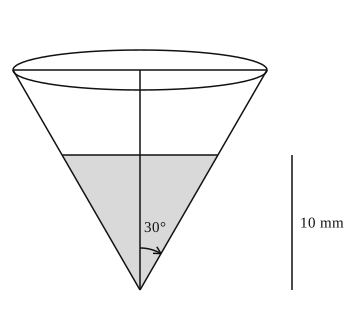
A room freshner bottle in the shape of an inverted cone sprays the perfume at regular intervals such that volume of the perfume in the bottle decreases at the steady rate of 1 mm3/min. Find the rate at which level of perfume is dropping at an instant when level of perfume in the bottle is 10 mm, if the semi-vertical angle of conical bottle is 6π.
Show answer & solution
Answer: The level is dropping at 100π3 mm/min.
Let h be the level of perfume and r the radius of its surface. Then r=htan6π=3h.
V=31πr2h=9πh3.
dtdV=3πh2dtdh.
With dtdV=−1 and h=10: −1=3100πdtdh⇒dtdh=−100π3.
Vectors a=3i^−2j^+2k^ and b=i^+2k^ represent the two adjacent sides of a parallelogram. Find the vectors representing its diagonals and hence find their lengths.
Show answer & solution
Answer: Diagonals 4i^−2j^+4k^ (length 6) and 2i^−2j^ (length 22)
Out of two bags, bag I contains 3 red and 4 white balls and bag II contains 8 red and 6 white balls. A die is thrown. If it shows a number less than 3 then a ball is drawn at random from bag I, otherwise a ball is drawn at random from bag II. Find the probability that the ball drawn from one of the bags is a red ball.
Show answer & solution
Answer:2111
Let E1: die shows 1 or 2 (bag I), E2: die shows 3, 4, 5 or 6 (bag II). P(E1)=31, P(E2)=32.
Let R: red ball drawn. P(R∣E1)=73, P(R∣E2)=148=74.
The probability of simultaneous occurrence of atleast one of the two events X and Y is a. If the probability that exactly one of the events X, Y occurs is b, prove that P(X′)+P(Y′)=2−2a+b.
Show answer & solution
Answer: Proved.
Given P(X∪Y)=P(X)+P(Y)−P(X∩Y)=a.
Exactly one occurs: P(X)+P(Y)−2P(X∩Y)=b.
Subtracting: P(X∩Y)=a−b, so P(X)+P(Y)=a+(a−b)=2a−b.
A relation R is defined on Z, the set of integers, as R={(x,y):∣x−y∣ is divisible by a prime number 'p', x,y∈Z} check whether R is an equivalence relation or not.
Show answer & solution
Answer: R is an equivalence relation.
Take p as a fixed prime.
Reflexive: ∣x−x∣=0 is divisible by p, so (x,x)∈R for all x∈Z.
Symmetric: if (x,y)∈R then p divides ∣x−y∣=∣y−x∣, so (y,x)∈R.
Transitive: if (x,y),(y,z)∈R then x−y=kp and y−z=mp for integers k, m.
Adding, x−z=(k+m)p, so p divides ∣x−z∣ and (x,z)∈R.
R is reflexive, symmetric and transitive, so R is an equivalence relation.
Check whether the lines given by 2x−1=3y−2=4z−3 and 5x−4=2y−1=z are parallel or not. If parallel, find the distance between them, otherwise find their point of intersection, if the lines are intersecting.
Show answer & solution
Answer: The lines are not parallel; they intersect at (−1,−1,−1).
Direction ratios 2, 3, 4 and 5, 2, 1 are not proportional, so the lines are not parallel.
General points: (2λ+1,3λ+2,4λ+3) and (5μ+4,2μ+1,μ).
Equate z: μ=4λ+3. Equate y: 3λ+2=2(4λ+3)+1⇒λ=−1, so μ=−1.
Check x: 2(−1)+1=−1 and 5(−1)+4=−1. Satisfied, so the lines intersect.
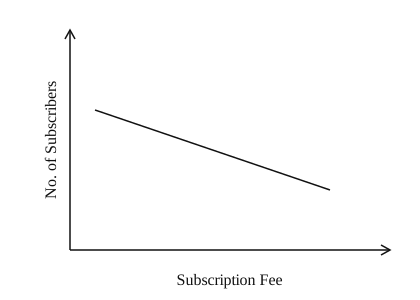
An online delivery company in a city has 5000 subscribers and collects annual subscription fees of ₹ 300 per subscriber for unlimited free deliveries. The company wishes to increase the annual subscription fee. It is predicted that, for every increase of ₹ 1, ten subscribers will discontinue. Assume that the company increased the annual fee by ₹ x. Based on the given information, answer the following questions : (i) How many subscribers will discontinue after an increase of ₹ x in annual fee ? (1) (ii) If R(x) denotes the total revenue collected after the increase of ₹ x in subscription fee, express R(x) as a function of x. (1) (iii) Find the value of x for which R(x) is maximum. (2) OR (iii) Find the sub-intervals of (0, 5000) in which R(x) is increasing and decreasing. (2)
Show answer & solution
Answer: (i) 10x (ii) R(x)=(300+x)(5000−10x) (iii) x=100; OR increasing on (0, 100), decreasing on (100, 5000)
(i) 10 subscribers leave per ₹ 1 increase, so 10x subscribers discontinue.
(ii) Fee =300+x, subscribers =5000−10x, so R(x)=(300+x)(5000−10x)=1500000+2000x−10x2.
(iii) R′(x)=2000−20x=0⇒x=100. R′′(x)=−20<0, so R is maximum at x=100.
OR (iii) R′(x)=20(100−x): R′(x)>0 on (0, 100) and R′(x)<0 on (100, 5000).
So R is increasing on (0, 100) and decreasing on (100, 5000).
In an online jackpot, there is one first prize of ₹ 3,00,000, two second prizes of ₹ 2,00,000 each and three third prizes of ₹ 50,000 each. A total of 1,00,000 jackpot tickets each costing ₹ 100 were sold there by raising a fund of ₹ 1,00,00,000. Rohan bought one ticket. Based on given information, answer the following questions : (i) What are the possible amounts, the person can win ? (1) (ii) What is the probability that the person wins atleast ₹ 2,00,000 ? (2) OR (ii) What is the probability that the person does not win any amount ? (2) (iii) In another jackpot, Rohan also bought a ticket having a prize money of ₹ 5,00,000. The chances of winning the jackpot are 1 in 1,00,000. Find the probability that on exactly one of tickets he wins the jackpot. (1)
Show answer & solution
Answer: (i) ₹ 3,00,000, ₹ 2,00,000, ₹ 50,000 (or ₹ 0) (ii) 1000003; OR 10000099994=5000049997 (iii) 10102×99999=5×10999999
(i) He can win ₹ 3,00,000, ₹ 2,00,000 or ₹ 50,000, or nothing (₹ 0).
(ii) Tickets winning at least ₹ 2,00,000: 1 + 2 = 3. Probability =1000003.
OR (ii) Winning tickets: 1 + 2 + 3 = 6. P(no prize) =100000100000−6=5000049997.
(iii) Take P(jackpot on the first ticket) = P(first prize) =1000001 and P(jackpot on the second ticket) =1000001, independent.
Roundabouts are often made on busy roads to ease the traffic and avoid red lights. One such round-about is made such that equation representing its boundary is given by C1;x2+y2=64. There is a circular pond with a fountain in the middle of the roundabout whose equation is given by C2:x2+y2=4. Based on the given information, answer the following questions : (i) Represent the given equations C1 and C2 with the help of a diagram. (1) (ii) Express y as a function of x, (y = f(x)), for both C1 an C2. (1) (iii) Using integration find the area of region covered by the roundabout. (2) OR (iii) Using integration, find the area of region covered by circular pond. (2)
Show answer & solution
Answer: (i) Two concentric circles with centre O(0, 0) and radii 8 and 2 (ii) C1: y=±64−x2; C2: y=±4−x2 (iii) 64π sq units; OR 4π sq units
(i) C1 is a circle with centre (0, 0) and radius 8; C2 is a circle with centre (0, 0) and radius 2, inside C1.
(ii) C1: y=±64−x2, −8≤x≤8; C2: y=±4−x2, −2≤x≤2.
(iii) By symmetry, area =4∫0864−x2dx=4[2x64−x2+264sin−18x]08=4×32×2π=64π sq units.
OR (iii) Area =4∫024−x2dx=4[2x4−x2+2sin−12x]02=4×2×2π=4π sq units.