CBSE Class 12 Maths 2026 Question Paper 65/3/1 with Solutions
All 45 questions from the CBSE Class 12 Mathematics board paper, Set 65/3/1 (2026),
with answers and step-by-step solutions. Total 80 marks. Tap “Show answer & solution” under any question.
dxdy=F(x,y) will be a homogeneous differential equation for which of the following functions ? (i) F(x,y)=3x+2y (ii) F(x,y)=sinxy+logy−logx (iii) F(x,y)=ey/x+1 (iv) F(x,y)=x2+y2−y
(A)(i) and (ii)
(B)(i), (ii) and (iii)
(C)(ii), (iii) and (iv)
(D)(ii) and (iii)
Show answer & solution
Answer: (D) (ii) and (iii)
dxdy=F(x,y) is homogeneous when F is homogeneous of degree zero, i.e. F(λx,λy)=F(x,y).
(i) 3x+2y has degree 1: not homogeneous of degree zero.
Direction ratios of lines l1 and l2 are ⟨12,−3,9⟩ and ⟨4,q,−p⟩ respectively. The values of p and q for which l1 and l2 are parallel are respectively :
(A)−1,3
(B)3,1
(C)−3,−1
(D)−1,−3
Show answer & solution
Answer: (C) −3,−1
Parallel lines have proportional direction ratios: 124=−3q=9−p.
Assertion (A) : One of the particular solutions of the differential equation dxdy=ex+y can be ex+e−y=−2. Reason (R) : ex+e−y=C is the general solution of the differential equation dxdy=ex+y.
(A)Both Assertion (A) and Reason (R) are true and Reason (R) is the correct explanation of the Assertion (A).
(B)Both Assertion (A) and Reason (R) are true, but Reason (R) is not the correct explanation of the Assertion (A).
(C)Assertion (A) is true, but Reason (R) is false.
(D)Assertion (A) is false, but Reason (R) is true.
Show answer & solution
Answer: (D) Assertion (A) is false, but Reason (R) is true.
e−ydy=exdx gives −e−y=ex+k, i.e. ex+e−y=C. So R is true.
ex+e−y>0 for all real x, y, so it can never equal −2. A is false.
A relation R on A={1,2,3} is defined as R={(1,1)(3,3),(1,2)}. Is R a symmetric relation ? Justify. Write the smallest relation set R1 such that R∪R1 becomes an equivalence relation on the set {1,2,3}.
Show answer & solution
Answer: R is not symmetric; R1={(2,1),(2,2)}
(1,2)∈R but (2,1)∈/R, so R is not symmetric.
For reflexivity we need (2,2); for symmetry we need (2,1).
R∪{(2,1),(2,2)}={(1,1),(2,2),(3,3),(1,2),(2,1)} is reflexive, symmetric and transitive.
A survey was conducted on the patients who have undergone knee replacement surgeries. It was found that, Robotic Knee replacement surgeries have 90% success rate. On a particular day, robotic surgery was performed on three patients, A, B and C, one after the other. Assuming that the success and failure of each surgery is independent of each other, find the probability that : (i) exactly one surgery is successful, (ii) at most two surgeries are successful.
Show answer & solution
Answer: (i) 0.027 (ii) 0.271
P(success) = 0.9, P(failure) = 0.1 for each surgery, independently.
(i) Exactly one success: 3×0.9×0.1×0.1=0.027.
(ii) At most two successes = 1 − P(all three succeed) =1−(0.9)3=1−0.729=0.271.
On the inauguration day of a new showroom, a lucky draw was organized and some vouchers of ₹ 1,000 and ₹ 500 were given to the lucky draw winners. A total of 60 vouchers were given on the day. The number of ₹ 1,000 vouchers added to 3 times the number of ₹ 500 vouchers, gives 100. Express the given information as a system of linear equations in two variables. Hence, find the number of vouchers of each type by matrix method.
Show answer & solution
Answer: 40 vouchers of ₹ 1,000 and 20 vouchers of ₹ 500
Let x = number of ₹ 1,000 vouchers, y = number of ₹ 500 vouchers.
x+y=60, x+3y=100.
AX=B with A=[1113], X=[xy], B=[60100].
∣A∣=2=0, adj A=[3−1−11], A−1=21[3−1−11].
X=A−1B=21[180−100−60+100]=[4020].
So 40 vouchers of ₹ 1,000 and 20 vouchers of ₹ 500.
Represent the equations of lines l1 and l2 in vector form and check whether they are intersecting or not. l1:−3x+3=1y−1=5z−5 l2:−1x+1=−22−y=5z−5
Show answer & solution
Answer:l1:r=−3i^+j^+5k^+λ(−3i^+j^+5k^), l2:r=−i^+2j^+5k^+μ(−i^+2j^+5k^); the lines intersect (at the origin).
l1 passes through (−3,1,5) with d.r. ⟨−3,1,5⟩: r=−3i^+j^+5k^+λ(−3i^+j^+5k^).
l2 is −1x+1=2y−2=5z−5: through (−1,2,5), d.r. ⟨−1,2,5⟩: r=−i^+2j^+5k^+μ(−i^+2j^+5k^).
The direction ratios are not proportional, so the lines are not parallel.
Opposite sides of a square are along the lines : r=i^+2j^−4k^+λ(2i^+3j^+6k^) r=3i^+3j^−5k^+μ(2i^+3j^+6k^) Find the area of the square if direction ratios of other pair of opposite sides of the square are given by ⟨−3,6,p⟩. Also, find the value of p.
Show answer & solution
Answer: Area =49293 sq units; p=−2
The lines are parallel with b=2i^+3j^+6k^, ∣b∣=7. The side of the square is the distance between them.
a2−a1=2i^+j^−k^.
b×(a2−a1)=(2i^+3j^+6k^)×(2i^+j^−k^)=−9i^+14j^−4k^, of magnitude 81+196+16=293.
Side d=7293, so area =d2=49293 sq units.
The other sides are perpendicular to these: 2(−3)+3(6)+6p=0, so p=−2.
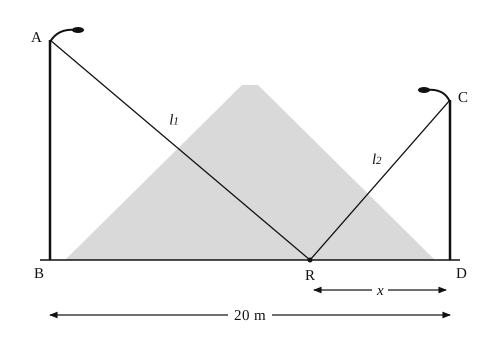
Two vertical light poles of height 22 m and 16 m stand on the opposite sides of a 20 m wide road as shown below in the figure. Two ladders of length l1 and l2 are placed from a common point R on the road at a distance of x m from the smaller pole. Based on the above information, answer the following questions : (i) Express p(x)=l1+l2 in terms of x. (1) (ii) Find p′(x). (1) (iii) (a) Find the value of x for which l12+l22 is minimum. (2) OR (iii) (b) If the 22 m long pole is also replaced by a 16 m long pole, at what distance from either pole should the ladders be kept so that the sum of squares of lengths of ladders needed to reach the top of the pole is minimum ? (2)
Show answer & solution
Answer: (i) p(x)=x2−40x+884+x2+256 (ii) p′(x)=x2−40x+884x−20+x2+256x (iii)(a) x=10 m (iii)(b) 10 m from each pole
(i) R is x m from the 16 m pole and (20−x) m from the 22 m pole.
A survey was conducted to find out the success rate of students who qualified the entrance examination by dropping a year after class XII. As per the data collected, 40% students appearing in the examination were dropouts and the remaining students were regular students of class XII. Of the dropouts, 5% qualify the examination while 10% of the regular students qualify the examination. Based on the above information, answer the following questions. (i) Find the probability that a student selected at random is a regular student. (1) (ii) A student is selected at random from a group of dropout students. What is the probability that the student will not qualify the examination ? (1) (iii) (a) A student selected at random qualified the examination. Find the probability that student is not a dropout. (2) OR (iii) (b) A student selected at random did not qualify the examination. Find the probability that the student was a regular student. (2)
Show answer & solution
Answer: (i) 0.6 (ii) 0.95 (iii)(a) 43 (iii)(b) 4627
Let D = dropout, R = regular, Q = qualifies. P(D)=0.4, P(R)=0.6, P(Q∣D)=0.05, P(Q∣R)=0.1.
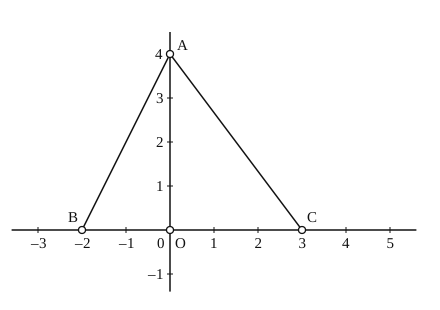
There is a triangular park in the society. The park is divided into two sections as shown in the figure. In the region OAC, children are allowed to play games like cricket, football, while in the region AOB, activities which involve running are not allowed. The vertices of the triangular park ABC are A(0, 4), B(– 2, 0) and C(3, 0). Based on the above information, answer the following questions : (i) Write the equation of the boundary line AB of the park. (1) (ii) Write the equation of the boundary line AC of the park. (1) (iii) (a) Using integration, find the area of region OAC, in which children are allowed to play cricket, football. (2) OR (iii) (b) Using integration, find the area of region AOB. (2)
Show answer & solution
Answer: (i) y=2x+4 (ii) 4x+3y=12 (iii)(a) 6 sq units (iii)(b) 4 sq units
(i) Slope of AB =0+24−0=2, so y=2x+4.
(ii) Slope of AC =3−00−4=−34, so y=4−34x, i.e. 4x+3y=12.
(iii)(a) Area OAC =∫03(4−34x)dx=[4x−32x2]03=12−6=6 sq units.
(iii)(b) Area AOB =∫−20(2x+4)dx=[x2+4x]−20=0−(4−8)=4 sq units.