CBSE Class 12 Maths 2026 Question Paper 65/4/3 with Solutions
All 45 questions from the CBSE Class 12 Mathematics board paper, Set 65/4/3 (2026),
with answers and step-by-step solutions. Total 80 marks. Tap “Show answer & solution” under any question.
A cylindrical tank is being filled with sand at a rate of 314 m3/h. If the radius of the tank is 10 m, then the height of sand in the tank increases at the rate of :
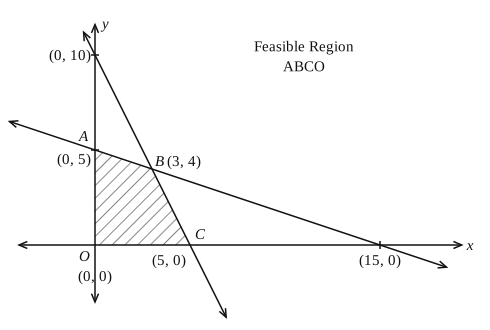
In the graph, the feasible region representing the Linear Programming Problem for maximising objective function Z=px+qy, p,q>0 is shaded. If all points on segment AB give max (Z), then which of the following is true ?
(A)p=2q
(B)p=3q
(C)q=3p
(D)q=2p
Show answer & solution
Answer: (C) q=3p
At A(0, 5): Z=5q. At B(3, 4): Z=3p+4q.
Maximum at every point of AB means Z(A)=Z(B): 5q=3p+4q.
The probability that a particular item is available in three shops A, B and C is 54, 43 and 32 respectively. If a person visits all the three shops to buy the item, then what is the probability that it will be available in at least one of the shops ?
(A)6059
(B)1
(C)601
(D)609
Show answer & solution
Answer: (A) 6059
Treating availability in the shops as independent, P(not available in any) =51×41×31=601.
Assertion (A) : If A and B are two square matrices such that AB and BA are defined, then it is not necessary that AB = BA. Reason (R) : Product of two diagonal matrices of same order is commutative.
(A)Both Assertion (A) and Reason (R) are true and Reason (R) is the correct explanation of the Assertion (A).
(B)Both Assertion (A) and Reason (R) are true, but Reason (R) is not the correct explanation of the Assertion (A).
(C)Assertion (A) is true, but Reason (R) is false.
(D)Assertion (A) is false, but Reason (R) is true.
Show answer & solution
Answer: (B) Both A and R are true, but R is not the correct explanation of A.
Matrix multiplication is not commutative in general, e.g. A=[0010], B=[1000] give AB=O=BA. So A is true.
For diagonal matrices the product is diagonal with entries aibi=biai, so R is true.
R is about a special case and does not explain why AB need not equal BA in general.
Assertion (A) : A function f:N→N given by f(x)=x3+2,∀x∈N is one-one but not onto. Reason (R) : Since ∀y∈N (Codomain), there does not exist x=(y−2)1/3 in N (Domain) such that f(x)=x3+2=y.
(A)Both Assertion (A) and Reason (R) are true and Reason (R) is the correct explanation of the Assertion (A).
(B)Both Assertion (A) and Reason (R) are true, but Reason (R) is not the correct explanation of the Assertion (A).
(C)Assertion (A) is true, but Reason (R) is false.
(D)Assertion (A) is false, but Reason (R) is true.
Show answer & solution
Answer: (C) Assertion (A) is true, but Reason (R) is false.
x13+2=x23+2⇒x1=x2, so f is one-one.
y=1 (or 2) has no pre-image in N, so f is not onto. A is true.
R says that for every y∈N no such x exists, which is false: for y=3, x=1∈N.
Let two rods placed on the ground be represented by vectors 4i^−j^+3k^ and −2i^+j^−2k^. Find a vector representing a flag-post of height 5 m that has to be erected perpendicular to both the rods.
Show answer & solution
Answer:±35(−i^+2j^+2k^)
a×b=i^4−2j^−11k^3−2=−i^+2j^+2k^.
Its magnitude is 1+4+4=3, so a unit vector perpendicular to both is 31(−i^+2j^+2k^).
Required vector of length 5: ±35(−i^+2j^+2k^) (the upward one is taken for the flag-post).
In a school, the probability of holding a debate competition is 31 and that of a quiz competition is 32. In the two participating teams, A has 4 girls and 6 boys and B has 7 girls and 3 boys. If a debate competition is held, the students are selected from team A and for the quiz competition they are selected from team B. If only two students are to be chosen from the teams, then find the probability that one will be a girl and the other a boy.
Show answer & solution
Answer:4522
Let E1: debate (team A), E2: quiz (team B); P(E1)=31, P(E2)=32. Let G: one girl and one boy chosen.
Let n be a fixed positive integer. A relation R is defined in set Z such that R={(x,y):(x−y) is divisible by n,x,y∈Z}. Determine if R is an equivalence relation.
Show answer & solution
Answer: Yes, R is an equivalence relation.
Reflexive: x−x=0=0⋅n, so (x,x)∈R for all x∈Z.
Symmetric: if x−y=kn then y−x=(−k)n, so (y,x)∈R.
Transitive: if x−y=kn and y−z=mn then x−z=(k+m)n, so (x,z)∈R.
Find the length of the perpendicular drawn from the point P(1, 2, 3) to the line 3x−6=2y−7=−2z−7. Also, find the equation of the perpendicular line joining P and the foot of the perpendicular.
Show answer & solution
Answer: Length 7 units; foot (3, 5, 9); line 2x−1=3y−2=6z−3, i.e. r=(i^+2j^+3k^)+t(2i^+3j^+6k^)
A general point on the line is Q(3λ+6,2λ+7,−2λ+7), so PQ=(3λ+5)i^+(2λ+5)j^+(4−2λ)k^.
A carpenter needs to design a wooden box in the shape of a cuboid such that the sum of its length and breadth is 3 cm more than its height. Twice of its length, thrice of its breadth and its height add up to 10 cm. Its breadth added to 7 times its height is 1 cm less than 3 times its length. On the basis of the above information, answer the following questions : (i) Write the equations representing the various dimensions and express them as the matrix equation AX = B. (1) (ii) Find if A−1 exists. Justify your answer. (1) (iii) Find A−1. (2) OR (iii) Find A2+7I. (2)
Show answer & solution
Answer: (i) l+b−h=3, 2l+3b+h=10, 3l−b−7h=1; 12313−1−11−7lbh=3101 (ii) Yes, ∣A∣=8=0 (iii) A−1=81−2017−118−444−31; OR A2+7I=711−2051777−652
(i) Let length l, breadth b, height h (cm). l+b=h+3, 2l+3b+h=10, b+7h=3l−1.
So l+b−h=3, 2l+3b+h=10, 3l−b−7h=1: A=12313−1−11−7, X=lbh, B=3101.
(ii) ∣A∣=1(−21+1)−1(−14−3)−1(−2−9)=−20+17+11=8=0, so A is non-singular and A−1 exists.
An NGO organises a charity event in which they decide to distribute woollen caps to protect children from winter. The caps to be distributed are in three separate boxes, Box I has 30 red caps, Box II has 20 red and 10 green caps, and Box III has 30 green caps. The probability that a Box i is selected and a cap picked out is 6i, where i = 1, 2, 3. Based on the above information, answer the following questions : A person selects a cap. (i) What is the probability that he selects a red cap ? (2) (ii) If he selects a green cap, what is the probability that the cap has come from Box II ? (2)
Show answer & solution
Answer: (i) 187 (ii) 112
Let Ei: Box i is selected; P(E1)=61, P(E2)=62, P(E3)=63.
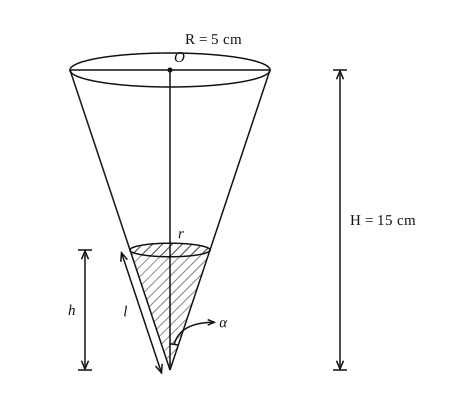
At a birthday party, children are being served orange juice in conical cups, as shown in the figure. Each cup is 15 cm deep and has a radius 5 cm. The juice is being poured into this cup at a rate of 0.1 cm3/s. On the basis of the above information, answer the following questions : (i) Establish a relation between the height h of the juice in the cup and radius r of the surface of the juice in the cup, if the semi-vertical angle of the cone is α. (1) (ii) At what rate is the juice level in the cup rising when the juice is 6 cm deep ? (1) (iii) When the juice is 6 cm deep, then find at what rate is the upper surface area of juice increasing ? (2) OR (iii) When the juice is 6 cm deep, then find the rate at which the wetted surface area of the cup is increasing. (2)
Show answer & solution
Answer: (i) r=htanα, here tanα=155 so r=3h (ii) 40π1 cm/s (iii) 301 cm2/s; OR 3010 cm2/s
(i) In the right triangle formed by the axis, a radius of the juice surface and the slant side, tanα=hr, so r=htanα. For the cup tanα=155=31, so r=3h.
(ii) V=31πr2h=27πh3, so dtdV=9πh2dtdh.
At h=6: 0.1=4πdtdh⇒dtdh=40π1 cm/s.
(iii) Upper surface area A=πr2=9πh2; dtdA=92πhdtdh=912π⋅40π1=301 cm2/s.
OR (iii) Wetted surface S=πrl with l=h2+r2=310h, so S=910πh2.