CBSE Class 12 Maths 2026 Question Paper 65/5/2 with Solutions
All 45 questions from the CBSE Class 12 Mathematics board paper, Set 65/5/2 (2026),
with answers and step-by-step solutions. Total 80 marks. Tap “Show answer & solution” under any question.
An ant is observed crawling on a sheet of paper along a straight line given by equation y=2x−4. Area of the surface covered by the ant bounded by y-axis, x-axis and x=1 is :
(A)1 sq. unit
(B)3 sq. units
(C)2 sq. units
(D)4 sq. units
Show answer & solution
Answer: (B) 3 sq. units
For 0≤x≤1, y=2x−4<0, so the region lies below the x-axis.
The corner points of the feasible region determined by the system of linear constraints are (0, 0), (0, 40), (20, 40) (60, 20) and (60, 0). If the objective function of an LPP is Z=4x+3y, then the maximum value is :
(A)200
(B)300
(C)240
(D)120
Show answer & solution
Answer: (B) 300
Z at the corners: (0, 0): 0; (0, 40): 120; (20, 40): 200; (60, 20): 300; (60, 0): 240.
If vectors a=3i^+2j^+λk^ and b=2i^−4j^+5k^, represent the two strips of the Red Cross sign placed outside a doctor’s clinic, then the value of λ is :
(A)1
(B)25
(C)52
(D)0
Show answer & solution
Answer: (C) 52
The two strips of a Red Cross sign are perpendicular, so a⋅b=0.
Assertion (A): A relation R on the set {1, 2, 3} defined as R = {(1, 1), (1, 2), (2, 1), (2, 2), (3, 3)} is an equivalence relation. Reason (R): A relation that is reflexive, symmetric and transitive is an equivalence relation.
(A)Both Assertion (A) and Reason (R) are true and Reason (R) is the correct explanation of the Assertion (A).
(B)Both Assertion (A) and Reason (R) are true, but Reason (R) is not the correct explanation of the Assertion (A).
(C)Assertion (A) is true, but Reason (R) is false.
(D)Assertion (A) is false, but Reason (R) is true.
Show answer & solution
Answer: (A) Both A and R are true and R is the correct explanation of A.
Reflexive: (1, 1), (2, 2), (3, 3) are in R.
Symmetric: (1, 2) and (2, 1) are both in R.
Transitive: (1, 2), (2, 1) give (1, 1) in R; (2, 1), (1, 2) give (2, 2) in R; all other cases are trivial.
So R is an equivalence relation; R is the definition of an equivalence relation and explains A.
Assertion (A): Consider a Linear Programming Problem with minimise Z=x+2y subject to constraints 2x+y≥3, x+2y≥6, x,y≥0 which gives minimum Z at infinitely many points. The corner points of feasible region are (0, 3) and (6, 0). Reason (R): If two corner points produce the same minimum value of the objective function, then every point on the line segment joining the points will give the same minimum value.
(A)Both Assertion (A) and Reason (R) are true and Reason (R) is the correct explanation of the Assertion (A).
(B)Both Assertion (A) and Reason (R) are true, but Reason (R) is not the correct explanation of the Assertion (A).
(C)Assertion (A) is true, but Reason (R) is false.
(D)Assertion (A) is false, but Reason (R) is true.
Show answer & solution
Answer: (A) Both A and R are true and R is the correct explanation of A.
Lines 2x+y=3 and x+2y=6 meet at (0, 3); the feasible (unbounded) region has corner points (0, 3) and (6, 0).
Z(0,3)=6 and Z(6,0)=6; since x+2y≥6 in the region, the minimum is 6.
Every point on the segment joining (0, 3) and (6, 0) gives Z=6, so the minimum occurs at infinitely many points.
Three honey bees were found flying along the vectors a=2i^−3j^+k^, b=4j^−2k^ and c=3i^+2k^ respectively. Find the value of λ such that the path for a+λb is perpendicular to c.
A thin metallic wire in the shape of a circular ring has its enclosed area increasing at a uniform rate when heated. Show that the rate of change of circumference varies inversely as the radius.
Show answer & solution
Answer: Proved.
Let r be the radius, A=πr2 the enclosed area and C=2πr the circumference.
Given dtdA=k, a constant: 2πrdtdr=k⇒dtdr=2πrk.
dtdC=2πdtdr=2π⋅2πrk=rk.
So the rate of change of circumference varies inversely as the radius.
A box contains 6 cards numbered 1 to 6. A student is asked to pick up two cards, one by one after replacement and note down the numbers on the cards. Let A be the event of getting sum of the numbers on two cards as 10, and B, the event of a number other than 4 on the first card selected. Find P(A and B) and find whether the events A and B are independent events or not.
Show answer & solution
Answer:P(A and B)=181; A and B are not independent.
There are 36 equally likely outcomes.
A = {(4, 6), (5, 5), (6, 4)}, so P(A)=363=121.
P(B)=65 (first card is not 4).
A∩B={(5,5),(6,4)}, so P(A∩B)=362=181.
P(A)P(B)=121⋅65=725=181, so A and B are not independent.
Let three toys A, B and C be placed in the same straight line. If the position vectors of A, B and C are 55i^−2j^, 5i^+8j^ and ai^−52j^ respectively, find the value of ‘a’.
Find cost (per kg) of each fertilizer A, B and C that the farmer needs to buy, such that 1 kg each of fertilizer A and C added to 2 kg of B costs him ₹ 400. Also, cost of each kg of fertilizer B and C added together is equal to cost of 1 kg of fertilizer A. However, cost of 3 kg of fertilizer B added to ₹ 200 is the same as cost of 1 kg of fertilizer A and C together. Use matrix method to find the solution.
Show answer & solution
Answer: A: ₹ 180 per kg, B: ₹ 40 per kg, C: ₹ 140 per kg.
Let the costs per kg of A, B, C be ₹ x, ₹ y, ₹ z: x+2y+z=400, x−y−z=0, x−3y+z=200.
There are three types of vaccines A1, A2, A3, available in the market to protect the population of the country from spread of certain infection. According to a survey conducted, it was found that 25% of the population was given Vaccine A1, 35% of the population was given Vaccine A2 and 40% of the population was given Vaccine A3. The survey also stated that the probabilities that Vaccines A1, A2 and A3 would protect against the infection were 60%, 55% and 50% respectively. Based on the above information, answer the following questions : Find the probability that : (i) The person taking vaccine A2 will get infected. (1) (ii) If a person is chosen randomly, he/she will be protected from the infection. (1) (iii) (a) The person was given Vaccine A1, given that the randomly chosen person is infected. (2) OR (iii) (b) The person was given Vaccine A3, given that the randomly chosen person is not infected. (2)
Show answer & solution
Answer: (i) 0.45 (ii) 0.5425 (iii) (a) 18340 OR (iii) (b) 21780
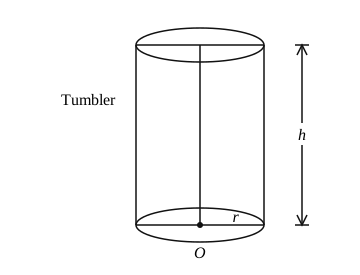
A company produces cylindrical tumblers, open from the top. Since they want uniformity in the product, they fix the surface area of the tumblers produced. Based on the above information, answer the following questions : If for a tumbler, V is its volume, h the height and r the radius of the circular base, then : (i) Differentiate its volume with respect to radius of the base, where the surface area is constant. (2) (ii) If the company wants to maximize the volume of each tumbler, then establish a relation between its height and the radius of the base. (2)
Show answer & solution
Answer: (i) drdV=2S−3πr2, where S is the fixed surface area (ii) h = r
Let the fixed surface area be S=πr2+2πrh, so h=2πrS−πr2.
V=πr2h=2r(S−πr2)=2Sr−πr3.
(i) drdV=2S−3πr2.
(ii) drdV=0⇒S=3πr2⇒πr2+2πrh=3πr2⇒h=r.
dr2d2V=−3πr<0, so V is maximum when h = r (height equals radius of the base).
A school wants the students of class XII to do a project on ‘Sustainability’ keeping the world environment in mind. They select the student participants on the basis of an essay writing competition. 7 students out of 80 are selected for the project and are categorized into two sets such that : Girl students belong to Set A = {G1,G2,G3,G4}, Boy students belong to Set B = {B1,B2,B3}. Based on the above information, answer the following questions : (i) How many relations are possible from Set A → Set B ? (1) (ii) Let R be a relation from A → B such that R = {(G1,B1),(G2,B2),(G3,B2),(G4,B3),(G1,B2)}. Is R an injective function ? Justify your answer. (1) (iii) (a) Let the relation R from A → A be such that R = {(x, y), x, y ∈ A, x and y are students from the same colony in the city} Verify if R is an equivalence relation. (2) OR (iii) (b) Verify if any function f : B → A is bijective. Give reason to support your answer. (2)
Show answer & solution
Answer: (i) 212=4096 (ii) No, R is not a function (G1 has two images), so it is not an injective function. (iii) (a) Yes, R is an equivalence relation. OR (iii) (b) No; since n(B) = 3 < n(A) = 4, no function from B to A can be onto, so none is bijective.
(i) n(A×B)=4×3=12, so the number of relations is 212=4096.
(ii) G1 is related to both B1 and B2, so R is not a function and hence not an injective function.
(iii) (a) Reflexive: every student is from the same colony as himself/herself. Symmetric: if x and y are from the same colony, so are y and x. Transitive: if x, y and y, z are from the same colony, then x, z are too. So R is an equivalence relation.
(iii) (b) B has 3 elements and A has 4, so a function f : B → A has at most 3 images and cannot be onto; hence no such f is bijective.