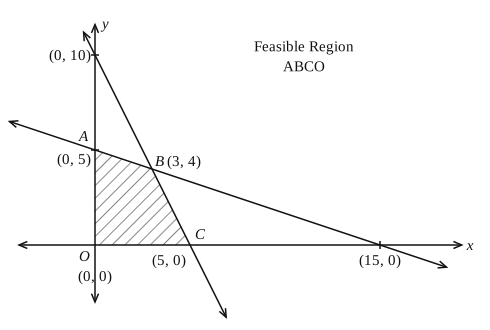
In the graph, the feasible region representing the Linear Programming Problem for maximising objective function Z=px+qy, p,q>0 is shaded. If all points on segment AB give max (Z), then which of the following is true ?
(A)p=2q
(B)p=3q
(C)q=3p
(D)q=2p
Show answer & solution
Answer: (C) q=3p
At A(0, 5): Z=5q. At B(3, 4): Z=3p+4q.
Maximum at every point of AB means Z(A)=Z(B): 5q=3p+4q.
The corner points of the feasible region determined by the system of linear constraints are (0, 0), (0, 40), (20, 40) (60, 20) and (60, 0). If the objective function of an LPP is Z=4x+3y, then the maximum value is :
(A)200
(B)300
(C)240
(D)120
Show answer & solution
Answer: (B) 300
Z at the corners: (0, 0): 0; (0, 40): 120; (20, 40): 200; (60, 20): 300; (60, 0): 240.
Assertion (A): Consider a Linear Programming Problem with minimise Z=x+2y subject to constraints 2x+y≥3, x+2y≥6, x,y≥0 which gives minimum Z at infinitely many points. The corner points of feasible region are (0, 3) and (6, 0). Reason (R): If two corner points produce the same minimum value of the objective function, then every point on the line segment joining the points will give the same minimum value.
(A)Both Assertion (A) and Reason (R) are true and Reason (R) is the correct explanation of the Assertion (A).
(B)Both Assertion (A) and Reason (R) are true, but Reason (R) is not the correct explanation of the Assertion (A).
(C)Assertion (A) is true, but Reason (R) is false.
(D)Assertion (A) is false, but Reason (R) is true.
Show answer & solution
Answer: (A) Both A and R are true and R is the correct explanation of A.
Lines 2x+y=3 and x+2y=6 meet at (0, 3); the feasible (unbounded) region has corner points (0, 3) and (6, 0).
Z(0,3)=6 and Z(6,0)=6; since x+2y≥6 in the region, the minimum is 6.
Every point on the segment joining (0, 3) and (6, 0) gives Z=6, so the minimum occurs at infinitely many points.