MonoMath CBSE
CBSE Maths › Class 12 PYQs › 2025

CBSE Class 12 Maths 2025 Question Paper 65/1/1 with Solutions

All 45 questions from the CBSE Class 12 Mathematics board paper, Set 65/1/1 (2025), with answers and step-by-step solutions. Total 80 marks. Tap “Show answer & solution” under any question.

Set 65/1/1Set 65/1/2Set 65/1/3Set 65/2/1Set 65/2/2Set 65/2/3Set 65/4/1Set 65/4/2Set 65/4/3Set 65/5/1Set 65/5/2Set 65/5/3Set 65/6/1Set 65/6/2Set 65/6/3Set 65/7/1Set 65/7/2Set 65/7/3
Q11 markMCQMatrices

If A = , then is

  1. (A)
  2. (B)
  3. (C)
  4. (D)
Show answer & solution
Answer: (D)
  1. A is diagonal, so is diagonal with the reciprocals of the diagonal entries.
  2. Reciprocals of are .
  3. So , which is option (D).
Also asked in: 2025 65/1/2, 2025 65/1/3
Q21 markMCQVector Algebra

If vector and vector , then which of the following is correct ?

  1. (A)
  2. (B)
  3. (C)
  4. (D)
Show answer & solution
Answer: (B)
  1. So .
  2. Also , , so (C) and (D) are false, and the vectors are not parallel.
Q31 markMCQIntegrals

is equal to

  1. (A)
  2. (B)0
  3. (C)1
  4. (D)2
Show answer & solution
Answer: (B) 0
  1. for and for .
  2. Integral .
  3. (It is an odd function, so the integral over is 0.)

Which of the following is not a homogeneous function of and y ?

  1. (A)
  2. (B)
  3. (C)
  4. (D)
Show answer & solution
Answer: (D)
  1. is homogeneous of degree 2; of degree 1.
  2. is a function of only, so it is homogeneous of degree 0.
  3. cannot be written as , so (D) is not homogeneous.
Also asked in: 2025 65/1/2, 2025 65/1/3

If f() = , then which of the following is correct ?

  1. (A)f() is both continuous and differentiable, at and .
  2. (B)f() is differentiable but not continuous, at and .
  3. (C)f() is continuous but not differentiable, at and .
  4. (D)f() is neither continuous nor differentiable, at and .
Show answer & solution
Answer: (C) f() is continuous but not differentiable, at and .
  1. Sums of modulus functions are continuous everywhere.
  2. For : ; for : ; for : .
  3. At : left derivative , right derivative ; at : left derivative , right derivative .
  4. So f is continuous but not differentiable at and .
Also asked in: 2025 65/1/2, 2025 65/1/3
Q61 markMCQDeterminants

If A is a square matrix of order 2 such that det (A) = 4, then det (4 adj A) is equal to :

  1. (A)16
  2. (B)64
  3. (C)256
  4. (D)512
Show answer & solution
Answer: (B) 64
  1. For order : and .
  2. Here : .
Q71 markMCQProbability

If E and F are two independent events such that P(E) = , P(F) = , then P(E/) is equal to :

  1. (A)
  2. (B)
  3. (C)
  4. (D)
Show answer & solution
Answer: (C)
  1. E and F independent E and are independent.
  2. So P(E/) = P(E) = .
Also asked in: 2025 65/1/2

The absolute maximum value of function f() = in [0, 2] is :

  1. (A)0
  2. (B)2
  3. (C)4
  4. (D)5
Show answer & solution
Answer: (C) 4
  1. in [0, 2].
  2. , , .
  3. Absolute maximum value = 4.
Also asked in: 2025 65/1/2, 2025 65/1/3
Q91 markMCQMatrices

Let A = , B = , C = [9 8 7], which of the following is defined ?

  1. (A)Only AB
  2. (B)Only AC
  3. (C)Only BA
  4. (D)All AB, AC and BA
Show answer & solution
Answer: (A) Only AB
  1. A is , B is , C is .
  2. AB: is defined.
  3. AC: is not defined; BA: is not defined.
  4. So only AB is defined.
Also asked in: 2025 65/1/3
Q101 markMCQIntegrals

If , then k is equal to

  1. (A)
  2. (B)
  3. (C)
  4. (D)
Show answer & solution
Answer: (A)
  1. Put , .
  2. Integral .
  3. So .
Also asked in: 2025 65/1/2, 2025 65/1/3
Q111 markMCQVector Algebra

If , , and , then angle between and is

  1. (A)
  2. (B)
  3. (C)
  4. (D)
Show answer & solution
Answer: (C)
  1. , so .
  2. .
  3. .
Also asked in: 2025 65/1/2, 2025 65/1/3

The integrating factor of differential equation is

  1. (A)
  2. (B)
  3. (C)
  4. (D)
Show answer & solution
Answer: (B)
  1. Write as , i.e. .
  2. This is linear in with .
  3. IF .
Q131 markMCQMatrices

If A = is a scalar matrix, then is equal to

  1. (A)0
  2. (B)1
  3. (C)7
  4. (D)
Show answer & solution
Answer: (B) 1
  1. In a scalar matrix all off-diagonal entries are 0 and the diagonal entries are equal.
  2. So and .
  3. .
Q141 markMCQLinear Programming

The corner points of the feasible region in graphical representation of a L.P.P. are (2, 72), (15, 20) and (40, 15). If Z = be the objective function, then

  1. (A)Z is maximum at (2, 72), minimum at (15, 20)
  2. (B)Z is maximum at (15, 20) minimum at (40, 15)
  3. (C)Z is maximum at (40, 15), minimum at (15, 20)
  4. (D)Z is maximum at (40, 15), minimum at (2, 72)
Show answer & solution
Answer: (C) Z is maximum at (40, 15), minimum at (15, 20)
  1. Z(2, 72) = 36 + 648 = 684
  2. Z(15, 20) = 270 + 180 = 450
  3. Z(40, 15) = 720 + 135 = 855
  4. Maximum at (40, 15), minimum at (15, 20).
Also asked in: 2025 65/1/2, 2025 65/1/3
Q151 markMCQMatrices

If A and B are invertible matrices, then which of the following is not correct ?

  1. (A)
  2. (B)
  3. (C)adj (A) =
  4. (D)
Show answer & solution
Answer: (A)
  1. is true (reversal law).
  2. gives adj (A) , true.
  3. , true.
  4. is false in general (e.g. A = B = I gives ).
Also asked in: 2025 65/1/2, 2025 65/1/3
Q161 markMCQLinear Programming

If the feasible region of a linear programming problem with objective function Z = a + by, is bounded, then which of the following is correct ?

  1. (A)It will only have a maximum value.
  2. (B)It will only have a minimum value.
  3. (C)It will have both maximum and minimum values.
  4. (D)It will have neither maximum nor minimum value.
Show answer & solution
Answer: (C) It will have both maximum and minimum values.
  1. When the feasible region is bounded, the objective function attains both a maximum and a minimum value,
  2. and each occurs at a corner point of the feasible region.
Also asked in: 2025 65/1/2, 2025 65/1/3

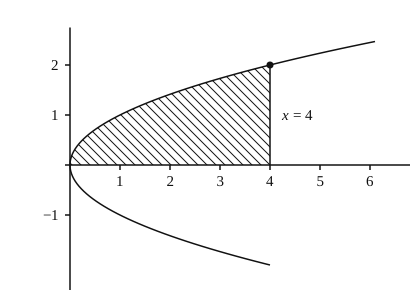
The area of the shaded region bounded by the curves , and the -axis is given by

Diagram for CBSE 2025 Class 12 Maths question 17
  1. (A)
  2. (B)
  3. (C)
  4. (D)
Show answer & solution
Answer: (D)
  1. The shaded region lies above the -axis, under the upper branch , from to .
  2. Area .
Also asked in: 2025 65/1/2, 2025 65/1/3

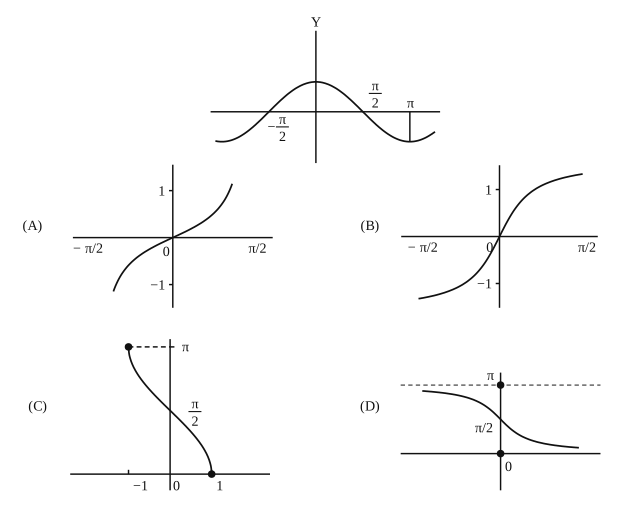
The graph of a trigonometric function is as shown. Which of the following will represent graph of its inverse ?

Diagram for CBSE 2025 Class 12 Maths question 18
  1. (A)Graph (A) in the figure
  2. (B)Graph (B) in the figure
  3. (C)Graph (C) in the figure
  4. (D)Graph (D) in the figure
Show answer & solution
Answer: (C) Graph (C) in the figure, i.e.
  1. The given graph has maximum 1 at , zeros at and minimum at : it is .
  2. Its inverse has domain and range , decreasing from to , passing through .
  3. This is graph (C).
Also asked in: 2025 65/1/2, 2025 65/1/3
Q191 markAssertion–ReasonRelations and Functions

Assertion (A): Let Z be the set of integers. A function f : Z Z defined as f() = , Z is a bijective.
Reason (R): A function is a bijective if it is both surjective and injective.

  1. (A)Both Assertion (A) and Reason (R) are true and the Reason (R) is the correct explanation of the Assertion (A).
  2. (B)Both Assertion (A) and Reason (R) are true, but Reason (R) is not the correct explanation of the Assertion (A).
  3. (C)Assertion (A) is true, but Reason (R) is false.
  4. (D)Assertion (A) is false, but Reason (R) is true.
Show answer & solution
Answer: (D) Assertion (A) is false, but Reason (R) is true.
  1. f is one-one: .
  2. f is not onto Z: e.g. gives Z.
  3. So f is not a bijection: A is false.
  4. R is the definition of a bijection, so R is true.
Also asked in: 2025 65/1/2, 2025 65/1/3
Q201 markAssertion–ReasonContinuity and Differentiability

Assertion (A): f() = is continuous at for k = .
Reason (R): For a function f to be continuous at = a, .

  1. (A)Both Assertion (A) and Reason (R) are true and the Reason (R) is the correct explanation of the Assertion (A).
  2. (B)Both Assertion (A) and Reason (R) are true, but Reason (R) is not the correct explanation of the Assertion (A).
  3. (C)Assertion (A) is true, but Reason (R) is false.
  4. (D)Assertion (A) is false, but Reason (R) is true.
Show answer & solution
Answer: (D) Assertion (A) is false, but Reason (R) is true.
  1. ; .
  2. Continuity needs , i.e. , not . So A is false.
  3. R is the correct condition for continuity, so R is true.
Also asked in: 2025 65/1/2, 2025 65/1/3
Q212 marksVery Short AnswerContinuity and Differentiability

Differentiate w.r.t .

Show answer & solution
Answer:
  1. Let . Then .
  2. .
Also asked in: 2025 65/1/2, 2025 65/1/3
OR
Q21 (OR) (OR)2 marksVery Short AnswerContinuity and Differentiability

If , then find .

Show answer & solution
Answer:
  1. , a constant.
  2. Differentiate: .
  3. .
Also asked in: 2025 65/1/2, 2025 65/1/3
Q222 marksVery Short AnswerInverse Trigonometric Functions

Evaluate :

Show answer & solution
Answer:
  1. (principal value).
  2. .
  3. .
Q232 marksVery Short AnswerVector Algebra

The diagonals of a parallelogram are given by and . Find the area of the parallelogram.

Show answer & solution
Answer: sq units
  1. Area for diagonals .
  2. .
  3. .
  4. Area sq units.
Also asked in: 2025 65/1/2, 2025 65/1/3
Q242 marksVery Short AnswerApplication of Derivatives

Find the intervals in which function f() = is (i) increasing (ii) decreasing.

Show answer & solution
Answer: (i) increasing on (ii) decreasing on
  1. Domain: .
  2. .
  3. for and for .
  4. So f is increasing on and decreasing on .
Q252 marksVery Short AnswerVector Algebra

Two friends while flying kites from different locations, find the strings of their kites crossing each other. The strings can be represented by vectors and . Determine the angle formed between the kite strings. Assume there is no slack in the strings.

Show answer & solution
Answer: , i.e.
  1. .
  2. , .
  3. .
  4. .
Also asked in: 2025 65/1/2, 2025 65/1/3
OR
Q25 (OR) (OR)2 marksVery Short AnswerVector Algebra

Find a vector of magnitude 21 units in the direction opposite to that of where A and B are the points A(2, 1, 3) and B(8, , 0) respectively.

Show answer & solution
Answer:
  1. , .
  2. Unit vector opposite to : .
  3. Required vector .
Also asked in: 2025 65/1/2, 2025 65/1/3
Q263 marksShort AnswerApplication of Derivatives

The side of an equilateral triangle is increasing at the rate of 3 cm/s. At what rate its area increasing when the side of the triangle is 15 cm ?

Show answer & solution
Answer: cm/s
  1. Area .
  2. .
  3. At , : cm/s.
Q273 marksShort AnswerLinear Programming

Solve the following linear programming problem graphically :
Maximise Z =
Subject to the constraints :


Show answer & solution
Answer: The feasible region is unbounded and Z has no maximum value.
  1. Feasible region: , , . Lines and meet at (2, 2).
  2. Corner points: O(0, 0) and (2, 2); the region is unbounded to the right (along the -axis and along beyond (2, 2)).
  3. Z(0, 0) = 0, Z(2, 2) = 6.
  4. Check : points such as (10, 0) satisfy all constraints and give Z = 10 > 6, so the half-plane meets the region.
  5. Hence Z has no maximum value.
Q283 marksShort AnswerIntegrals

Find :

Show answer & solution
Answer:
  1. , .
  2. Integrand .
  3. By parts, .
  4. So the integral .
OR
Q28 (OR) (OR)3 marksShort AnswerIntegrals

Evaluate :

Show answer & solution
Answer:
  1. , so .
  2. Integral .
  3. Put : .
  4. .
Q293 marksShort AnswerThree Dimensional Geometry

Verify that lines given by and are skew lines. Hence, find shortest distance between the lines.

Show answer & solution
Answer: Shortest distance units (non-zero, so the lines are skew)
  1. Line 1: , .
  2. Line 2: , . The directions are not parallel.
  3. , magnitude .
  4. ; .
  5. So the lines do not intersect and are not parallel: they are skew. SD .
Also asked in: 2025 65/1/2, 2025 65/1/3
OR
Q29 (OR) (OR)3 marksShort AnswerVector Algebra

During a cricket match, the position of the bowler, the wicket keeper and the leg slip fielder are in a line given by , and respectively. Calculate the ratio in which the wicketkeeper divides the line segment joining the bowler and the leg slip fielder.

Show answer & solution
Answer: 2 : 3 (internally)
  1. Let W divide BF in the ratio .
  2. : .
  3. Check : . Correct.
  4. Ratio = 2 : 3 internally.
Also asked in: 2025 65/1/2, 2025 65/1/3
Q303 marksShort AnswerProbabilityNot in current syllabus

The probability distribution for the number of students being absent in a class on a Saturday is as follows :
X: 0, 2, 4, 5
P(X): p, 2p, 3p, p
Where X is the number of students absent.
(i) Calculate p. (1)
(ii) Calculate the mean of the number of absent students on Saturday. (2)

Show answer & solution
Answer: (i) (ii) Mean = 3
  1. (i) .
  2. (ii) Mean .
Also asked in: 2025 65/1/2, 2025 65/1/3
OR
Q30 (OR) (OR)3 marksShort AnswerProbability

For the vacancy advertised in the newspaper, 3000 candidates submitted their applications. From the data it was revealed that two third of the total applicants were females and other were males. The selection for the job was done through a written test. The performance of the applicants indicates that the probability of a male getting a distinction in written test is 0.4 and that a female getting a distinction is 0.35. Find the probability that the candidate chosen at random will have a distinction in the written test.

Show answer & solution
Answer: (about 0.367)
  1. P(F) , P(M) ; P(D|M) = 0.4, P(D|F) = 0.35.
  2. By total probability, P(D) .
Also asked in: 2025 65/1/2, 2025 65/1/3
Q313 marksShort AnswerApplication of Integrals

Sketch the graph of y = and find the area of the region enclosed by the curve, -axis, between and , using integration.

Show answer & solution
Answer: 9 sq units
  1. The graph is a V with vertex at : for and for .
  2. Area .
  3. sq units.
Also asked in: 2025 65/1/2, 2025 65/1/3

If , then prove that .

Show answer & solution
Answer: Proved.
  1. Put , . Then .
  2. .
  3. So , i.e. , a constant.
  4. Thus .
  5. Differentiate w.r.t. : .
  6. Hence . Proved.
Also asked in: 2025 65/1/3
OR
Q32 (OR) (OR)5 marksLong AnswerContinuity and Differentiability

If and y = , then find at .

Show answer & solution
Answer:
  1. .
  2. , so .
  3. .
  4. At : .
Also asked in: 2025 65/1/3
Q335 marksLong AnswerApplication of Derivatives

Find the absolute maximum and absolute minimum of function f() = on [1, 5].

Show answer & solution
Answer: Absolute maximum 56 at ; absolute minimum 24 at
  1. ; critical points .
  2. Absolute maximum = 56 at ; absolute minimum = 24 at .
Also asked in: 2025 65/1/2
Q345 marksLong AnswerThree Dimensional Geometry

Find the image A' of the point A(1, 6, 3) in the line . Also, find the equation of the line joining A and A'.

Show answer & solution
Answer: A'(1, 0, 7); line AA':
  1. General point of the line: M.
  2. is perpendicular to (1, 2, 3):
  3. , so foot M(1, 3, 5).
  4. M is the mid-point of AA': A' .
  5. Direction of AA' = (0, , 4) (0, 3, ).
  6. Line AA': , i.e. .
Also asked in: 2025 65/1/2, 2025 65/1/3
OR
Q34 (OR) (OR)5 marksLong AnswerThree Dimensional Geometry

Find a point P on the line such that its distance from point Q(2, 4, ) is 7 units. Also, find the equation of line joining P and Q.

Show answer & solution
Answer: P(, 1, ); line PQ:
  1. General point P.
  2. PQ.
  3. .
  4. P = (, 1, ). Direction PQ = (6, 3, 2) (check: ).
  5. Line PQ: .
Also asked in: 2025 65/1/2, 2025 65/1/3
Q355 marksLong AnswerDeterminants

A school wants to allocate students into three clubs : Sports, Music and Drama, under following conditions :
• The number of students in Sports club should be equal to the sum of the number of students in Music and Drama club.
• The number of students in Music club should be 20 more than half the number of students in Sports club.
• The total number of students to be allocated in all three clubs are 180.
Find the number of students allocated to different clubs, using matrix method.

Show answer & solution
Answer: Sports 90, Music 65, Drama 25
  1. Let Sports = , Music = , Drama = : , , .
  2. A = , X = , B = .
  3. .
  4. adj A = .
  5. X = adj A B , so , , .
  6. Sports: 90, Music: 65, Drama: 25.
Also asked in: 2025 65/1/2, 2025 65/1/3
Q364 marksCase StudyApplication of Derivatives

A technical company is designing a rectangular solar panel installation on a roof using 300 metres of boundary material. The design includes a partition running parallel to one of the sides dividing the area (roof) into two sections.
Let the length of the side perpendicular to the partition be metres and with parallel to the partition be y metres.
Based on this information, answer the following questions :
(i) Write the equation for the total boundary material used in the boundary and parallel to the partition in terms of and y. (1)
(ii) Write the area of the solar panel as a function of . (1)
(iii) (a) Find the critical points of the area function. Use second derivative test to determine critical points at the maximum area. Also, find the maximum area. (2)
OR (iii) (b) Using first derivative test, calculate the maximum area the company can enclose with the 300 metres of boundary material, considering the parallel partition. (2)

Show answer & solution
Answer: (i) (ii) (iii) (a) critical point ; so maximum; maximum area 3750 m (y = 50) OR (iii) (b) maximum area 3750 m
  1. (i) Two sides of length and three of length y (two sides plus the partition): .
  2. (ii) , so .
  3. (iii)(a) . , so maximum at , y = 50; max area m.
  4. (iii)(b) is positive for and negative for , so A has a maximum at ; maximum area m.
Also asked in: 2025 65/1/2, 2025 65/1/3
Q374 marksCase StudyRelations and Functions

A class-room teacher is keen to assess the learning of her students the concept of “relations” taught to them. She writes the following five relations each defined on the set A = {1, 2, 3} :
= {(2, 3), (3, 2)}
= {(1, 2), (1, 3), (3, 2)}
= {(1, 2), (2, 1), (1, 1)}
= {(1, 1), (1, 2), (3, 3), (2, 2)}
= {(1, 1), (1, 2), (3, 3), (2, 2), (2, 1), (2, 3), (3, 2)}
The students are asked to answer the following questions about the above relations :
(i) Identify the relation which is reflexive, transitive but not symmetric.
(ii) Identify the relation which is reflexive and symmetric but not transitive.
(iii) (a) Identify the relations which are symmetric but neither reflexive nor transitive.
OR (iii) (b) What pairs should be added to the relation to make it an equivalence relation ?

Show answer & solution
Answer: (i) (ii) (iii) (a) and OR (iii) (b) (1, 1), (2, 2), (3, 3), (2, 1), (3, 1), (2, 3)
  1. : symmetric; not reflexive; not transitive ((2, 3), (3, 2) but (2, 2) missing).
  2. : not reflexive, not symmetric; transitive ((1, 3), (3, 2) gives (1, 2), present).
  3. : symmetric; not reflexive; not transitive ((2, 1), (1, 2) but (2, 2) missing).
  4. : reflexive and transitive, not symmetric ((1, 2) in but (2, 1) not).
  5. : reflexive and symmetric, not transitive ((1, 2), (2, 3) but (1, 3) missing).
  6. (i) (ii) (iii)(a) and .
  7. (iii)(b) Reflexivity needs (1, 1), (2, 2), (3, 3); symmetry needs (2, 1), (3, 1), (2, 3). The result is A A, which is transitive, so add these six pairs.
Also asked in: 2025 65/1/2, 2025 65/1/3
Q384 marksCase StudyProbability

A bank offers loan to its customers on different types of interest namely, fixed rate, floating rate and variable rate. From the past data with the bank, it is known that a customer avails loan on fixed rate, floating rate or variable rate with probabilities 10%, 20% and 70% respectively. A customer after availing loan can pay the loan or default on loan repayment. The bank data suggests that the probability that a person defaults on loan after availing it at fixed rate, floating rate and variable rate is 5%, 3% and 1% respectively.
Based on the above information, answer the following :
(i) What is the probability that a customer after availing the loan will default on the loan repayment ? (2)
(ii) A customer after availing the loan, defaults on loan repayment. What is the probability that he availed the loan at a variable rate of interest ? (2)
Show answer & solution
Answer: (i) 0.018 (ii)
  1. (i) P(D) = 0.1(0.05) + 0.2(0.03) + 0.7(0.01) = 0.005 + 0.006 + 0.007 = 0.018.
  2. (ii) By Bayes' theorem, P(V|D) .
Also asked in: 2025 65/1/2, 2025 65/1/3
← 2026 65/5/3 2025 65/1/2 →
Practise smarter: chapter-wise revision, formula sheets and step-by-step NCERT solutions on MonoMath CBSE →