CBSE Class 12 Maths 2025 Question Paper 65/5/2 with Solutions
All 45 questions from the CBSE Class 12 Mathematics board paper, Set 65/5/2 (2025),
with answers and step-by-step solutions. Total 80 marks. Tap “Show answer & solution” under any question.
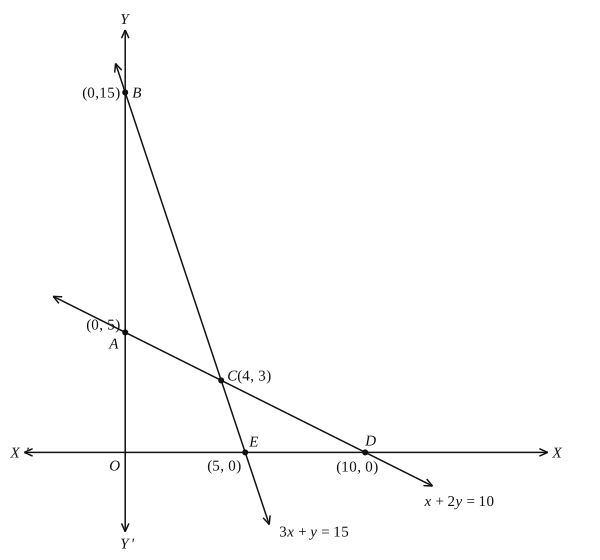
For a Linear Programming Problem (LPP), the given objective function Z = 3x + 2y is subject to constraints : x+2y≤10 3x+y≤15 x,y≥0 The correct feasible region is :
(A)ABC
(B)AOEC
(C)CED
(D)Open unbounded region BCD
Show answer & solution
Answer: (B) AOEC
Both constraints are of the type ≤, so the feasible region lies on the origin side of both lines and in the first quadrant.
On the origin side of x+2y=10 and of 3x+y=15, with x,y≥0, the region is bounded by O, E(5, 0), C(4, 3) and A(0, 5).
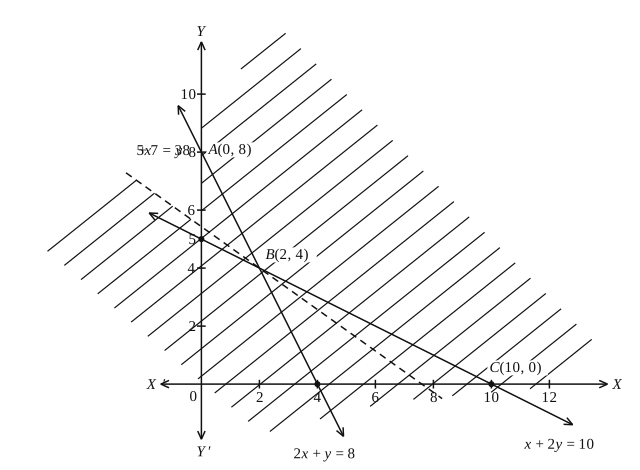
Assertion (A) : The shaded portion of the graph represents the feasible region for the given Linear Programming Problem (LPP). Min Z = 50x + 70y subject to constraints 2x+y≥8, x+2y≥10, x,y≥0 Z = 50x + 70y has a minimum value = 380 at B(2, 4). Reason (R) : The region representing 50x + 70y < 380 does not have any point common with the feasible region.
(A)Both Assertion (A) and Reason (R) are true and Reason (R) is the correct explanation of the Assertion (A).
(B)Both Assertion (A) and Reason (R) are true, but Reason (R) is not the correct explanation of the Assertion (A).
(C)Assertion (A) is true, but Reason (R) is false.
(D)Assertion (A) is false, but Reason (R) is true.
Show answer & solution
Answer: (D) Assertion (A) is false, but Reason (R) is true.
The feasible region for 2x+y≥8, x+2y≥10, x,y≥0 is the unbounded region in the first quadrant lying on or above A(0, 8), B(2, 4), C(10, 0) (away from the origin).
The hatched portion in the graph also covers points below these lines and points outside the first quadrant, so it is not the feasible region: Assertion is false.
Corner values: Z(A) = 560, Z(B) = 100 + 280 = 380, Z(C) = 500, smallest is 380 at B.
The line 5x+7y=38 (i.e. 50x+70y=380) has slope −75, between the slopes −2 and −21 of the two boundary lines, so it meets the feasible region only at B and the half-plane 50x+70y<380 has no common point with it: Reason is true.
The radius of a cylinder is decreasing at a rate of 2 cm/s and the altitude is increasing at the rate of 3 cm/s. Find the rate of change of volume of this cylinder when its radius is 4 cm and altitude is 6 cm.
Show answer & solution
Answer:−48π cm³/s, i.e. the volume is decreasing at 48π cm³/s
V=πr2h⇒dtdV=π(2rhdtdr+r2dtdh)
With r=4, h=6, dtdr=−2, dtdh=3:
dtdV=π(2⋅4⋅6⋅(−2)+16⋅3)=π(−96+48)=−48π cm³/s
So the volume is decreasing at the rate of 48π cm³/s.
A man needs to hang two lanterns on a straight wire whose end points have coordinates A (4, 1, – 2) and B (6, 2, – 3). Find the coordinates of the points where he hangs the lanterns such that these points trisect the wire AB.
Show answer & solution
Answer:(314,34,−37) and (316,35,−38)
The points of trisection divide AB internally in the ratios 1 : 2 and 2 : 1.
The probability that a student buys a colouring book is 0.7 and that she buys a box of colours is 0.2. The probability that she buys a colouring book, given that she buys a box of colours, is 0.3. Find the probability that the student : (i) Buys both the colouring book and the box of colours. (ii) Buys a box of colours given that she buys the colouring book.
Show answer & solution
Answer: (i) 0.06 (ii) 353
Let C: buys a colouring book, B: buys a box of colours. P(C)=0.7, P(B)=0.2, P(C∣B)=0.3.
Q27 (OR) (OR)3 marksShort AnswerProbabilityNot in current syllabus
A person has a fruit box that contains 6 apples and 4 oranges. He picks out a fruit three times, one after the other, after replacing the previous one in the box. Find : (i) The probability distribution of the number of oranges he draws. (ii) The expectation of the random variable (number of oranges).
Show answer & solution
Answer: (i) X = 0, 1, 2, 3 with P(X) = 12527,12554,12536,1258 (ii) E(X)=56
Let X = number of oranges drawn. Draws are with replacement, so each draw gives an orange with probability p=104=52, q=53.
In the Linear Programming Problem (LPP), find the point/points giving maximum value for Z = 5x + 10y subject to constraints x+2y≤120 x+y≥60 x−2y≥0 x,y≥0
Show answer & solution
Answer: Maximum Z = 600 at (120, 0) and (60, 30), and at every point on the segment joining them.
Corner points of the (bounded) feasible region:
x+y=60 and x−2y=0 give (40, 20); x+2y=120 and x−2y=0 give (60, 30); (60, 0) and (120, 0) on the x-axis.
Z at (60, 0) = 300; at (120, 0) = 600; at (60, 30) = 300 + 300 = 600; at (40, 20) = 200 + 200 = 400.
Maximum Z = 600 occurs at both (120, 0) and (60, 30).
Hence every point on the line segment joining (120, 0) and (60, 30) gives the maximum value 600.
Draw a rough sketch of the curve y=x. Using integration, find the area of the region bounded by the curve y=x, x = 4 and x-axis, in the first quadrant.
Show answer & solution
Answer:316 sq units
y=x is the upper half of the parabola y2=x (starting at the origin, rising to the right); at x=4, y=2.
The region lies between the curve, the x-axis and the line x=4.
An amount of ₹ 10,000 is put into three investments at the rate of 10%, 12% and 15% per annum. The combined annual income of all three investments is ₹ 1,310, however the combined annual income of the first and the second investments is ₹ 190 short of the income from the third. Use matrix method and find the investment amount in each at the beginning of the year.
Show answer & solution
Answer: ₹ 2,000 at 10%, ₹ 3,000 at 12% and ₹ 5,000 at 15%
Let the amounts be ₹ x, ₹ y, ₹ z at 10%, 12%, 15%.
A gardener wanted to plant vegetables in his garden. Hence he bought 10 seeds of brinjal plant, 12 seeds of cabbage plant and 8 seeds of radish plant. The shopkeeper assured him of germination probabilities of brinjal, cabbage and radish to be 25%, 35% and 40% respectively. But before he could plant the seeds, they got mixed up in the bag and he had to sow them randomly. Based upon the above information, answer the following questions : (i) Calculate the probability of a randomly chosen seed to germinate. (2) (ii) What is the probability that it is a cabbage seed, given that the chosen seed germinates ? (2)
Show answer & solution
Answer: (i) 0.33 (ii) 3314
Let E1,E2,E3: the seed is brinjal, cabbage, radish; G: the seed germinates.
A carpenter needs to make a wooden cuboidal box, closed from all sides, which has a square base and fixed volume. Since he is short of the paint required to paint the box on completion, he wants the surface area to be minimum. On the basis of the above information, answer the following questions : (i) Taking length = breadth = x m and height = y m, express the surface area (S) of the box in terms of x and its volume (V), which is constant. (1) (ii) Find dxdS. (1) (iii) (a) Find a relation between x and y such that the surface area (S) is minimum. (2) OR (iii) (b) If surface area (S) is constant, the volume (V) =41(Sx−2x3), x being the edge of base. Show that volume (V) is maximum for x=6S. (2)
Show answer & solution
Answer: (i) S=2x2+x4V (ii) dxdS=4x−x24V (iii)(a) x=y (the box is a cube) OR (iii)(b) Proved.
(i) V=x2y⇒y=x2V; S=2x2+4xy=2x2+x4V
(ii) dxdS=4x−x24V
(iii)(a) dxdS=0⇒x3=V=x2y⇒y=x; dx2d2S=4+x38V>0, so S is minimum when x=y.
Let A be the set of 30 students of class XII in a school. Let f:A→N, N is a set of natural numbers such that function f(x) = Roll Number of student x. On the basis of the given information, answer the following : (i) Is f a bijective function ? (1) (ii) Give reasons to support your answer to (i). (1) (iii) (a) Let R be a relation defined by the teacher to plan the seating arrangement of students in pairs, where R = {(x, y) : x, y are Roll Numbers of students such that y = 3x}. List the elements of R. Is the relation R reflexive, symmetric and transitive ? Justify your answer. (2) OR (iii) (b) Let R be a relation defined by R = {(x, y) : x, y are Roll Numbers of students such that y=x3}. List the elements of R. Is R a function ? Justify your answer. (2)
Show answer & solution
Answer: (i) No (ii) f is one-one (different students have different roll numbers) but not onto, since only 30 natural numbers are images (iii)(a) R = {(1, 3), (2, 6), (3, 9), (4, 12), (5, 15), (6, 18), (7, 21), (8, 24), (9, 27), (10, 30)}; R is neither reflexive, nor symmetric, nor transitive OR (iii)(b) R = {(1, 1), (2, 8), (3, 27)}; R is not a function on the set of roll numbers, since roll numbers 4 to 30 have no image
(i) and (ii) Two different students cannot have the same roll number, so f is one-one. The codomain N is infinite but the range has only 30 elements, so f is not onto. Hence f is not bijective.
(iii)(a) Taking roll numbers 1 to 30: R = {(1, 3), (2, 6), (3, 9), (4, 12), (5, 15), (6, 18), (7, 21), (8, 24), (9, 27), (10, 30)}.
Not reflexive: (1, 1) ∉ R. Not symmetric: (1, 3) ∈ R but (3, 1) ∉ R. Not transitive: (1, 3), (3, 9) ∈ R but (1, 9) ∉ R.
(iii)(b) y=x3≤30 only for x=1,2,3: R = {(1, 1), (2, 8), (3, 27)}.
Each of 1, 2, 3 has exactly one image, but roll numbers 4 to 30 have no image, so R is not a function from the set of roll numbers to itself (it is a function only on its domain {1, 2, 3}).