CBSE Class 12 Maths 2025 Question Paper 65/2/1 with Solutions
All 45 questions from the CBSE Class 12 Mathematics board paper, Set 65/2/1 (2025),
with answers and step-by-step solutions. Total 80 marks. Tap “Show answer & solution” under any question.
Four friends Abhay, Bina, Chhaya and Devesh were asked to simplify 4AB+3(AB+BA)−4BA, where A and B are both matrices of order 2×2. It is known that A=B=I and A−1=B. Their answers are given as : Abhay : 6AB Bina : 7AB−BA Chhaya : 8AB Devesh : 7BA−AB Who answered it correctly ?
(A)Abhay
(B)Bina
(C)Chhaya
(D)Devesh
Show answer & solution
Answer: (B) Bina
4AB+3(AB+BA)−4BA=4AB+3AB+3BA−4BA.
=7AB−BA.
Matrix multiplication is not commutative in general, so AB and BA cannot be combined.
A cylindrical tank of radius 10 cm is being filled with sugar at the rate of 100π cm3/s. The rate, at which the height of the sugar inside the tank is increasing, is :
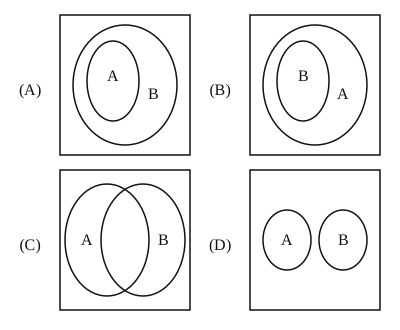
If A denotes the set of continuous functions and B denotes set of differentiable functions, then which of the following depicts the correct relation between set A and B ?
(A)Figure (A): set A drawn inside set B
(B)Figure (B): set B drawn inside set A
(C)Figure (C): sets A and B drawn overlapping
(D)Figure (D): sets A and B drawn separate (disjoint)
Show answer & solution
Answer: (B) Set B drawn inside set A
Every differentiable function is continuous, so B⊆A.
Not every continuous function is differentiable (e.g. ∣x∣ at x=0), so B is a proper subset of A.
The figure with B inside A, option (B), is correct.
A factory produces two products X and Y. The profit earned by selling X and Y is represented by the objective function Z=5x+7y, where x and y are the number of units of X and Y respectively sold. Which of the following statement is correct ?
(A)The objective function maximizes the difference of the profit earned from products X and Y.
(B)The objective function measures the total production of products X and Y.
(C)The objective function maximizes the combined profit earned from selling X and Y.
(D)The objective function ensures the company produces more of product X than product Y.
Show answer & solution
Answer: (C) The objective function maximizes the combined profit earned from selling X and Y.
Z=5x+7y adds the profit from X (5x) and the profit from Y (7y).
So Z is the combined (total) profit, which is to be maximised.
It is not a difference, not total production, and it does not force more X than Y.
Assertion (A) : A=diag[352] is a scalar matrix of order 3×3. Reason (R) : If a diagonal matrix has all non-zero elements equal, it is known as a scalar matrix.
(A)Both Assertion (A) and Reason (R) are true and the Reason (R) is the correct explanation of the Assertion (A).
(B)Both Assertion (A) and Reason (R) are true, but Reason (R) is not the correct explanation of the Assertion (A).
(C)Assertion (A) is true but Reason (R) is false.
(D)Assertion (A) is false but Reason (R) is true.
Show answer & solution
Answer: (D) Assertion (A) is false but Reason (R) is true.
A scalar matrix is a diagonal matrix whose diagonal elements are all equal.
In diag[352] the diagonal elements 3, 5, 2 are not equal, so it is not a scalar matrix: (A) is false.
(R) describes a scalar matrix correctly (the non-zero elements of a diagonal matrix lie on the diagonal), so (R) is true.
Assertion (A) : Every point of the feasible region of a Linear Programming Problem is an optimal solution. Reason (R) : The optimal solution for a Linear Programming Problem exists only at one or more corner point(s) of the feasible region.
(A)Both Assertion (A) and Reason (R) are true and the Reason (R) is the correct explanation of the Assertion (A).
(B)Both Assertion (A) and Reason (R) are true, but Reason (R) is not the correct explanation of the Assertion (A).
(C)Assertion (A) is true but Reason (R) is false.
(D)Assertion (A) is false but Reason (R) is true.
Show answer & solution
Answer: (D) Assertion (A) is false but Reason (R) is true.
Every point of the feasible region is a feasible solution, but only the point(s) giving the best value of Z are optimal. So (A) is false.
By the corner point theorem, if an optimal value exists it occurs at a corner point (or along an edge joining two optimal corner points). So (R) is taken as true.
Let R be a relation defined over N, where N is set of natural numbers, defined as “mRn if and only if m is a multiple of n, m, n ∈ N.” Find whether R is reflexive, symmetric and transitive or not.
Show answer & solution
Answer: R is reflexive and transitive but not symmetric.
Reflexive: m=1⋅m, so m is a multiple of m and (m,m)∈R for all m∈N. R is reflexive.
Symmetric: (4,2)∈R since 4 is a multiple of 2, but (2,4)∈/R since 2 is not a multiple of 4. R is not symmetric.
Transitive: if mRn and nRp, then m=kn and n=lp for some k,l∈N, so m=(kl)p and mRp. R is transitive.
Q303 marksShort AnswerProbabilityNot in current syllabus
A die with number 1 to 6 is biased such that P(2)=103 and probability of other numbers is equal. Find the mean of the number of times number 2 appears on the dice, if the dice is thrown twice.
Show answer & solution
Answer: Mean =53
Let X = number of times 2 appears in two throws; X = 0, 1, 2. (The other numbers each have probability 507, which is not needed.)
Two dice are thrown. Defined are the following two events A and B : A={(x,y):x+y=9}, B={(x,y):x=3}, where (x,y) denote a point in the sample space. Check if events A and B are independent or mutually exclusive.
Show answer & solution
Answer: A and B are neither independent nor mutually exclusive.
Sample space has 36 outcomes.
A={(3,6),(4,5),(5,4),(6,3)}, so P(A)=364=91.
B has 36−6=30 outcomes, so P(B)=65.
A∩B={(4,5),(5,4),(6,3)}, so P(A∩B)=363=121.
P(A)P(B)=91⋅65=545=121, so A and B are not independent.
Find the image A′ of the point A(2, 1, 2) in the line l:r=4i^+2j^+2k^+λ(i^−j^−k^). Also, find the equation of line joining AA′. Find the foot of perpendicular from point A on the line l.
Show answer & solution
Answer: Foot of perpendicular (311,37,37); image A′(316,311,38); line AA′: 5x−2=4y−1=1z−2
A general point of l is P(4+λ,2−λ,2−λ).
AP=(2+λ)i^+(1−λ)j^−λk^.
AP⊥l: (2+λ)−(1−λ)+λ=0, so 1+3λ=0, λ=−31.
Foot of perpendicular P(311,37,37).
P is the mid-point of AA′, so A′=2P−A=(322−2,314−1,314−2)=(316,311,38).
Direction of AA′ =(310,38,32)∝(5,4,1).
Line AA′: 5x−2=4y−1=1z−2, i.e. r=2i^+j^+2k^+μ(5i^+4j^+k^).
A school is organizing a debate competition with participants as speakers S={S1,S2,S3,S4} and these are judged by judges J={J1,J2,J3}. Each speaker can be assigned one judge. Let R be a relation from set S to J defined as R={(x,y):speaker x is judged by judge y,x∈S,y∈J}. Based on the above, answer the following : (i) How many relations can be there from S to J ? (1) (ii) A student identifies a function from S to J as f={(S1,J1),(S2,J2),(S3,J2),(S4,J3)} Check if it is bijective. (1) (iii) (a) How many one-one functions can be there from set S to set J ? (2) OR (iii) (b) Another student considers a relation R1={(S1,S2),{S2,S4)} in set S. Write minimum ordered pairs to be included in R1 so that R1 is reflexive but not symmetric. (2)
Show answer & solution
Answer: (i) 212=4096 (ii) Not bijective (it is onto but not one-one) (iii) (a) 0 OR (iii) (b) (S1,S1),(S2,S2),(S3,S3),(S4,S4)
(i) n(S×J)=4×3=12, so the number of relations is 212=4096.
(ii) f(S2)=f(S3)=J2, so f is not one-one; hence f is not bijective (it is onto, since J1,J2,J3 all have pre-images).
(iii) (a) A one-one function from S to J needs n(S)≤n(J); here 4>3, so the number of one-one functions is 0.
OR (iii) (b) For reflexivity R1 must contain (S1,S1),(S2,S2),(S3,S3),(S4,S4).
Adding just these four pairs makes R1 reflexive; it stays non-symmetric because (S1,S2)∈R1 but (S2,S1)∈/R1.
Three persons viz. Amber, Bonzi and Comet are manufacturing cars which run on petrol and on battery as well. Their production share in the market is 60%, 30% and 10% respectively. Of their respective production capacities, 20%, 10% and 5% cars respectively are electric (or battery operated). Based on the above, answer the following : (i) (a) What is the probability that a randomly selected car is an electric car ? (2) OR (i) (b) What is the probability that a randomly selected car is a petrol car ? (2) (ii) A car is selected at random and is found to be electric. What is the probability that it was manufactured by Comet ? (1) (iii) A car is selected at random and is found to be electric. What is the probability that it was manufactured by Amber or Bonzi ? (1)
Show answer & solution
Answer: (i) (a) 0.155(=20031) OR (i) (b) 0.845(=200169) (ii) 311 (iii) 3130
Let E1,E2,E3 be the events that the car is made by Amber, Bonzi, Comet, and E that it is electric.
A small town is analyzing the pattern of a new street light installation. The lights are set up in such a way that the intensity of light at any point x metres from the start of the street can be modelled by f(x)=exsinx, where x is in metres. Based on the above, answer the following : (i) Find the intervals on which the f(x) is increasing or decreasing, x∈[0,π]. (2) (ii) Verify, whether each critical point when x∈[0,π] is a point of local maximum or local minimum or a point of inflexion. (2)
Show answer & solution
Answer: (i) Increasing on [0,43π], decreasing on [43π,π] (ii) x=43π is the only critical point in (0,π) and it is a point of local maximum