CBSE Class 12 Maths 2025 Question Paper 65/6/3 with Solutions
All 45 questions from the CBSE Class 12 Mathematics board paper, Set 65/6/3 (2025),
with answers and step-by-step solutions. Total 80 marks. Tap “Show answer & solution” under any question.
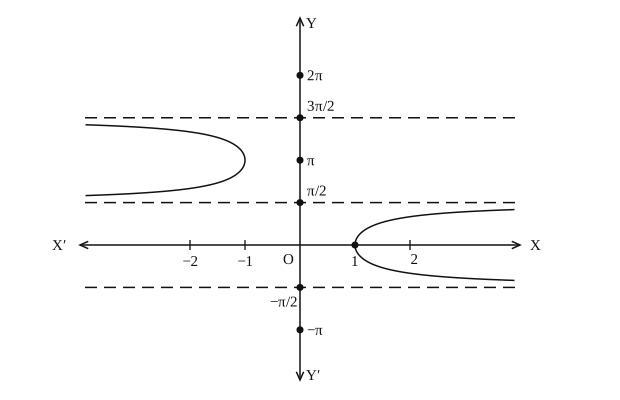
The curves exist only for x≤−1 and x≥1, and every vertical line meets the graph in more than one point, so it is not a graph of sec x or cosec x as a function of x.
The right branch passes through (1,0) and approaches y=±2π; the left branch passes through (−1,π) between y=2π and y=23π.
These are points of x=secy (sec0=1, secπ=−1, asymptotes where cosy=0).
So the graph shows y=sec−1x (cosec⁻¹x would pass through (1,2π)).
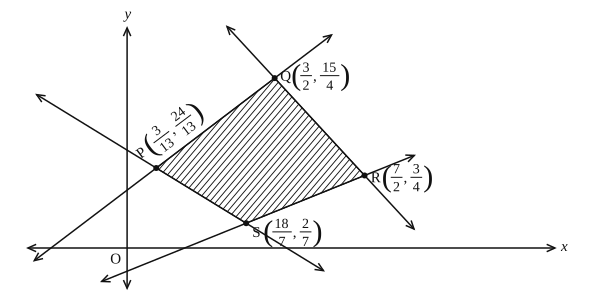
For a Linear Programming Problem (LPP), the given objective function is Z=x+2y. The feasible region PQRS determined by the set of constraints is shown as a shaded region in the graph. (Note : The figure is not to scale) P≡(133,1324), Q≡(23,415), R≡(27,43), S≡(718,72) Which of the following statements is correct ?
(A)Z is minimum at S(718,72)
(B)Z is maximum at R(27,43)
(C)(Value of Z at P) > (Value of Z at Q)
(D)(Value of Z at Q) < (Value of Z at R)
Show answer & solution
Answer: (A) Z is minimum at S(718,72)
Z at P =133+1348=1351≈3.92.
Z at Q =23+215=9.
Z at R =27+23=5.
Z at S =718+74=722≈3.14.
The region is bounded, so Z is minimum at S and maximum at Q.
(C) and (D) are false since Z at Q (9) is the largest value. So (A) is correct.
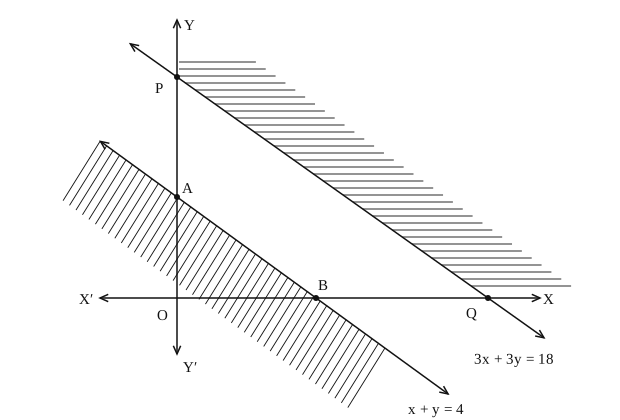
In a Linear Programming Problem (LPP), the objective function Z=2x+5y is to be maximised under the following constraints : x+y≤4, 3x+3y≥18, x,y≥0 Study the graph and select the correct option. (Note : The figure is not to scale) The solution of the given LPP :
(A)lies in the shaded unbounded region.
(B)lies in △ AOB.
(C)does not exist.
(D)lies in the combined region of △ AOB and unbounded shaded region.
Show answer & solution
Answer: (C) does not exist.
3x+3y≥18 means x+y≥6.
No point can satisfy both x+y≤4 and x+y≥6.
The two shaded regions have no common part, so there is no feasible region.
A meeting will be held only if all three members A, B and C are present. The probability that member A does not turn up is 0.10, member B does not turn up is 0.20 and member C does not turn up is 0.05. The probability of the meeting being cancelled is :
Let the position vectors of the points A, B and C be 3i^−j^−2k^, i^+2j^−k^ and i^+5j^+3k^ respectively. Find the vector and cartesian equations of the line passing through A and parallel to line BC.
Consider the Linear Programming Problem, where the objective function Z=(x+4y) needs to be minimized subject to constraints 2x+y≥1000 x+2y≥800 x,y≥0. Draw a neat graph of the feasible region and find the minimum value of Z.
Show answer & solution
Answer: Minimum Z = 800 at (800, 0).
Draw 2x+y=1000 through (500,0), (0,1000) and x+2y=800 through (800,0), (0,400).
The feasible region lies on the side away from the origin of both lines, in the first quadrant; it is unbounded.
They meet where x=800−2y and 2(800−2y)+y=1000, giving y=200, x=400.
Corner points: (0,1000), (400,200), (800,0).
Z values: Z(0,1000)=4000, Z(400,200)=1200, Z(800,0)=800.
Smallest is 800. Check the half-plane x+4y<800: with x+2y≥800 it needs y<0, so it has no point in common with the region.
A student wants to pair up natural numbers in such a way that they satisfy the equation 2x+y=41, x,y∈N. Find the domain and range of the relation. Check if the relation thus formed is reflexive, symmetric and transitive. Hence, state whether it is an equivalence relation or not.
Show answer & solution
Answer: Domain ={1,2,3,…,20}, Range ={1,3,5,…,39}; not reflexive, not symmetric, not transitive; not an equivalence relation.
R={(x,y):2x+y=41,x,y∈N}, so y=41−2x≥1 gives x≤20.
R={(1,39),(2,37),(3,35),…,(19,3),(20,1)}.
Domain ={1,2,…,20}; Range ={39,37,…,3,1} = odd numbers from 1 to 39.
Not reflexive: (1,1)∈/R since 2+1=41.
Not symmetric: (1,39)∈R but (39,1)∈/R since 78+1=41.
Not transitive: (19,3)∈R and (3,35)∈R, but (19,35)∈/R since 38+35=41.
Bag I contains 4 white and 5 black balls. Bag II contains 6 white and 7 black balls. A ball drawn randomly by from bag I is transferred to bag II and then a ball is drawn randomly from bag II. Find the probability that the ball drawn is white.
Show answer & solution
Answer:6329
Let E1: white ball transferred, E2: black ball transferred; P(E1)=94, P(E2)=95.
If white is transferred, bag II has 7 white, 7 black: P(W∣E1)=147.
If black is transferred, bag II has 6 white, 8 black: P(W∣E2)=146.
A ladder of fixed length ‘h’ is to be placed along the wall such that it is free to move along the height of the wall. Based upon the above information, answer the following questions : (i) Express the distance (y) between the wall and foot of the ladder in terms of ‘h’ and height (x) on the wall at a certain instant. Also, write an expression in terms of h and x for the area (A) of the right triangle, as seen from the side by an observer. (1) (ii) Find the derivative of the area (A) with respect to the height on the wall (x), and find its critical point. (1) (iii) (a) Show that the area (A) of the right triangle is maximum at the critical point. (2) OR (iii) (b) If the foot of the ladder whose length is 5 m, is being pulled towards the wall such that the rate of decrease of distance (y) is 2 m/s, then at what rate is the height on the wall (x) increasing, when the foot of the ladder is 3 m away from the wall ? (2)
Show answer & solution
Answer: (i) y=h2−x2, A=21xh2−x2 (ii) dxdA=2h2−x2h2−2x2, critical point x=2h (iii) (a) Proved. OR (iii) (b) 23 m/s
(i) By Pythagoras, x2+y2=h2, so y=h2−x2.
A=21xy=21xh2−x2.
(ii) dxdA=21[h2−x2−h2−x2x2]=2h2−x2h2−2x2.
dxdA=0 gives x=2h (x > 0).
(iii) (a) For 0<x<2h, h2−2x2>0 so dxdA>0; for 2h<x<h, dxdA<0.
dxdA changes from positive to negative at x=2h, so A is maximum there.
(iii) (b) x2+y2=25; when y=3, x=4.
Differentiating: 2xdtdx+2ydtdy=0, with dtdy=−2.
A shop selling electronic items sells smartphones of only three reputed companies A, B and C because chances of their manufacturing a defective smartphone are only 5%, 4% and 2% respectively. In his inventory he has 25% smartphones from company A, 35% smartphones from company B and 40% smartphones from company C. A person buys a smartphone from this shop. (i) Find the probability that it was defective. (2) (ii) What is the probability that this defective smartphone was manufactured by company B ? (2)
Show answer & solution
Answer: (i) 0.0345 (ii) 6928
Let E1,E2,E3 be: phone from A, B, C; D: phone is defective.
Three students, Neha, Rani and Sam go to a market to purchase stationery items. Neha buys 4 pens, 3 notepads and 2 erasers and pays ₹ 60. Rani buys 2 pens, 4 notepads and 6 erasers for ₹ 90. Sam pays ₹ 70 for 6 pens, 2 notepads and 3 erasers. Based upon the above information, answer the following questions : (i) Form the equations required to solve the problem of finding the price of each item, and express it in the matrix form AX = B. (1) (ii) Find |A| and confirm if it is possible to find A−1. (1) (iii) (a) Find A−1, if possible, and write the formula to find X. (2) OR (iii) (b) Find A2−8I, where I is an identity matrix. (2)
Show answer & solution
Answer: (i) 4x+3y+2z=60, 2x+4y+6z=90, 6x+2y+3z=70; 426342263xyz=609070 (ii) ∣A∣=50=0, so A−1 exists (iii) (a) A−1=501030−20−501010−2010, X=A−1B (pen ₹ 5, notepad ₹ 8, eraser ₹ 8) OR (iii) (b) A2−8I=265246282632324625
(i) Let the prices of a pen, a notepad and an eraser be ₹ x, ₹ y, ₹ z.
4x+3y+2z=60, 2x+4y+6z=90, 6x+2y+3z=70.
A=426342263, X=xyz, B=609070.
(ii) ∣A∣=4(12−12)−3(6−36)+2(4−24)=0+90−40=50=0, so A is non-singular and A−1 exists.