Application of Derivatives: 2 marks Questions (CBSE Class 12)
12 different 2 marks questions on Application of Derivatives from CBSE Class 12 Maths board exams 2026, newest first.
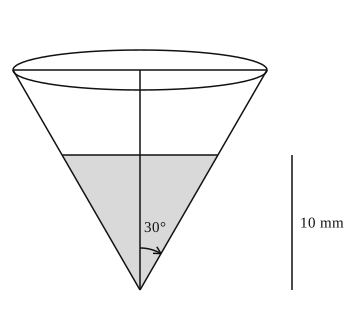
A room freshner bottle in the shape of an inverted cone sprays the perfume at regular intervals such that volume of the perfume in the bottle decreases at the steady rate of 1 mm3 6 π
Show answer & solution
Answer: The level is dropping at 100 π 3
Let h be the level of perfume and r the radius of its surface. Then r = h tan 6 π = 3 h V = 3 1 π r 2 h = 9 π h 3 d t d V = 3 π h 2 d t d h With d t d V = − 1 h = 10 − 1 = 3 100 π d t d h ⇒ d t d h = − 100 π 3 So the level drops at 100 π 3
Find the absolute maximum value of f ( x ) = cos x + sin 2 x x ∈ [ 0 , π ]
Show answer & solution
Answer: 4 5 x = 3 π
f ′ ( x ) = − sin x + 2 sin x cos x = sin x ( 2 cos x − 1 ) f ′ ( x ) = 0 ⇒ x = 0 , π cos x = 2 1 ⇒ x = 3 π f ( 0 ) = 1 f ( 3 π ) = 2 1 + 4 3 = 4 5 f ( π ) = − 1 Absolute maximum value = 4 5
If the volume of a solid hemisphere increases at a uniform rate, prove that its surface area varies inversely as its radius.
Show answer & solution
Answer: Proved.
Let r be the radius. V = 3 2 π r 3 d t d V = k d t d V = 2 π r 2 d t d r = k ⇒ d t d r = 2 π r 2 k Total surface area of a solid hemisphere S = 2 π r 2 + π r 2 = 3 π r 2 d t d S = 6 π r d t d r = 6 π r ⋅ 2 π r 2 k = r 3 k So the rate of change of the surface area varies inversely as the radius.
Find the sub-interval(s) of ( 0 , 2 π ) f ( x ) = tan x − 4 x
Show answer & solution
Answer: ( 3 π , 2 π )
f ′ ( x ) = sec 2 x − 4 f ′ ( x ) > 0 ⟺ sec 2 x > 4 ⟺ cos 2 x < 4 1 ⟺ cos x < 2 1 In ( 0 , 2 π ) x > 3 π f is increasing on ( 3 π , 2 π ) ( 0 , 3 π )
Find the sub-interval of ( 0 , ∞ ) f ( x ) = x 2 e − x
Show answer & solution
Answer: ( 0 , 2 )
f ′ ( x ) = 2 x e − x − x 2 e − x = x e − x ( 2 − x ) For x > 0 x e − x > 0 f ′ ( x ) > 0 ⟺ x < 2 f is increasing on ( 0 , 2 ) ( 2 , ∞ )
Find the sub-interval of ( 0 , ∞ ) f ( x ) = x log x
Show answer & solution
Answer: ( e 1 , ∞ )
f ′ ( x ) = log x + 1 f ′ ( x ) > 0 ⟺ log x > − 1 ⟺ x > e 1 f is increasing on ( e 1 , ∞ ) ( 0 , e 1 )
Find the values of x for which f ( x ) = x x x > 0
Show answer & solution
Answer: x ≥ e 1 [ e 1 , ∞ )
log f = x log x ⇒ f ( x ) f ′ ( x ) = log x + 1 f ′ ( x ) = x x ( 1 + log x ) x x > 0 f ′ ( x ) > 0 ⟺ log x > − 1 ⟺ x > e 1 f ′ ( x ) = 0 x = e 1 [ e 1 , ∞ )
Find the interval(s) in which the function f ( x ) = l o g x x x ∈ ( 0 , 1 ) ∪ ( 1 , ∞ )
Show answer & solution
Answer: f is increasing on [ e , ∞ )
f ′ ( x ) = ( l o g x ) 2 l o g x − x ⋅ x 1 = ( l o g x ) 2 l o g x − 1 ( log x ) 2 > 0 f ′ ( x ) > 0 ⟺ log x > 1 ⟺ x > e f ′ ( x ) < 0 ( 0 , 1 ) ( 1 , e ) f ′ ( e ) = 0 [ e , ∞ )
Find the interval(s) for which the function f ( x ) = 3 x + x 3 x = 0
Show answer & solution
Answer: ( − ∞ , − 3 ] [ 3 , ∞ )
f ′ ( x ) = 3 1 − x 2 3 = 3 x 2 x 2 − 9 f ′ ( x ) > 0 ⟺ x 2 > 9 ⟺ x < − 3 x > 3 f ′ ( x ) = 0 x = ± 3 So f is increasing on ( − ∞ , − 3 ] [ 3 , ∞ )
Determine the values of x for which f ( x ) = x + 1 x − 3 x = − 1
Show answer & solution
Answer: f is increasing for all real x = − 1 ( − ∞ , − 1 ) ( − 1 , ∞ )
f ′ ( x ) = ( x + 1 ) 2 ( x + 1 ) − ( x − 3 ) = ( x + 1 ) 2 4 f ′ ( x ) > 0 x = − 1 So f is increasing on ( − ∞ , − 1 ) ( − 1 , ∞ )
Determine the interval(s) in which f ( x ) = 5 x 3/2 − 3 x 5/2 x > 0
Show answer & solution
Answer: f is increasing on ( 0 , 1 )
f ′ ( x ) = 2 15 x 1/2 − 2 15 x 3/2 = 2 15 x ( 1 − x ) For x > 0 x > 0 f ′ ( x ) > 0 0 < x < 1 f ′ ( x ) < 0 x > 1 So f is increasing on ( 0 , 1 )
Determine the interval(s) in which f ( x ) = 3 x + x 3 x = 0
Show answer & solution
Answer: f is increasing on ( − ∞ , − 3 ] [ 3 , ∞ )
f ′ ( x ) = 3 1 − x 2 3 = 3 x 2 x 2 − 9 = 3 x 2 ( x − 3 ) ( x + 3 ) f ′ ( x ) > 0 x < − 3 x > 3 f ′ ( x ) < 0 − 3 < x < 0 0 < x < 3 So f is increasing on ( − ∞ , − 3 ] [ 3 , ∞ )
Practise smarter: chapter-wise revision, formula sheets and step-by-step NCERT solutions on
MonoMath CBSE →