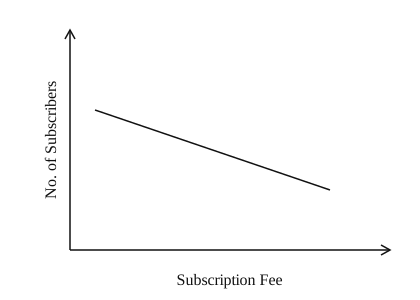
An online delivery company in a city has 5000 subscribers and collects annual subscription fees of ₹ 300 per subscriber for unlimited free deliveries. The company wishes to increase the annual subscription fee. It is predicted that, for every increase of ₹ 1, ten subscribers will discontinue. Assume that the company increased the annual fee by ₹ x. Based on the given information, answer the following questions : (i) How many subscribers will discontinue after an increase of ₹ x in annual fee ? (1) (ii) If R(x) denotes the total revenue collected after the increase of ₹ x in subscription fee, express R(x) as a function of x. (1) (iii) Find the value of x for which R(x) is maximum. (2) OR (iii) Find the sub-intervals of (0, 5000) in which R(x) is increasing and decreasing. (2)
Show answer & solution
Answer: (i) 10x (ii) R(x)=(300+x)(5000−10x) (iii) x=100; OR increasing on (0, 100), decreasing on (100, 5000)
(i) 10 subscribers leave per ₹ 1 increase, so 10x subscribers discontinue.
(ii) Fee =300+x, subscribers =5000−10x, so R(x)=(300+x)(5000−10x)=1500000+2000x−10x2.
(iii) R′(x)=2000−20x=0⇒x=100. R′′(x)=−20<0, so R is maximum at x=100.
OR (iii) R′(x)=20(100−x): R′(x)>0 on (0, 100) and R′(x)<0 on (100, 5000).
So R is increasing on (0, 100) and decreasing on (100, 5000).
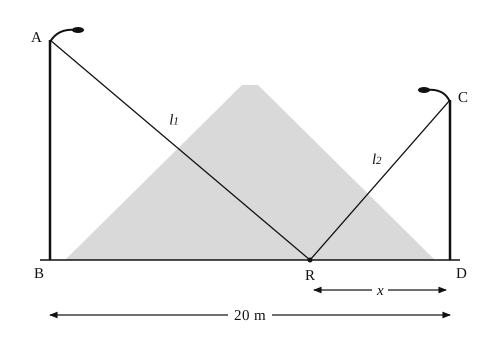
Two vertical light poles of height 22 m and 16 m stand on the opposite sides of a 20 m wide road as shown below in the figure. Two ladders of length l1 and l2 are placed from a common point R on the road at a distance of x m from the smaller pole. Based on the above information, answer the following questions : (i) Express p(x)=l1+l2 in terms of x. (1) (ii) Find p′(x). (1) (iii) (a) Find the value of x for which l12+l22 is minimum. (2) OR (iii) (b) If the 22 m long pole is also replaced by a 16 m long pole, at what distance from either pole should the ladders be kept so that the sum of squares of lengths of ladders needed to reach the top of the pole is minimum ? (2)
Show answer & solution
Answer: (i) p(x)=x2−40x+884+x2+256 (ii) p′(x)=x2−40x+884x−20+x2+256x (iii)(a) x=10 m (iii)(b) 10 m from each pole
(i) R is x m from the 16 m pole and (20−x) m from the 22 m pole.
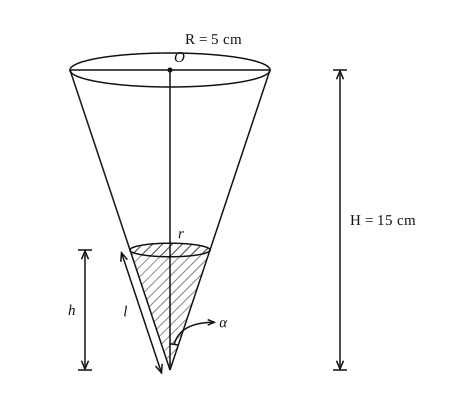
At a birthday party, children are being served orange juice in conical cups, as shown in the figure. Each cup is 15 cm deep and has a radius 5 cm. The juice is being poured into this cup at a rate of 0.1 cm3/s. On the basis of the above information, answer the following questions : (i) Establish a relation between the height h of the juice in the cup and radius r of the surface of the juice in the cup, if the semi-vertical angle of the cone is α. (1) (ii) At what rate is the juice level in the cup rising when the juice is 6 cm deep ? (1) (iii) When the juice is 6 cm deep, then find at what rate is the upper surface area of juice increasing ? (2) OR (iii) When the juice is 6 cm deep, then find the rate at which the wetted surface area of the cup is increasing. (2)
Show answer & solution
Answer: (i) r=htanα, here tanα=155 so r=3h (ii) 40π1 cm/s (iii) 301 cm2/s; OR 3010 cm2/s
(i) In the right triangle formed by the axis, a radius of the juice surface and the slant side, tanα=hr, so r=htanα. For the cup tanα=155=31, so r=3h.
(ii) V=31πr2h=27πh3, so dtdV=9πh2dtdh.
At h=6: 0.1=4πdtdh⇒dtdh=40π1 cm/s.
(iii) Upper surface area A=πr2=9πh2; dtdA=92πhdtdh=912π⋅40π1=301 cm2/s.
OR (iii) Wetted surface S=πrl with l=h2+r2=310h, so S=910πh2.
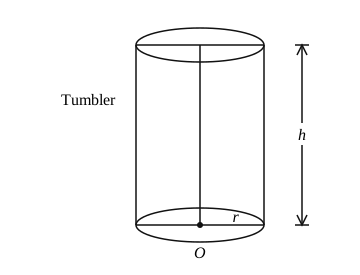
A company produces cylindrical tumblers, open from the top. Since they want uniformity in the product, they fix the surface area of the tumblers produced. Based on the above information, answer the following questions : If for a tumbler, V is its volume, h the height and r the radius of the circular base, then : (i) Differentiate its volume with respect to radius of the base, where the surface area is constant. (2) (ii) If the company wants to maximize the volume of each tumbler, then establish a relation between its height and the radius of the base. (2)
Show answer & solution
Answer: (i) drdV=2S−3πr2, where S is the fixed surface area (ii) h = r
Let the fixed surface area be S=πr2+2πrh, so h=2πrS−πr2.
V=πr2h=2r(S−πr2)=2Sr−πr3.
(i) drdV=2S−3πr2.
(ii) drdV=0⇒S=3πr2⇒πr2+2πrh=3πr2⇒h=r.
dr2d2V=−3πr<0, so V is maximum when h = r (height equals radius of the base).