Inverse Trigonometric Functions: 1 mark Questions (CBSE Class 12)
11 different 1 mark questions on Inverse Trigonometric Functions from CBSE Class 12 Maths board exams 2026, newest first.
If 2cos−1x=y, then
- (A)0≤y≤π
- (B)−π≤y≤π
- (C)0≤y≤2π
- (D)−π≤y≤0
Show answer & solution
Answer: (C) 0≤y≤2π
- The principal value branch of cos−1x has range [0,π].
- So 0≤cos−1x≤π.
- Multiplying by 2: 0≤2cos−1x≤2π, i.e. 0≤y≤2π.
If tan−1x=3y, then
- (A)−2π<y<2π
- (B)−23π<y<23π
- (C)−6π<y<6π
- (D)−6π≤y≤6π
Show answer & solution
Answer: (C) −6π<y<6π
- The range of tan−1x is (−2π,2π).
- So −2π<3y<2π, i.e. −6π<y<6π.
If sin−1x+π=y, then
- (A)−2π≤y≤2π
- (B)−23π≤y≤−2π
- (C)2π≤y≤23π
- (D)0≤y≤π
Show answer & solution
Answer: (C) 2π≤y≤23π
- The range of sin−1x is [−2π,2π].
- Adding π: 2π≤sin−1x+π≤23π, i.e. 2π≤y≤23π.
The domain of f(x)=cos−1(2x−5) is :
- (A)[−1,1]
- (B)[4,6]
- (C)[−7,−3]
- (D)[2,3]
Show answer & solution
Answer: (D) [2,3]
- The domain of cos−1 is [−1,1], so −1≤2x−5≤1.
- Adding 5: 4≤2x≤6, so 2≤x≤3.
- Domain = [2,3].
The domain of sin−1(1−2x) is :
- (A)[−1,1]
- (B)[−1,3]
- (C)[−2,2]
- (D)[0,1]
Show answer & solution
Answer: (D) [0,1]
- Need −1≤1−2x≤1.
- Subtract 1: −2≤−2x≤0; divide by −2: 0≤x≤1.
- Domain = [0,1].
The domain of cos−1(4x+1) is :
- (A)[−1,1]
- (B)[−3,5]
- (C)[−4,4]
- (D)[−21,0]
Show answer & solution
Answer: (D) [−21,0]
- Need −1≤4x+1≤1.
- Subtract 1: −2≤4x≤0, so −21≤x≤0.
- Domain = [−21,0].
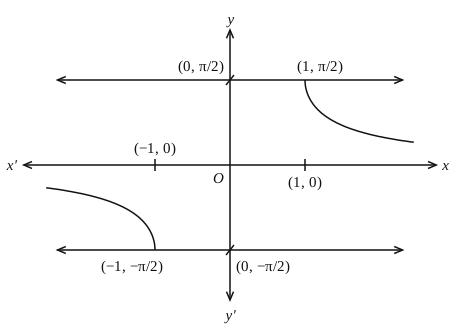
The following graph represents :
- (A)y=cos−1x
- (B)y=sec−1x
- (C)y=tan−1x
- (D)y=cosec−1x
Show answer & solution
Answer: (D) y=cosec−1x
- The graph exists only for x≤−1 and x≥1, so the domain is R−(−1,1).
- It passes through (1,2π) and (−1,−2π) and approaches 0 but never takes the value 0.
- So the range is [−2π,2π]−{0}.
- This is the principal branch of y=cosec−1x.
The principal value of sec−1(2)+2cosec−1(−2) is :
- (A)−2π
- (B)−4π
- (C)4π
- (D)2π
Show answer & solution
Answer: (B) −4π
- sec−1(2)=4π (principal range [0,π]−{2π}).
- cosec−1(−2)=−4π (principal range [−2π,2π]−{0}).
- Value =4π+2(−4π)=−4π.
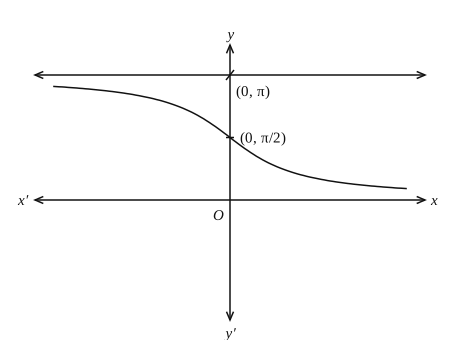
The following graph represents :
- (A)y=sec−1x
- (B)y=cot−1x
- (C)y=tan−1x
- (D)y=cosec−1x
Show answer & solution
Answer: (B) y=cot−1x
- The curve is defined for every real x, so the domain is R.
- It lies between y=0 and y=π without touching them, so the range is (0,π).
- It is decreasing and passes through (0,2π).
- This is the principal branch of y=cot−1x.
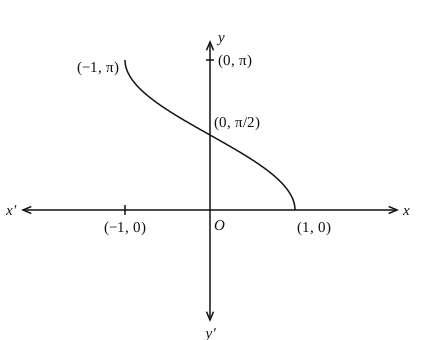
The following graph represents :
- (A)y=cos−1x
- (B)y=sec−1x
- (C)y=sin−1x
- (D)y=tan−1x
Show answer & solution
Answer: (A) y=cos−1x
- The curve exists only for −1≤x≤1, so the domain is [−1,1].
- It goes from (−1,π) through (0,2π) down to (1,0), so the range is [0,π] and it is decreasing.
- This is the principal branch of y=cos−1x.
For the inverse trigonometric functions, which of the following Principal Value Branch is not correctly defined ?
- (A)tan−1:R→(−2π,2π)
- (B)sec−1:R−(−1,1)→[0,π]−{2π}
- (C)cot−1:R→(0,π)
- (D)cosec−1:R−(−1,1)→[−2π,2π]
Show answer & solution
Answer: (D) cosec−1:R−(−1,1)→[−2π,2π]
- The principal value branch of cosec−1 is [−2π,2π]−{0}, since cosecy is not defined at y=0.
- Options (A), (B) and (C) are the standard principal value branches, so (D) is not correctly defined.
Practise smarter: chapter-wise revision, formula sheets and step-by-step NCERT solutions on
MonoMath CBSE →