The first term of an A.P. is 5, the last term is 45 and the sum of all the terms is 400. Find the number of terms and the common difference of the A.P.
Show answer & solution
Answer: Number of terms = 16; common difference =
- : , so .
- : , so .
202 different questions from Arithmetic Progressions (NCERT Chapter 5) asked in CBSE Class 10 Maths board exams 2022–2026. 2 of them came up in more than one year. Pick a mark group to practise, each with answers and step-by-step solutions.
The first term of an A.P. is 5, the last term is 45 and the sum of all the terms is 400. Find the number of terms and the common difference of the A.P.
Three numbers in A.P. have the sum 30. What is its middle term ?
term of the A.P. , ... is :
Assertion (A) : The mean of first 'n' natural numbers is .
Reason (R): The sum of first 'n' natural numbers is .
The term of the A.P. is :
In an A.P., term exceeds the term by 21. If sum of first 10 terms is 55, then form the A.P.
The sum of first n terms of an A.P. is . Find its term and hence term.
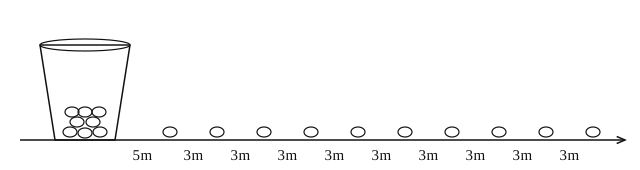
In a potato race, a bucket is placed at the starting point, which is 5 m from the first potato. The other potatoes are arranged 3 m apart in a straight line, with a total of 10 potatoes, as shown in the figure :
A competitor starts from the bucket, picks up the nearest potato, runs back to the bucket to drop it in, then returns to pick up the next potato. This process continues until all the potatoes are in the bucket.
Based on the above information, answer the following questions :
(i) What is the distance covered to pick up the first potato and drop it in bucket ? (1)
(ii) What is the distance covered to pick up the second potato and drop it in bucket ? (1)
(iii) (a) What is the total distance the competitor has to run ? (2)
OR
(iii) (b) If average speed of competitor is 5 m/s, then find the average time taken by competitor to put all the potatoes in the bucket. (2)
Your elder brother wants to buy a car and plans to take a loan from a bank for his car. He repays his total loan of ₹ 1,18,000 by paying every month, starting with the first instalment of ₹ 1,000 and he increases the instalment by ₹ 100 every month.
Based on the information given above, answer the following questions :
(i) Find the amount paid by him in the instalment. (1)
(ii) If the total number of instalments is 40, what is the amount paid in the last instalment ? (1)
(iii) (a) What amount does he still have to pay after the instalment ? (2)
OR
(iii) (b) Find the ratio of the tenth instalment to the last instalment. (2)
‘Kolam’ is a decorative art which is made with rice flour in South Indian States. It is drawn on grid pattern of dots. One such art work is shown below.
Observe the given figure carefully. There are 4 dots in first square, 8 dots in second square, 12 dots in third square and so on.
Based on the above, answer the following questions :
(i) Show that number of dots given above form an A.P. Write the first term and common difference. (1)
(ii) Write term of the A.P. formed. (1)
(iii) (a) The pattern is expanded on a large ground. If total 220 dots are used, then find the number of squares formed. (2)
OR (b) Is it possible to complete n number of squares using 100 dots ? If yes, then find the value of n.