MonoMath CBSE
CBSE Maths › Class 10 PYQs

Quadratic Equations: CBSE Class 10 Previous Year Questions

209 different questions from Quadratic Equations (NCERT Chapter 4) asked in CBSE Class 10 Maths board exams 2022–2026. Pick a mark group to practise, each with answers and step-by-step solutions.

1 mark questions73 questions2 marks questions38 questions3 marks questions23 questions4 marks questions13 questions5 marks questions62 questions

Most asked Quadratic Equations questions

The roots of the quadratic equation are

  1. (A)real and equal
  2. (B)not real
  3. (C)real and negative of each other
  4. (D)rational numbers
Show answer & solution
Answer: (B) not real
  1. Here , , .
  2. .
  3. So the roots are not real.

If the roots of the quadratic equation are real and equal, then the value(s) of is/are :

  1. (A)
  2. (B)0
  3. (C)4
  4. (D)– 5
Show answer & solution
Answer: (A)
  1. Equal roots:
  2. , so

The value of p for which roots of the quadratic equation are rational, is

  1. (A)1
  2. (B)
  3. (C)25
  4. (D)
Show answer & solution
Answer: (B)
  1. Roots are rational when is a perfect square (and p is rational).
  2. : (no real roots).
  3. : , a perfect square; gives , which are rational.
  4. : , not a perfect square. : .
  5. So .

Verify that roots of the quadratic equation are equal when .

Show answer & solution
Answer: Proved.
  1. Given , so .
  2. Then and .
  3. Since , the roots are equal.

Find two consecutive negative integers, sum of whose squares is 481.

Show answer & solution
Answer: – 16 and – 15
  1. Let the integers be and ( negative)
  2. , so , i.e.
  3. , so (negative)
  4. Integers: and (check: )

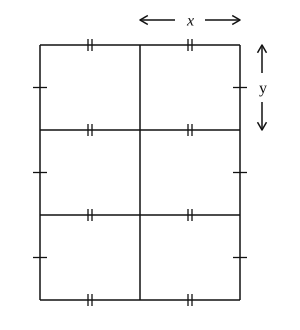
Observe the figure given above. It shows six identical rectangular enclosures made by using fencing wire mesh. These enclosures are used to protect baby animals in a zoo. Dimensions of each enclosure is feet × y feet. The total length of fencing required is 152 feet and area of each enclosure is 80 square feet.
Based on the above, answer the following questions :
(i) Write an expression for length of fencing required in terms of and y. (1)
(ii) Write the area of each enclosure in terms of . (1)
(iii) (a) Write the above equation in quadratic equation form and thus find the dimensions of each enclosure using factorisation method. (2)
OR
(b) Using above equation in quadratic form, solve the equation and find the dimensions of each enclosure using quadratic formula. (2)

Diagram for CBSE 2026 Class 10 Maths question 36
Show answer & solution
Answer: (i) (ii) Area = sq feet (iii) ; each enclosure is 10 feet × 8 feet (x = 9 feet, y = feet also satisfies)
  1. (i) The figure has 4 horizontal fences each of length 2x and 3 vertical fences each of length 3y.
  2. Fencing = .
  3. (ii) From (i), , so area = .
  4. (iii) (a) .
  5. , so or .
  6. If , ; if , .
  7. Each enclosure is 10 feet × 8 feet (the other solution gives 9 feet × feet).
  8. (iii) (b) or 9, giving the same dimensions.

ABCD is a rectangle of dimensions 80 cm 60 cm. Another rectangle PQRS is drawn inside ABCD leaving space of equal width cm along the edges of ABCD. If area PQRS is half of the area ABCD, then find the value of .

Show answer & solution
Answer:
  1. Dimensions of PQRS: cm and cm.
  2. , so or
  3. makes negative, so .
Q34 (OR) (OR)5 marksLong AnswerQuadratic EquationsCBSE 2026 · Basic 430/5/1

A train covers a distance of 90 km at a uniform speed. Had the speed been 15 km/h more, it would have taken 30 minutes less for the same journey. Find the original speed of the train.

Show answer & solution
Answer: 45 km/h
  1. Let the original speed be x km/h.
  2. Speed cannot be negative, so x = 45 km/h.

A faster train takes one hour less than a slower train for a journey of 200 km. If the speed of the slower train is 10 km/hr less than that of the faster train, find the speeds of the two trains.
Show answer & solution
Answer: Slower train 40 km/hr, faster train 50 km/hr
  1. Let the speed of the slower train be km/hr; faster train km/hr.
  2. , so (speed cannot be negative).
  3. Slower train: 40 km/hr; faster train: 50 km/hr.

The sum of the areas of two squares is 640 m. If the difference in their perimeters is 64 m, find the sides of the two squares.

Show answer & solution
Answer: 24 m and 8 m
  1. Let the sides be m and m with .
  2. , so .
  3. :
  4. , i.e.
  5. , so (side cannot be negative).
  6. . The sides are 24 m and 8 m.
← Pair of Linear Equations in Two Variables Arithmetic Progressions →
Practise smarter: chapter-wise revision, formula sheets and step-by-step NCERT solutions on MonoMath CBSE →