MonoMath CBSE
CBSE Maths › Class 10 PYQs

Triangles: CBSE Class 10 Previous Year Questions

210 different questions from Triangles (NCERT Chapter 6) asked in CBSE Class 10 Maths board exams 2022–2026. 8 of them came up in more than one year. Pick a mark group to practise, each with answers and step-by-step solutions.

1 mark questions70 questions2 marks questions56 questions3 marks questions21 questions4 marks questions4 questions5 marks questions59 questions

Most asked Triangles questions

Q35 (OR) (OR)5 marksLong AnswerTrianglesCBSE 2023 · Standard 30/4/2

If a line is drawn parallel to one side of a triangle to intersect the other two sides in distinct points, then prove that the other two sides are divided in the same ratio.

Show answer & solution
Answer: Proved.
  1. Given: In , a line DE BC meets AB at D and AC at E. To prove: .
  2. Construction: join BE and CD; draw EM AB and DN AC.
  3. ar(ADE) , ar(BDE) , so .
  4. ar(ADE) , ar(DEC) , so .
  5. and are on the same base DE and between the same parallels DE and BC, so ar(BDE) = ar(DEC).
  6. Therefore .

State and prove Basic Proportionality theorem.

Show answer & solution
Answer: Proved.
  1. Statement: If a line is drawn parallel to one side of a triangle to intersect the other two sides in distinct points, the other two sides are divided in the same ratio.
  2. Given: In , DE BC, with D on AB and E on AC. To prove: .
  3. Construction: Join BE and CD; draw EM AB and DN AC.
  4. ar(ADE) = and ar(BDE) = , so .
  5. ar(ADE) = and ar(DEC) = , so .
  6. Triangles BDE and DEC are on the same base DE and between the same parallels DE and BC, so ar(BDE) = ar(DEC).
  7. Hence .

E is a point on the side AD produced of a parallelogram ABCD and BE intersects CD at F. Show that .

Show answer & solution
Answer: Proved.
  1. In and :
  2. (opposite angles of parallelogram ABCD).
  3. AD BC, so AE BC and BE is a transversal; hence (alternate angles).
  4. By AA similarity, .
Q35 (OR) (OR)5 marksLong AnswerTrianglesCBSE 2023 · Basic 430/6/1

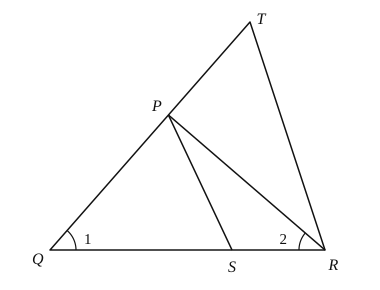
In the given figure, and . Prove that .

Diagram for CBSE 2023 Class 10 Maths question 35 (OR)
Show answer & solution
Answer: Proved.
  1. In , i.e. , so (sides opposite equal angles).
  2. Given , so .
  3. In and : and (common angle ).
  4. By SAS similarity, .

In , if AD BC and , then prove that .

Show answer & solution
Answer: Proved.
  1. .
  2. In and : and .
  3. So (SAS similarity).
  4. Hence and .
  5. .
  6. In : .
  7. So .
Q242 marksVery Short AnswerTrianglesCBSE 2023 · Basic 430/2/2

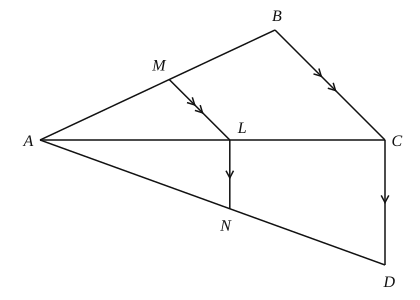
In the given figure, and . Prove that .

Diagram for CBSE 2023 Class 10 Maths question 24
Show answer & solution
Answer: Proved.
  1. In , , so by BPT, ...(1)
  2. In , , so by BPT, ...(2)
  3. From (1) and (2),
  4. Hence .
Q35 (OR) (OR)5 marksLong AnswerTrianglesCBSE 2023 · Standard 30/2/1

Through the mid-point M of the side CD of a parallelogram ABCD, the line BM is drawn intersecting AC in L and AD (produced) in E. Prove that EL = 2BL.

Show answer & solution
Answer: Proved.
  1. In and : MC = MD, (vertically opposite), (alternate angles, ).
  2. So (ASA), giving DE = BC.
  3. AD = BC, so AE = AD + DE = 2BC.
  4. In and : (vertically opposite), (alternate angles).
  5. So (AA) and .
  6. Hence EL = 2BL.

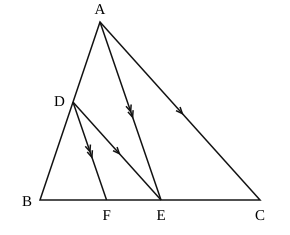
In the given figure, DE AC and DF AE
Prove that

Diagram for CBSE 2023 Class 10 Maths question 31
Show answer & solution
Answer: Proved.
  1. In , DE AC, so by BPT ... (1)
  2. In , DF AE, so by BPT ... (2)
  3. From (1) and (2), .

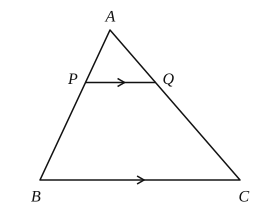
In the given figure, PQ BC. If AP : AB = 3 : 7 then, AQ : QC equals :

Diagram for CBSE 2026 Class 10 Maths question 15
  1. (A)3 : 7
  2. (B)3 : 10
  3. (C)7 : 3
  4. (D)3 : 4
Show answer & solution
Answer: (D) 3 : 4
  1. AP : AB = 3 : 7, so AP : PB = 3 : 4.
  2. By BPT, .

Which of the following statements is not always true ?

  1. (A)Two circles are similar.
  2. (B)Two isosceles right triangles are similar.
  3. (C)Two rectangles are similar.
  4. (D)Two equilateral triangles are similar.
Show answer & solution
Answer: (C) Two rectangles are similar.
  1. All circles, all isosceles right triangles (angles 45°, 45°, 90°) and all equilateral triangles have the same shape, so they are always similar.
  2. Two rectangles have equal angles, but their sides need not be in the same ratio (e.g. 1 × 2 and 1 × 3).
  3. So 'Two rectangles are similar' is not always true.
← Arithmetic Progressions Coordinate Geometry →
Practise smarter: chapter-wise revision, formula sheets and step-by-step NCERT solutions on MonoMath CBSE →