MonoMath CBSE
CBSE Maths › Class 12 PYQs › 2024

CBSE Class 12 Maths 2024 Question Paper 65/1/3 with Solutions

All 45 questions from the CBSE Class 12 Mathematics board paper, Set 65/1/3 (2024), with answers and step-by-step solutions. Total 80 marks. Tap “Show answer & solution” under any question.

Set 65/1/1Set 65/1/2Set 65/1/3Set 65/2/1Set 65/2/2Set 65/2/3Set 65/3/1Set 65/3/2Set 65/3/3Set 65/4/1Set 65/4/2Set 65/4/3Set 65/5/1Set 65/5/2Set 65/5/3

If , , then is :

  1. (A)
  2. (B)
  3. (C)
  4. (D)
Show answer & solution
Answer: (D)
  1. and .
  2. .

The solution of the differential equation is :

  1. (A)
  2. (B)
  3. (C)
  4. (D)
Show answer & solution
Answer: (B)
  1. Separating variables: .
  2. (by parts).
  3. So .
Q31 markMCQVector Algebra

The vector with terminal point A (2, – 3, 5) and initial point B (3, – 4, 7) is :

  1. (A)
  2. (B)
  3. (C)
  4. (D)
Show answer & solution
Answer: (D)
  1. = position vector of A − position vector of B.
  2. .
Also asked in: 2024 65/1/1, 2024 65/1/2

The distance of point P(a, b, c) from y-axis is :

  1. (A)b
  2. (B)
  3. (C)
  4. (D)
Show answer & solution
Answer: (C)
  1. The foot of the perpendicular from P(a, b, c) to the y-axis is (0, b, 0).
  2. Distance .
Also asked in: 2024 65/1/1, 2024 65/1/2

The number of corner points of the feasible region determined by constraints , , is :

  1. (A)0
  2. (B)1
  3. (C)2
  4. (D)3
Show answer & solution
Answer: (C) 2
  1. The feasible region lies in the first quadrant on the side of away from the origin; it is unbounded.
  2. The line meets the axes at (4, 0) and (0, 4), and these are the only corner points.
  3. So there are 2 corner points.
Also asked in: 2024 65/1/1, 2024 65/1/2
Q61 markMCQMatrices

If matrices A and B are of order and respectively, then the order of is :

  1. (A)
  2. (B)
  3. (C)
  4. (D)
Show answer & solution
Answer: (D)
  1. A′ has order and B′ has order .
  2. So is defined and has order .

A relation R defined on a set of human beings as
R = {(x, y) : x is 5 cm shorter than y}
is :

  1. (A)reflexive only
  2. (B)reflexive and transitive
  3. (C)symmetric and transitive
  4. (D)neither transitive, nor symmetric, nor reflexive
Show answer & solution
Answer: (D) neither transitive, nor symmetric, nor reflexive
  1. Not reflexive: no person is 5 cm shorter than himself.
  2. Not symmetric: if x is 5 cm shorter than y, then y is 5 cm taller (not shorter) than x.
  3. Not transitive: if x is 5 cm shorter than y and y is 5 cm shorter than z, then x is 10 cm shorter than z.
  4. So R is neither reflexive, nor symmetric, nor transitive.
Q81 markMCQMatrices

If a matrix has 36 elements, the number of possible orders it can have, is :

  1. (A)13
  2. (B)3
  3. (C)5
  4. (D)9
Show answer & solution
Answer: (D) 9
  1. An order needs .
  2. The divisors of 36 are 1, 2, 3, 4, 6, 9, 12, 18, 36, i.e. 9 divisors.
  3. Each divisor m gives one order , so there are 9 possible orders.
Also asked in: 2024 65/1/1, 2024 65/1/2

Which of the following statements is true for the function ?

  1. (A)f(x) is continuous and differentiable
  2. (B)f(x) is continuous
  3. (C)f(x) is continuous and differentiable
  4. (D)f(x) is discontinuous at infinitely many points
Show answer & solution
Answer: (C) f(x) is continuous and differentiable
  1. For , is a polynomial, so it is continuous and differentiable there.
  2. At : but , so f is discontinuous (hence not differentiable) at .
  3. So f is continuous and differentiable for all , and has only one point of discontinuity.
Also asked in: 2024 65/1/1

Let f(x) be a continuous function on [a, b] and differentiable on (a, b). Then, this function f(x) is strictly increasing in (a, b) if

  1. (A)
  2. (B)
  3. (C)
  4. (D)
Show answer & solution
Answer: (B)
  1. A function continuous on [a, b] and differentiable on (a, b) is strictly increasing on (a, b) if for every x in (a, b).
  2. gives strictly decreasing, gives constant, and says nothing about increase.
Also asked in: 2024 65/1/1, 2024 65/1/2
Q111 markMCQMatrices

If , then the value of is :

  1. (A)7
  2. (B)6
  3. (C)8
  4. (D)18
Show answer & solution
Answer: (D) 18
  1. Equating corresponding elements: and .
  2. .
Also asked in: 2024 65/1/1, 2024 65/1/2
Q121 markMCQIntegrals

If f(x) is an odd function, then equals :

  1. (A)
  2. (B)0
  3. (C)
  4. (D)
Show answer & solution
Answer: (B) 0
  1. Let . Then , so g is odd.
  2. For an odd function, .
Q131 markMCQVector Algebra

Let be the angle between two unit vectors and such that . Then, is equal to :

  1. (A)
  2. (B)
  3. (C)
  4. (D)
Show answer & solution
Answer: (C)
  1. .
  2. .
Also asked in: 2024 65/1/1, 2024 65/1/2

The integrating factor of the differential equation , , is :

  1. (A)
  2. (B)
  3. (C)
  4. (D)
Show answer & solution
Answer: (D)
  1. Divide by : , so .
  2. .
  3. I.F. .
Also asked in: 2024 65/1/1

If the direction cosines of a line are , , , then the value of k is :

  1. (A)
  2. (B)
  3. (C)
  4. (D)
Show answer & solution
Answer: (D)
  1. For direction cosines, .
  2. .
Also asked in: 2024 65/1/1, 2024 65/1/2
Q161 markMCQLinear Programming

A linear programming problem deals with the optimization of a/an :

  1. (A)logarithmic function
  2. (B)linear function
  3. (C)quadratic function
  4. (D)exponential function
Show answer & solution
Answer: (B) linear function
  1. In an LPP the objective function to be maximised or minimised is a linear function, subject to linear constraints.
Also asked in: 2024 65/1/1, 2024 65/1/2
Q171 markMCQProbability

If , then which of the following statements is true ?

  1. (A)
  2. (B)
  3. (C)
  4. (D)
Show answer & solution
Answer: (C)
  1. and the two are equal, so .
  2. .
Also asked in: 2024 65/1/1, 2024 65/1/2
Q181 markMCQDeterminants

is equal to :

  1. (A)
  2. (B)2
  3. (C)0
  4. (D)
Show answer & solution
Answer: (B) 2
  1. Value .
  2. .
Also asked in: 2024 65/1/1
Q191 markAssertion–ReasonDeterminants

Assertion (A) : For matrix , where , .
Reason (R) : .

  1. (A)Both Assertion (A) and Reason (R) are true and Reason (R) is the correct explanation of the Assertion (A).
  2. (B)Both Assertion (A) and Reason (R) are true, but Reason (R) is not the correct explanation of the Assertion (A).
  3. (C)Assertion (A) is true, but Reason (R) is false.
  4. (D)Assertion (A) is false, but Reason (R) is true.
Show answer & solution
Answer: (A) Both (A) and (R) are true and (R) is the correct explanation of (A).
  1. Expand along : .
  2. .
  3. Since , , so . Assertion is true.
  4. Reason is true, and it is exactly what gives the range of , so it explains the Assertion.
Also asked in: 2024 65/1/1, 2024 65/1/2
Q201 markAssertion–ReasonThree Dimensional Geometry

Assertion (A) : A line in space cannot be drawn perpendicular to x, y and z axes simultaneously.
Reason (R) : For any line making angles, , , with the positive directions of x, y and z axes respectively, .

  1. (A)Both Assertion (A) and Reason (R) are true and Reason (R) is the correct explanation of the Assertion (A).
  2. (B)Both Assertion (A) and Reason (R) are true, but Reason (R) is not the correct explanation of the Assertion (A).
  3. (C)Assertion (A) is true, but Reason (R) is false.
  4. (D)Assertion (A) is false, but Reason (R) is true.
Show answer & solution
Answer: (A) Both (A) and (R) are true and (R) is the correct explanation of (A).
  1. Reason is the standard identity for direction cosines, so it is true.
  2. If a line were perpendicular to all three axes, then and .
  3. So no such line exists: Assertion is true, and the Reason explains it.
Also asked in: 2024 65/1/1, 2024 65/1/2
Q212 marksVery Short AnswerVector Algebra

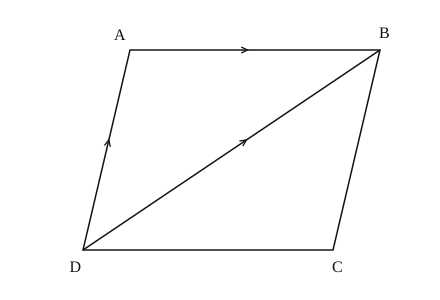
In the given figure, ABCD is a parallelogram. If and , then find and hence find the area of parallelogram ABCD.

Diagram for CBSE 2024 Class 12 Maths question 21
Show answer & solution
Answer: ; area sq units
  1. In : .
  2. .
  3. .
  4. Area sq units.
Also asked in: 2024 65/1/1, 2024 65/1/2
Q222 marksVery Short AnswerContinuity and Differentiability

Check the differentiability of function at , where [·] denotes greatest integer function.

Show answer & solution
Answer: f is not differentiable at .
  1. .
  2. , which does not exist (tends to ).
  3. .
  4. , so f is not differentiable at (it is not even continuous there).
OR
Q22 (OR) (OR)2 marksVery Short AnswerContinuity and Differentiability

If , find at the point .

Show answer & solution
Answer:
  1. Differentiating: .
  2. .
  3. At : .
Q232 marksVery Short AnswerApplication of Derivatives

Find local maximum value and local minimum value (whichever exists) for the function .

Show answer & solution
Answer: Local minimum value = 3 (at ); no local maximum.
  1. .
  2. ; , so is a point of local minimum.
  3. Local minimum value .
  4. There is no other critical point, so no local maximum exists.
Q242 marksVery Short AnswerIntegrals

Find :

Show answer & solution
Answer:
  1. Put , so and .
  2. .
  3. .
  4. .
Also asked in: 2024 65/1/1, 2024 65/1/2
OR
Q24 (OR) (OR)2 marksVery Short AnswerIntegrals

Evaluate :

Show answer & solution
Answer: 2
  1. Put , so ; when , and when , .
  2. .
  3. .
Also asked in: 2024 65/1/1, 2024 65/1/2
Q252 marksVery Short AnswerVector Algebra

If and are two non-zero vectors such that and , then prove that .

Show answer & solution
Answer: Proved.
  1. .
  2. .
  3. Substituting: .
  4. Hence .
Also asked in: 2024 65/1/1, 2024 65/1/2
Q263 marksShort AnswerLinear Programming

Solve the following linear programming problem graphically :
Minimise
subject to the constraints


Show answer & solution
Answer: Minimum z = 160 at x = 40, y = 20
  1. Draw through (120, 0), (0, 60); through (60, 0), (0, 60); through (0, 0), (60, 30).
  2. The feasible region (below , above , below , ) is bounded.
  3. meets at (60, 30) and at (40, 20).
  4. Corner points: (40, 20), (60, 30), (120, 0), (60, 0).
  5. z at these: 160, 240, 600, 300.
  6. Minimum z = 160 at x = 40, y = 20.
Q273 marksShort AnswerProbability

E and F are two independent events such that and . Find P(F) and .

Show answer & solution
Answer: ,
  1. .
  2. : , so and .
  3. .
  4. .
Also asked in: 2024 65/1/1, 2024 65/1/2
Q283 marksShort AnswerRelations and Functions

A relation R on set A = {1, 2, 3, 4, 5} is defined as . Check whether the relation R is reflexive, symmetric and transitive.

Show answer & solution
Answer: R is reflexive and symmetric but not transitive.
  1. Reflexive: for every , , so . R is reflexive.
  2. Symmetric: if then , so . R is symmetric.
  3. Transitive: since , and since .
  4. But , so . R is not transitive.
Also asked in: 2024 65/1/1, 2024 65/1/2
OR
Q28 (OR) (OR)3 marksShort AnswerRelations and Functions

A function f is defined from as , such that and . Find function f(x). Hence, check whether function f(x) is one-one and onto or not.

Show answer & solution
Answer: ; f is both one-one and onto.
  1. and ; subtracting, , so .
  2. .
  3. One-one: .
  4. Onto: for any , take ; then .
  5. Hence f is one-one and onto.
Also asked in: 2024 65/1/1, 2024 65/1/2
Q293 marksShort AnswerContinuity and Differentiability

If , prove that .

Show answer & solution
Answer: Proved.
  1. Put , : .
  2. .
  3. So , i.e. .
  4. (a constant).
  5. Differentiating: .
  6. Hence .
OR
Q29 (OR) (OR)3 marksShort AnswerContinuity and Differentiability

If , then find .

Show answer & solution
Answer: , i.e.
  1. .
  2. Differentiating: .
  3. .
  4. .
Also asked in: 2024 65/1/1, 2024 65/1/2
Q303 marksShort AnswerIntegrals

Find :

Show answer & solution
Answer:
  1. Put (for the partial fractions only): .
  2. : gives ; gives .
  3. .
  4. .
Also asked in: 2024 65/1/1, 2024 65/1/2
OR
Q30 (OR) (OR)3 marksShort AnswerIntegrals

Evaluate :

Show answer & solution
Answer: 5
  1. On [1, 3]: and , so their sum is 2.
  2. .
  3. .
  4. Total .
Also asked in: 2024 65/1/1, 2024 65/1/2
Q313 marksShort AnswerDifferential Equations

Solve the following differential equation :

Show answer & solution
Answer:
  1. Write as , linear in x.
  2. I.F. .
  3. ; put : .
  4. .
  5. So .
Q325 marksLong AnswerThree Dimensional Geometry

Find the equation of a line which is the mirror image of the line with respect to line , given that line passes through the point P(1, 6, 3) and parallel to line .

Show answer & solution
Answer:
  1. Since , its mirror image is also parallel to (direction ratios 1, 2, 3) and passes through the image P′ of P in .
  2. A point of is ; .
  3. For the foot of the perpendicular: ; M = (1, 3, 5).
  4. M is the mid-point of PP′, so P′ = (2 − 1, 6 − 6, 10 − 3) = (1, 0, 7).
  5. .
Q335 marksLong AnswerDeterminants

If , find and use it to solve the following system of equations :
, ,

Show answer & solution
Answer: ; , ,
  1. , so exists.
  2. Cofactors: , , ; , , ; , , .
  3. .
  4. The system is with , .
  5. .
  6. So , , .
Also asked in: 2024 65/1/1, 2024 65/1/2
OR
Q33 (OR) (OR)5 marksLong AnswerMatrices

If and , find the value of .

Show answer & solution
Answer: 3
  1. Use .
  2. (Row 1 of A)·(column 3 of ): .
  3. (Row 2)·(column 3): .
  4. (Row 3)·(column 1): .
  5. (Row 1)·(column 2): .
  6. Check (Row 1)·(column 1): . Correct.
  7. .
Also asked in: 2024 65/1/1, 2024 65/1/2
Q345 marksLong AnswerIntegrals

Find :

Show answer & solution
Answer:
  1. Denominator: .
  2. Put , : .
  3. .
  4. .
  5. .
OR
Q34 (OR) (OR)5 marksLong AnswerIntegrals

Evaluate :

Show answer & solution
Answer:
  1. Split: .
  2. The first integrand is odd, so its integral is 0; the second is even.
  3. .
  4. .
  5. .
Q355 marksLong AnswerApplication of Integrals

Using integration, find the area of the ellipse , included between the lines and .

Show answer & solution
Answer: sq units
  1. Upper half of the ellipse: . The region is symmetric about both axes.
  2. Area .
  3. .
  4. .
  5. sq units.
Also asked in: 2024 65/1/1, 2024 65/1/2

If a function defined as is one-one and onto, then we can define a unique function such that , where and , . Function g is called the inverse of function f.
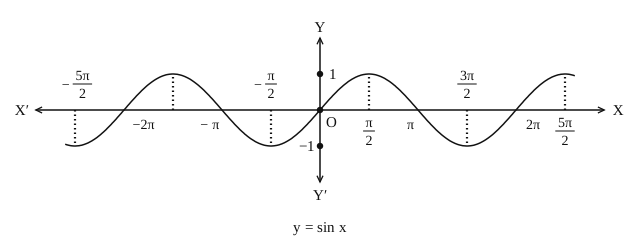
The domain of sine function is R and function sine : is neither one-one nor onto. The following graph shows the sine function.
Let sine function be defined from set A to [– 1, 1] such that inverse of sine function exists, i.e., is defined from [– 1, 1] to A.
On the basis of the above information, answer the following questions :
(i) If A is the interval other than principal value branch, give an example of one such interval. (1)
(ii) If is defined from [– 1, 1] to its principal value branch, find the value of . (1)
(iii) Draw the graph of from [– 1, 1] to its principal value branch. (2)
OR (iii) Find the domain and range of . (2)

Diagram for CBSE 2024 Class 12 Maths question 36
Show answer & solution
Answer: (i) e.g. (ii) (iii) graph of from through O to OR (iii) domain [0, 2], range
  1. (i) Sine is one-one and onto [– 1, 1] on (or ), so A can be such an interval.
  2. (ii) .
  3. (iii) Reflect the part of on in the line : an increasing curve from through (0, 0) to , with domain [– 1, 1] and range .
  4. OR (iii) Need , i.e. : domain [0, 2].
  5. , so : range .
Also asked in: 2024 65/1/1, 2024 65/1/2
Q374 marksCase StudyApplication of Derivatives

The traffic police has installed Over Speed Violation Detection (OSVD) system at various locations in a city. These cameras can capture a speeding vehicle from a distance of 300 m and even function in the dark.
A camera is installed on a pole at the height of 5 m. It detects a car travelling away from the pole at the speed of 20 m/s. At any point, x m away from the base of the pole, the angle of elevation of the speed camera from the car C is .
On the basis of the above information, answer the following questions :
(i) Express in terms of height of the camera installed on the pole and x. (1)
(ii) Find . (1)
(iii) Find the rate of change of angle of elevation with respect to time at an instant when the car is 50 m away from the pole. (2)
OR (iii) If the rate of change of angle of elevation with respect to time of another car at a distance of 50 m from the base of the pole is rad/s, then find the speed of the car. (2)

Show answer & solution
Answer: (i) (ii) (iii) rad/s (angle decreasing at rad/s) OR (iii) 15 m/s
  1. (i) , so .
  2. (ii) .
  3. (iii) .
  4. At : rad/s.
  5. OR (iii) Magnitude of at is .
  6. m/s.
Also asked in: 2024 65/1/1, 2024 65/1/2
Q384 marksCase StudyProbability

According to recent research, air turbulence has increased in various regions around the world due to climate change. Turbulence makes flights bumpy and often delays the flights.
Assume that, an airplane observes severe turbulence, moderate turbulence or light turbulence with equal probabilities. Further, the chance of an airplane reaching late to the destination are 55%, 37% and 17% due to severe, moderate and light turbulence respectively.
On the basis of the above information, answer the following questions :
(i) Find the probability that an airplane reached its destination late. (2)
(ii) If the airplane reached its destination late, find the probability that it was due to moderate turbulence. (2)

Show answer & solution
Answer: (i) (ii)
  1. Let be severe, moderate and light turbulence, ; let A be reaching late.
  2. , , .
  3. (i) .
  4. (ii) By Bayes' theorem, .
Also asked in: 2024 65/1/1, 2024 65/1/2
← 2024 65/1/2 2024 65/2/1 →
Practise smarter: chapter-wise revision, formula sheets and step-by-step NCERT solutions on MonoMath CBSE →