CBSE Class 12 Maths 2024 Question Paper 65/5/1 with Solutions
All 45 questions from the CBSE Class 12 Mathematics board paper, Set 65/5/1 (2024),
with answers and step-by-step solutions. Total 80 marks. Tap “Show answer & solution” under any question.
The position vectors of points P and Q are p and q respectively. The point R divides line segment PQ in the ratio 3 : 1 and S is the mid-point of line segment PR. The position vector of S is :
Assertion (A) : The vectors a=6i^+2j^−8k^, b=10i^−2j^−6k^, c=4i^−4j^+2k^ represent the sides of a right angled triangle. Reason (R) : Three non-zero vectors of which none of two are collinear forms a triangle if their resultant is zero vector or sum of any two vectors is equal to the third.
(A)Both Assertion (A) and Reason (R) are true and the Reason (R) is the correct explanation of the Assertion (A).
(B)Both Assertion (A) and Reason (R) are true and Reason (R) is not the correct explanation of the Assertion (A).
(C)Assertion (A) is true, but Reason (R) is false.
(D)Assertion (A) is false, but Reason (R) is true.
Show answer & solution
Answer: (B) Both Assertion (A) and Reason (R) are true and Reason (R) is not the correct explanation of the Assertion (A).
a+c=10i^−2j^−6k^=b, and no two of the vectors are collinear, so they form a triangle.
a⋅c=24−8−16=0, so the triangle is right angled. A is true.
R is a true statement of the condition for three vectors to form a triangle.
R only shows a triangle is formed; the right angle comes from a⋅c=0, which R does not explain.
Verify: (0,1,1)⋅(2,−1,1)=0−1+1=0 and (0,1,1)⋅(1,1,−1)=0+1−1=0; magnitude 22⋅2=4.
Q313 marksShort AnswerProbabilityNot in current syllabus
The random variable X has the following probability distribution where a and b are some constants : X: 1, 2, 3, 4, 5 P(X): 0.2, a, a, 0.2, b If the mean E(X) = 3, then find values of a and b and hence determine P(X≥3).
Find the product of the matrices 12323−3−32−4−614−15175913−8−1 and hence solve the system of linear equations : x+2y−3z=−4 2x+3y+2z=2 3x−3y−4z=11
Show answer & solution
Answer: Product =67I; x=3, y=−2, z=1
Row 1: (−6+28+45,17+10−27,13−16+3)=(67,0,0); similarly rows 2 and 3 give (0,67,0) and (0,0,67).
So PQ=67I, where P is the first matrix and Q the second; hence P−1=671Q.
Find the co-ordinates of the foot of the perpendicular drawn from the point (2, 3, –8) to the line 24−x=6y=31−z. Also, find the perpendicular distance of the given point from the line.
Show answer & solution
Answer: Foot (2, 6, –2); distance 35 units
The line is −2x−4=6y=−3z−1=λ; general point Q(4−2λ,6λ,1−3λ).
Find the shortest distance between the lines L1 & L2 given below : L1 : The line passing through (2, –1, 1) and parallel to 1x=1y=3z L2 : r=i^+(2μ+1)j^−(μ+2)k^.
Students of a school are taken to a railway museum to learn about railways heritage and its history. An exhibit in the museum depicted many rail lines on the track near the railway station. Let L be the set of all rail lines on the railway track and R be the relation on L defined by R={(l1,l2):l1 is parallel to l2} On the basis of the above information, answer the following questions : (i) Find whether the relation R is symmetric or not. (ii) Find whether the relation R is transitive or not. (iii) If one of the rail lines on the railway track is represented by the equation y = 3x + 2, then find the set of rail lines in R related to it. OR Let S be the relation defined by S={(l1,l2):l1 is perpendicular to l2} check whether the relation S is symmetric and transitive.
Show answer & solution
Answer: (i) Symmetric (ii) Transitive (iii) {l:l is a line y=3x+c, c∈R} OR S is symmetric but not transitive
(i) If l1∥l2 then l2∥l1, so (l1,l2)∈R⇒(l2,l1)∈R: R is symmetric.
(ii) If l1∥l2 and l2∥l3 then l1∥l3: R is transitive.
(iii) Lines related to y = 3x + 2 are the lines parallel to it, i.e. with slope 3: the set {y=3x+c:c∈R}.
OR If l1⊥l2 then l2⊥l1, so S is symmetric. If l1⊥l2 and l2⊥l3 then l1∥l3 (in a plane), so (l1,l3)∈/S: S is not transitive.
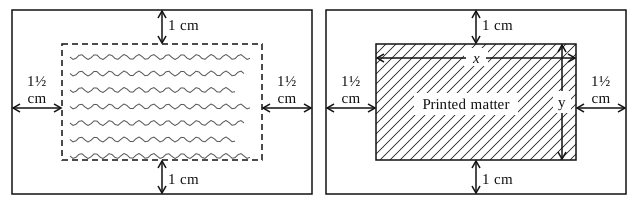
A rectangular visiting card is to contain 24 sq.cm. of printed matter. The margins at the top and bottom of the card are to be 1 cm and the margins on the left and right are to be 1½ cm as shown below : On the basis of the above information, answer the following questions : (i) Write the expression for the area of the visiting card in terms of x. (ii) Obtain the dimensions of the card of minimum area.
Show answer & solution
Answer: (i) A(x)=(x+3)(x24+2)=30+2x+x72 (ii) 9 cm × 6 cm (width × height)
(i) Printed matter is x cm by y cm with xy=24, so y=x24. Card is (x+3) cm by (y+2) cm.
A(x)=(x+3)(x24+2)=30+2x+x72.
(ii) A′(x)=2−x272=0⇒x=6 (x > 0); A′′(x)=x3144>0, so minimum.
Then y=4; card dimensions (6+3) cm × (4+2) cm = 9 cm × 6 cm (minimum area 54 sq cm).
A departmental store sends bills to charge its customers once a month. Past experience shows that 70% of its customers pay their first month bill in time. The store also found that the customer who pays the bill in time has the probability of 0.8 of paying in time next month and the customer who doesn’t pay in time has the probability of 0.4 of paying in time the next month. Based on the above information, answer the following questions : (i) Let E1 and E2 respectively denote the event of customer paying or not paying the first month bill in time. Find P(E1), P(E2). (ii) Let A denotes the event of customer paying second month’s bill in time, then find P(A∣E1) and P(A∣E2). (iii) Find the probability of customer paying second month’s bill in time. OR (iii) Find the probability of customer paying first month’s bill in time if it is found that customer has paid the second month’s bill in time.
Show answer & solution
Answer: (i) P(E1)=0.7, P(E2)=0.3 (ii) P(A∣E1)=0.8, P(A∣E2)=0.4 (iii) 0.68 OR (iii) 1714
(i) 70% pay in time: P(E1)=0.7, P(E2)=1−0.7=0.3.