CBSE Class 12 Maths 2024 Question Paper 65/2/2 with Solutions
All 45 questions from the CBSE Class 12 Mathematics board paper, Set 65/2/2 (2024),
with answers and step-by-step solutions. Total 80 marks. Tap “Show answer & solution” under any question.
If a line makes an angle of 30∘ with the positive direction of x-axis, 120∘ with the positive direction of y-axis, then the angle which it makes with the positive direction of z-axis is :
Which of the following statements is not true about equivalence classes Ai (i = 1, 2, .... n) formed by an equivalence relation R defined on a set A ?
(A)⋃i=1nAi=A
(B)Ai∩Aj=ϕ,i=j
(C)x∈Ai and x∈Aj⇒Ai=Aj
(D)All elements of Ai are related to each other, for all i
Show answer & solution
Answer: (B) Ai∩Aj=ϕ,i=j
Equivalence classes partition A: their union is A, and all elements of one class are related to each other.
Two classes sharing an element are the same class, so (C) is true.
Distinct classes are disjoint, i.e. Ai∩Aj=ϕ for i=j; so (B) is not true.
If vectors a, b and 2a+3b are unit vectors, then find the angle between a and b.
Show answer & solution
Answer:π
∣2a+3b∣2=1.
4∣a∣2+9∣b∣2+12a⋅b=1, i.e. 4+9+12a⋅b=1.
a⋅b=−1, so cosθ=1×1−1=−1.
Angle between a and b is π.
Q283 marksShort AnswerProbabilityNot in current syllabus
A pair of dice is thrown simultaneously. If X denotes the absolute difference of the numbers appearing on top of the dice, then find the probability distribution of X.
Find the value of p for which the lines r=λi^+(2λ+1)j^+(3λ+2)k^ and r=i^−3μj^+(pμ+7)k^ are perpendicular to each other and also intersect. Also, find the point of intersection of the given lines.
Show answer & solution
Answer: p = 2; point of intersection (1, 3, 5)
Line 1: through (0, 1, 2), direction i^+2j^+3k^. Line 2: through (1, 0, 7), direction 0i^−3j^+pk^.
If A1 denotes the area of region bounded by y2=4x, x = 1 and x-axis in the first quadrant and A2 denotes the area of region bounded by y2=4x, x = 4, find A1:A2.
Show answer & solution
Answer:A1:A2=1:16
A1=∫012xdx=[34x3/2]01=34.
The region bounded by y2=4x and x = 4 lies on both sides of the x-axis (symmetric).
Show that a function f:R→R defined by f(x)=1+x22x is neither one-one nor onto. Further, find set A so that the given function f:R→A becomes an onto function.
Show answer & solution
Answer: Proved; A = [−1, 1]
f(2)=54 and f(21)=1+411=54, but 2=21; so f is not one-one.
Let y=1+x22x. Then yx2−2x+y=0.
For y ≠ 0, real x exists only if 4−4y2≥0, i.e. −1≤y≤1; y = 0 comes from x = 0.
So the range of f is [−1, 1]; e.g. 2 ∈ R has no pre-image, so f is not onto R.
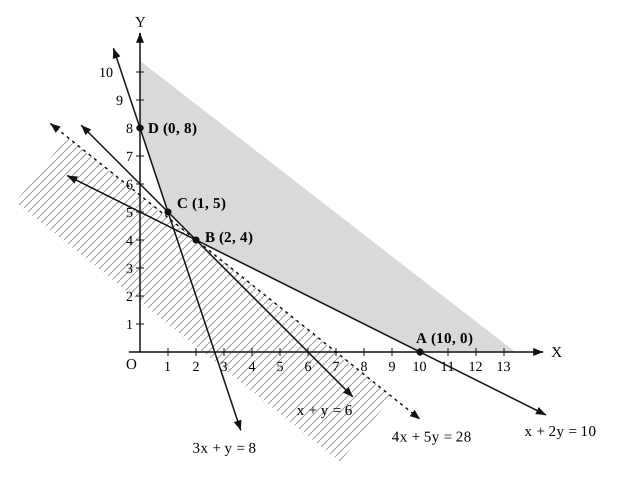
The month of September is celebrated as the Rashtriya Poshan Maah across the country. Following a healthy and well-balanced diet is crucial in order to supply the body with the proper nutrients it needs. A balanced diet also keeps us mentally fit and promotes improved level of energy. A dietician wishes to minimize the cost of a diet involving two types of foods, food X (x kg) and food Y (y kg) which are available at the rate of ₹ 16/kg and ₹ 20/kg respectively. The feasible region satisfying the constraints is shown in Figure-2. On the basis of the above information, answer the following questions : (i) Identify and write all the constraints which determine the given feasible region in Figure-2. (2) (ii) If the objective is to minimize cost Z = 16x + 20y, find the values of x and y at which cost is minimum. Also, find minimum cost assuming that minimum cost is possible for the given unbounded region. (2)
Show answer & solution
Answer: (i) x+2y≥10, x+y≥6, 3x+y≥8, x≥0, y≥0 (ii) x = 2, y = 4; minimum cost ₹ 112
(i) The shaded region lies on the side away from the origin of the lines x + 2y = 10, x + y = 6 and 3x + y = 8, in the first quadrant.
Constraints: x+2y≥10, x+y≥6, 3x+y≥8, x≥0, y≥0.
(ii) Corner points: D(0, 8): Z = 160; C(1, 5): Z = 16 + 100 = 116; B(2, 4): Z = 32 + 80 = 112; A(10, 0): Z = 160.
Smallest value is 112 at B(2, 4). The half-plane 16x + 20y < 112, i.e. 4x + 5y < 28, has no point in common with the feasible region, so 112 is the minimum.
Airplanes are by far the safest mode of transportation when the number of transported passengers are measured against personal injuries and fatality totals. Previous records state that the probability of an airplane crash is 0.00001%. Further, there are 95% chances that there will be survivors after a plane crash. Assume that in case of no crash, all travellers survive. Let E1 be the event that there is a plane crash and E2 be the event that there is no crash. Let A be the event that passengers survive after the journey. On the basis of the above information, answer the following questions : (i) Find the probability that the airplane will not crash. (1) (ii) Find P(A∣E1)+P(A∣E2). (1) (iii) (a) Find P(A). (2) OR (iii) (b) Find P(E2∣A). (2)
Show answer & solution
Answer: (i) 0.9999999 (ii) 1.95 (iii)(a) 0.999999995 OR (iii)(b) 199999999199999980 (about 0.9999999)
P(E1)=0.00001%=0.0000001, so (i) P(E2)=1−0.0000001=0.9999999.
(ii) P(A∣E1)=0.95, P(A∣E2)=1, so the sum is 1.95.
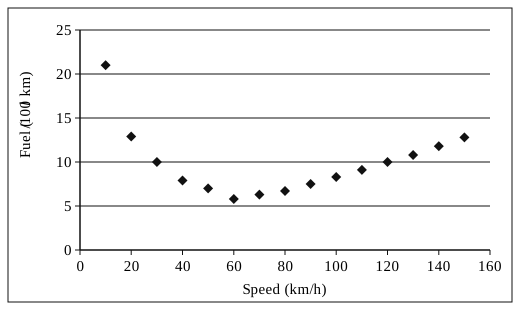
Overspeeding increases fuel consumption and decreases fuel economy as a result of tyre rolling friction and air resistance. While vehicles reach optimal fuel economy at different speeds, fuel mileage usually decreases rapidly at speeds above 80 km/h. The relation between fuel consumption F (l/100 km) and speed V (km/h) under some constraints is given as F=500V2−4V+14. On the basis of the above information, answer the following questions : (i) Find F, when V = 40 km/h. (1) (ii) Find dVdF. (1) (iii) (a) Find the speed V for which fuel consumption F is minimum. (2) OR (iii) (b) Find the quantity of fuel required to travel 600 km at the speed V at which dVdF=−0.01. (2)
Show answer & solution
Answer: (i) F = 7.2 l/100 km (ii) dVdF=250V−41 (iii)(a) V = 62.5 km/h OR (iii)(b) 37.2 litres
(i) F=5001600−440+14=3.2−10+14=7.2 l/100 km.
(ii) dVdF=5002V−41=250V−41.
(iii)(a) dVdF=0 gives V = 62.5; dV2d2F=2501>0, so F is minimum at V = 62.5 km/h.
(iii)(b) 250V−41=−0.01 gives 250V=0.24, V = 60 km/h.