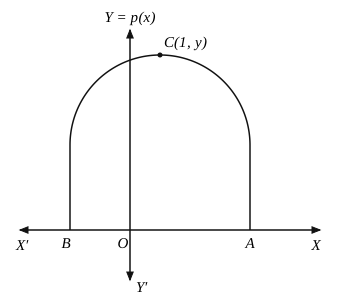
During a theatre drama, a backdrop of building arches was used. The shape of the curve shown below can be represented by the polynomial p(x)=−x2+2x+8, where x is the length (in feet) on stage level. Based on the figure given above, answer the following questions : (i) Determine the height of the arch. (1) (ii) (a) Find zeroes of the polynomial p(x). Which points on the graph represent the zeroes ? (2) OR (ii) (b) Find the span of the arch on the stage floor. (2) (iii) Write the coordinates of the point of intersection of the above curve with the y-axis. (1)
Show answer & solution
Answer: (i) 9 feet (ii) (a) Zeroes 4 and – 2, shown by points A(4, 0) and B(– 2, 0); OR (b) 6 feet (iii) (0, 8)
(i) Highest point C has x=1: p(1)=−1+2+8=9, so height =9 feet
(ii) (a) −x2+2x+8=0 gives x2−2x−8=0, (x−4)(x+2)=0
Zeroes: 4 and −2; they are the points A(4, 0) and B(– 2, 0) where the curve meets the x-axis
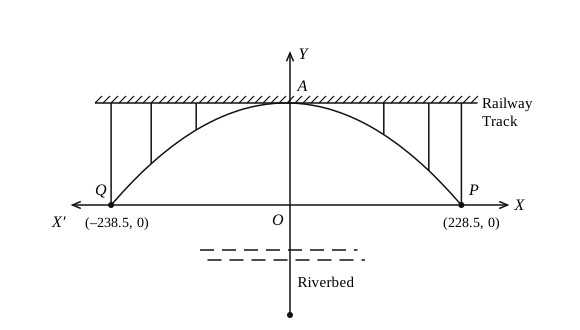
An arch of a railway bridge, built on Chenab riverbed, is shown in the above diagram. It is a parabolic arch connecting two hills at P and Q. If the parabolic curve is represented by the polynomial p(x)=−0.0025x2−0.025x+136. Observe the diagram and based on above information, answer the following questions : (i) Write the co-ordinates of point A. (1) (ii) Find the span of the arch. (1) (iii) (a) Write the zeroes of the polynomial using diagram and verify the relationship between sum of zeroes and polynomials. (2) OR (iii) (b) Find the values of p(x) at x=100 and x=−100. Are they same ? (2)
Show answer & solution
Answer: (i) A(0, 136) (ii) 467 m (iii) (a) Zeroes 228.5 and −238.5; sum = −10 = −ab OR (iii) (b) p(100) = 108.5, p(−100) = 113.5; not the same
(i) A lies on the y-axis, so x = 0 and p(0)=136. A = (0, 136).
(ii) Span = PQ = 228.5 − (−238.5) = 467 m.
(iii) (a) From the diagram the zeroes are 228.5 and −238.5.
Sum of zeroes = 228.5 + (−238.5) = −10.
−ab=−−0.0025−0.025=−10. Hence sum of zeroes =−ab, verified.
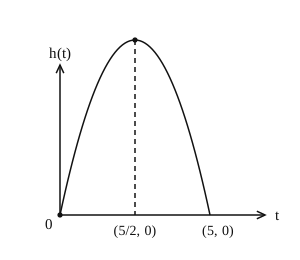
A ball is thrown in the air so that t seconds after it is thrown, its height h metre above its starting point is given by the polynomial h=25t−5t2. Observe the graph of the polynomial and answer the following questions : (i) Write zeroes of the given polynomial. (1) (ii) Find the maximum height achieved by ball. (1) (iii) (a) After throwing upward, how much time did the ball take to reach to the height of 30 m ? (2) OR (b) Find the two different values of t when the height of the ball was 20 m. (2)
Show answer & solution
Answer: (i) 0 and 5 (ii) 31.25 m (iii) (a) 2 seconds (it is again at 30 m at 3 seconds, on the way down) OR (b) t = 1 s and t = 4 s
(i) 25t−5t2=5t(5−t)=0 gives t=0 or t=5. The zeroes are 0 and 5 (the graph cuts the t-axis at (0, 0) and (5, 0)).
(ii) The maximum is at t=25: h=25×25−5×425=62.5−31.25=31.25 m.
(iii) (a) 25t−5t2=30 gives t2−5t+6=0, so (t−2)(t−3)=0 and t=2 or 3. Going upward, the ball first reaches 30 m after 2 seconds.
OR
(b) 25t−5t2=20 gives t2−5t+4=0, so (t−1)(t−4)=0 and t=1 s or t=4 s.
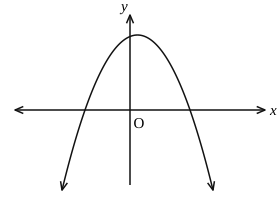
Rainbow is an arch of colours that is visible in the sky after rain or when water droplets are present in the atmosphere. The colours of the rainbow are generally, red, orange, yellow, green, blue, indigo and violet. Each colour of the rainbow makes a parabola. We know that any quadratic polynomial p(x)=ax2+bx+c(a=0) represents a parabola on the graph paper. Based on the above, answer the following questions : (i) The graph of a rainbow y=f(x) is shown in the figure. Write the number of zeroes of the curve. (1) (ii) If the graph of a rainbow does not intersect the x-axis but intersects y-axis at one point, then how many zeroes will it have ? (1) (iii) (a) If a rainbow is represented by the quadratic polynomial p(x)=x2+(a+1)x+b, whose zeroes are 2 and − 3, find the value of a and b. (2) OR (iii) (b) The polynomial x2−2x−(7p+3) represents a rainbow. If − 4 is a zero of it, find the value of p. (2)
Show answer & solution
Answer: (i) 2 (ii) 0 (iii) (a) a=0, b=−6 OR (b) p=3
(i) The curve cuts the x-axis at two points, so it has 2 zeroes.
(ii) It does not meet the x-axis, so it has no (0) zeroes.
(iii) (a) Sum of zeroes =2+(−3)=−1=−(a+1), so a=0.
Product of zeroes =2×(−3)=−6=b.
(iii) (b) (−4)2−2(−4)−(7p+3)=0, so 16+8−7p−3=0, 7p=21, p=3.
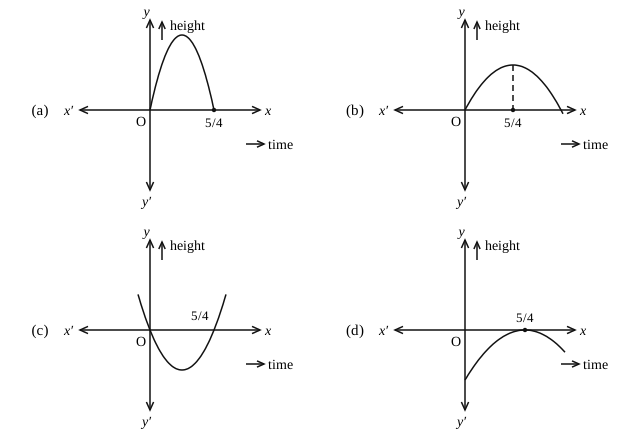
In a pool at an aquarium, a dolphin jumps out of the water travelling at 20 cm per second. Its height above water level after t seconds is given by h=20t−16t2. Based on the above, answer the following questions : (i) Find zeroes of polynomial p(t)=20t−16t2. (1) (ii) Which of the following types of graph represents p(t) ? (1) (iii) What would be the value of h at t=23 ? Interpret the result. (2) OR (iii) How much distance has the dolphin covered before hitting the water level again ? (2)
Show answer & solution
Answer: (i) 0 and 45 (ii) Graph (a) (iii) h = −6 cm: the dolphin is 6 cm below the water level at t=23 s; OR: 25 cm
(i) p(t)=4t(5−4t)=0 gives t = 0 or t=45.
(ii) The leading coefficient is negative, so the graph is a downward parabola cutting the time axis at 0 and 45: graph (a).
(iii) h=20×23−16×49=30−36=−6 cm.
Negative height means the dolphin has re-entered the water (at t=45 s) and is 6 cm below the water level.
OR: The dolphin is out of the water from t = 0 to t=45 s.
Distance covered at 20 cm per second =20×45=25 cm.