CBSE Class 10 Maths Standard 2024 Question Paper 30/2/2 with Solutions
All 44 questions from the CBSE Class 10 Mathematics Standard board paper, Set 30/2/2 (2024),
with answers and step-by-step solutions. Total 80 marks. Tap “Show answer & solution” under any question.
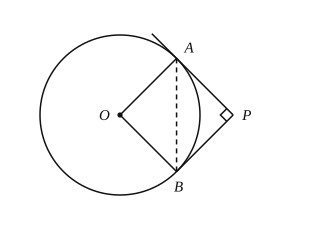
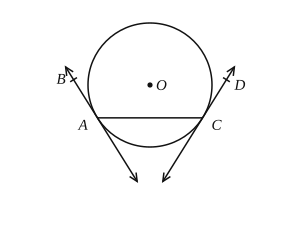
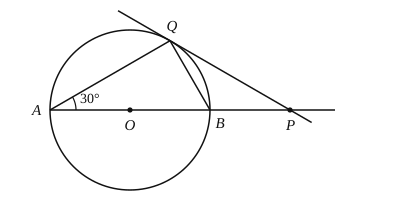
In the given figure, tangents PA and PB to the circle centred at O, from point P are perpendicular to each other. If PA = 5 cm, then length of AB is equal to
(A)5 cm
(B)52 cm
(C)25 cm
(D)10 cm
Show answer & solution
Answer: (B) 52 cm
PA = PB = 5 cm (tangents from an external point) and ∠APB=90∘.
After an examination, a teacher wants to know the marks obtained by Maximum number of the students in her class. She requires to calculate _____ of marks.
(A)median
(B)mode
(C)mean
(D)range
Show answer & solution
Answer: (B) mode
The value that occurs most often (obtained by the maximum number of students) is the mode.
A box contains cards numbered 6 to 55. A card is drawn at random from the box. The probability that the drawn card has a number which is a perfect square, is
(A)507
(B)557
(C)101
(D)495
Show answer & solution
Answer: (C) 101
Number of cards = 55 − 6 + 1 = 50.
Perfect squares from 6 to 55: 9, 16, 25, 36, 49, i.e. 5 numbers.
Assertion (A) : Two cubes each of edge length 10 cm are joined together. The total surface area of newly formed cuboid is 1200 cm2. Reason (R) : Area of each surface of a cube of side 10 cm is 100 cm2.
(A)Both Assertion (A) and Reason (R) are true. Reason (R) is the correct explanation of Assertion (A).
(B)Both Assertion (A) and Reason (R) are true. Reason (R) does not give correct explanation of (A).
(C)Assertion (A) is true but Reason (R) is not true.
(D)Assertion (A) is not true but Reason (R) is true.
Show answer & solution
Answer: (D) Assertion (A) is not true but Reason (R) is true.
R: each face is 10×10=100 cm2, so R is true.
The cuboid formed is 20 cm × 10 cm × 10 cm. It has 10 faces of the cubes exposed (two faces are hidden at the join).
TSA =10×100=1000 cm2, not 1200 cm2. So A is false.
In a test, the marks obtained by 100 students (out of 50) are given below : Marks obtained : 0 – 10, 10 – 20, 20 – 30, 30 – 40, 40 – 50 Number of students : 12, 23, 34, 25, 6 Find the mean marks of the students.
The angle of elevation of an aircraft from a point A on the ground is 60∘. After a flight of 30 seconds, the angle of elevation changes to 30∘. The aircraft is flying at a constant height of 35003 m at a uniform speed. Find the speed of the aircraft.
Show answer & solution
Answer:3700 m/s (about 233.33 m/s, i.e. 840 km/h)
Let B and C be the first and second positions of the aircraft, and M, N the points on the ground vertically below them, so BM = CN = 35003 m.
In right △AMB: tan60∘=AMBM, so AM=335003=3500 m.
In right △ANC: tan30∘=ANCN, so AN=35003×3=10500 m.
If the length of a rectangle is reduced by 5 cm and its breadth is increased by 2 cm, then the area of the rectangle is reduced by 80 cm2. However, if we increase the length by 10 cm and decrease the breadth by 5 cm, its area is increased by 50 cm2. Find the length and breadth of the rectangle.
Show answer & solution
Answer: Length = 40 cm, breadth = 30 cm
Let the length be x cm and breadth y cm.
(x−5)(y+2)=xy−80 gives 2x−5y−10=−80, i.e. 2x−5y=−70 ... (1)
(x+10)(y−5)=xy+50 gives −5x+10y−50=50, i.e. x−2y=−20 ... (2)
Tara scored 40 marks in a test, getting 3 marks for each right answer and losing 1 mark for each wrong answer. Had 4 marks been awarded for each correct answer and 2 marks been deducted for each wrong answer, then Tara would have scored 50 marks. Assuming that Tara attempted all questions, find the total number of questions in the test.
Show answer & solution
Answer: 20 questions
Let the right answers be x and wrong answers be y.
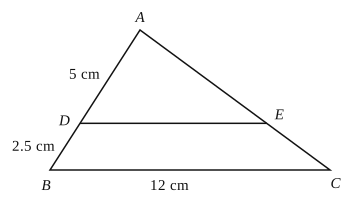
If a line is drawn parallel to one side of a triangle to intersect the other two sides in distinct points, then prove that the other two sides are divided in the same ratio.
Show answer & solution
Answer: Proved.
Given: In △ABC, DE ∥ BC with D on AB and E on AC. To prove: DBAD=ECAE.
Construction: Join BE and CD. Draw EN ⊥ AB and DM ⊥ AC.
ar(ADE) =21AD×EN and ar(BDE) =21DB×EN, so ar(BDE)ar(ADE)=DBAD ... (1)
ar(ADE) =21AE×DM and ar(DEC) =21EC×DM, so ar(DEC)ar(ADE)=ECAE ... (2)
△BDE and △DEC are on the same base DE and between the same parallels DE and BC, so ar(BDE) = ar(DEC) ... (3)
The word ‘circus’ has the same root as ‘circle’. In a closed circular area, various entertainment acts including human skill and animal training are presented before the crowd. A circus tent is cylindrical upto a height of 8 m and conical above it. The diameter of the base is 28 m and total height of tent is 18.5 m. Based on the above, answer the following questions : (i) Find slant height of the conical part. (1) (ii) Determine the floor area of the tent. (1) (iii) (a) Find area of the cloth used for making tent. (2) OR (b) Find total volume of air inside an empty tent. (2)
Show answer & solution
Answer: (i) 17.5 m (ii) 616 m2 (iii) (a) 1474 m2 OR (b) 7084 m3
Radius r=14 m, cylinder height h=8 m, cone height H=18.5−8=10.5 m.
(i) l=r2+H2=196+110.25=306.25=17.5 m
(ii) Floor area =πr2=722×14×14=616 m2
(iii) (a) Cloth = CSA of cylinder + CSA of cone =2πrh+πrl=πr(2h+l)=722×14×(16+17.5)=44×33.5=1474 m2
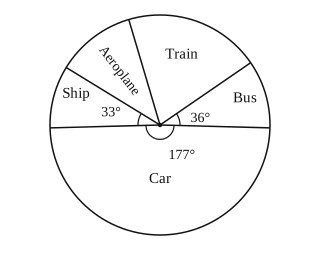
In a survey on holidays, 120 people were asked to state which type of transport they used on their last holiday. The following pie chart shows the results of the survey. Observe the pie chart and answer the following questions : (i) If one person is selected at random, find the probability that he/she travelled by bus or ship. (1) (ii) Which is most favourite mode of transport and how many people used it ? (1) (iii) (a) A person is selected at random. If the probability that he did not use train is 4/5, find the number of people who used train. (2) OR (b) The probability that randomly selected person used aeroplane is 7/60. Find the revenue collected by air company at the rate of ₹ 5,000 per person. (2)
Show answer & solution
Answer: (i) 12023 (ii) Car, 59 people (iii) (a) 24 OR (b) ₹70,000
120 people correspond to 360∘, so each person is 3∘.
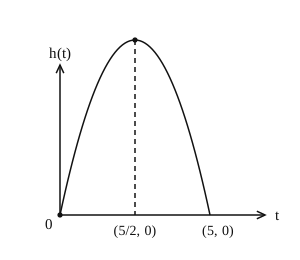
A ball is thrown in the air so that t seconds after it is thrown, its height h metre above its starting point is given by the polynomial h=25t−5t2. Observe the graph of the polynomial and answer the following questions : (i) Write zeroes of the given polynomial. (1) (ii) Find the maximum height achieved by ball. (1) (iii) (a) After throwing upward, how much time did the ball take to reach to the height of 30 m ? (2) OR (b) Find the two different values of t when the height of the ball was 20 m. (2)
Show answer & solution
Answer: (i) 0 and 5 (ii) 31.25 m (iii) (a) 2 seconds (it is again at 30 m at 3 seconds, on the way down) OR (b) t = 1 s and t = 4 s
(i) 25t−5t2=5t(5−t)=0 gives t=0 or t=5. The zeroes are 0 and 5 (the graph cuts the t-axis at (0, 0) and (5, 0)).
(ii) The maximum is at t=25: h=25×25−5×425=62.5−31.25=31.25 m.
(iii) (a) 25t−5t2=30 gives t2−5t+6=0, so (t−2)(t−3)=0 and t=2 or 3. Going upward, the ball first reaches 30 m after 2 seconds.
OR
(b) 25t−5t2=20 gives t2−5t+4=0, so (t−1)(t−4)=0 and t=1 s or t=4 s.