CBSE Class 10 Maths Basic 2023 Question Paper 430/5/1 with Solutions
All 44 questions from the CBSE Class 10 Mathematics Basic board paper, Set 430/5/1 (2023),
with answers and step-by-step solutions. Total 80 marks. Tap “Show answer & solution” under any question.
Assertion (A) : When two coins are tossed together, the probability of getting no tail is 41. Reason (R) : The probability P(E) of an event E satisfies 0≤ P(E) ≤1.
(A)Both Assertion (A) and Reason (R) are true and Reason (R) is the correct explanation of the Assertion (A).
(B)Both Assertion (A) and Reason (R) are true, but Reason (R) is not the correct explanation of the Assertion (A).
(C)Assertion (A) is true, but Reason (R) is false.
(D)Assertion (A) is false, but Reason (R) is true.
Show answer & solution
Answer: (B) Both (A) and (R) are true, but (R) is not the correct explanation of (A).
Outcomes: HH, HT, TH, TT. No tail means HH only.
P(no tail) =41, so A is true.
R is a true general fact, but it does not explain why the probability is 41.
Assertion (A) : The surface area of largest sphere that can be inscribed in a hollow cube of side ‘a’ cm is πa2 cm2. Reason (R) : The surface area of a sphere of radius ‘r’ is 34πr3.
(A)Both Assertion (A) and Reason (R) are true and Reason (R) is the correct explanation of the Assertion (A).
(B)Both Assertion (A) and Reason (R) are true, but Reason (R) is not the correct explanation of the Assertion (A).
(C)Assertion (A) is true, but Reason (R) is false.
(D)Assertion (A) is false, but Reason (R) is true.
Show answer & solution
Answer: (C) Assertion (A) is true, but Reason (R) is false.
The largest sphere has diameter a, so r=2a.
Surface area =4π(2a)2=πa2 cm2, so A is true.
34πr3 is the volume of a sphere, not its surface area (4πr2), so R is false.
Sabina went to a bank ATM to withdraw ₹ 2,000. She received ₹ 50 and ₹ 100 notes only. If Sabina got 25 notes in all, how many notes of ₹ 50 and ₹ 100 did she receive ?
Show answer & solution
Answer: 10 notes of ₹ 50 and 15 notes of ₹ 100
Let the number of ₹ 50 notes be x and ₹ 100 notes be y.
x+y=25 ... (1)
50x+100y=2000, i.e. x+2y=40 ... (2)
(2) − (1): y=15; then x=10.
She received 10 notes of ₹ 50 and 15 notes of ₹ 100.
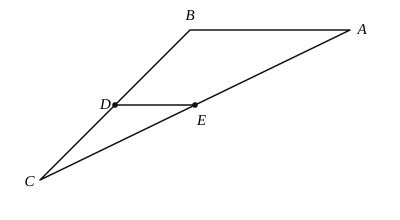
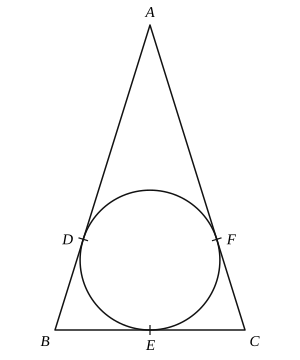
In the given figure, in △ABC points D and E are mid-points of sides BC and AC respectively. If given vertices are A(4, − 2), B(2, − 2) and C(− 6, − 7), then verify the result DE = 21 AB.
A person walking 48 m towards a tower in a horizontal line through its base observes that angle of elevation of the top of the tower changes from 45∘ to 60∘. Find the height of the tower and distance of the person, now, from the tower. (Use 3 = 1.732)
Show answer & solution
Answer: Height = 113.568 m (about 113.57 m); present distance = 65.568 m (about 65.57 m)
Let the height be h and the present distance be x m; the earlier distance was (x+48) m.
tan60∘=xh, so h=3x.
tan45∘=x+48h, so h=x+48.
3x=x+48, so x=3−148=24(3+1)=24×2.732=65.568 m.
h=x+48=113.568 m.
Height of the tower ≈ 113.57 m; the person is now ≈ 65.57 m from the tower.
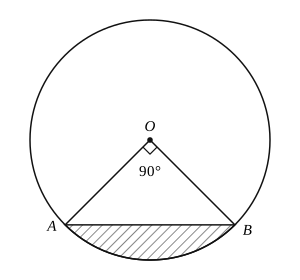
In the given figure, AB is a chord of a circle of radius 7 cm and centred at O. Find the area of the shaded region if ∠AOB=90∘. Also, find length of minor arc AB.
Show answer & solution
Answer: Area of shaded region = 14 cm2; minor arc AB = 11 cm
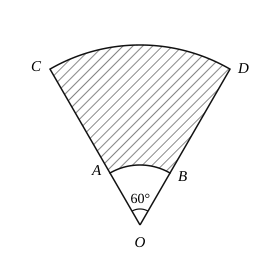
AB and CD are arcs of two concentric circles of radii 3.5 cm and 10.5 cm respectively and centred at O. Find the area of the shaded region if ∠AOB=60∘. Also, find the length of arc CD.
Show answer & solution
Answer: Area of shaded region =3154≈51.33 cm2; arc CD = 11 cm
Shaded area = sector OCD − sector OAB =36060×722×(10.52−3.52).
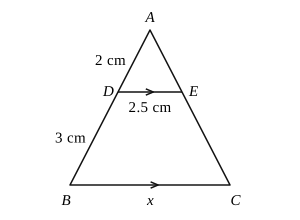
If a line is drawn parallel to one side of a triangle to intersect the other two sides at distinct points, then prove that the other two sides are divided in the same ratio.
Show answer & solution
Answer: Proved.
Given: In △ABC, DE ∥ BC meets AB at D and AC at E. To prove: DBAD=ECAE.
Construction: Join BE and CD; draw EM ⊥ AB and DN ⊥ AC.
ar(ADE) =21×AD×EM and ar(BDE) =21×DB×EM, so ar(BDE)ar(ADE)=DBAD.
Similarly ar(ADE) =21×AE×DN and ar(DEC) =21×EC×DN, so ar(DEC)ar(ADE)=ECAE.
△BDE and △DEC are on the same base DE and between the same parallels DE and BC, so ar(BDE) = ar(DEC).
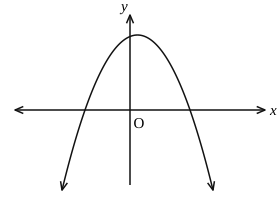
Rainbow is an arch of colours that is visible in the sky after rain or when water droplets are present in the atmosphere. The colours of the rainbow are generally, red, orange, yellow, green, blue, indigo and violet. Each colour of the rainbow makes a parabola. We know that any quadratic polynomial p(x)=ax2+bx+c(a=0) represents a parabola on the graph paper. Based on the above, answer the following questions : (i) The graph of a rainbow y=f(x) is shown in the figure. Write the number of zeroes of the curve. (1) (ii) If the graph of a rainbow does not intersect the x-axis but intersects y-axis at one point, then how many zeroes will it have ? (1) (iii) (a) If a rainbow is represented by the quadratic polynomial p(x)=x2+(a+1)x+b, whose zeroes are 2 and − 3, find the value of a and b. (2) OR (iii) (b) The polynomial x2−2x−(7p+3) represents a rainbow. If − 4 is a zero of it, find the value of p. (2)
Show answer & solution
Answer: (i) 2 (ii) 0 (iii) (a) a=0, b=−6 OR (b) p=3
(i) The curve cuts the x-axis at two points, so it has 2 zeroes.
(ii) It does not meet the x-axis, so it has no (0) zeroes.
(iii) (a) Sum of zeroes =2+(−3)=−1=−(a+1), so a=0.
Product of zeroes =2×(−3)=−6=b.
(iii) (b) (−4)2−2(−4)−(7p+3)=0, so 16+8−7p−3=0, 7p=21, p=3.
Singing bowls (hemispherical in shape) are commonly used in sound healing practices. Mallet (cylindrical in shape) is used to strike the bowl in a sequence to produce sound and vibration. One such bowl is shown here whose dimensions are : Hemispherical bowl has outer radius 6 cm and inner radius 5 cm. Mallet has height of 10 cm and radius 2 cm. Based on the above, answer the following questions : (i) What is the volume of the material used in making the mallet ? (1) (ii) The bowl is to be polished from inside. Find the inner surface area of the bowl. (1) (iii) (a) Find the volume of metal used to make the bowl. (2) OR (iii) (b) Find total surface area of the mallet. (Use π=3.14) (2)
Show answer & solution
Answer: (i) 7880≈125.71 cm3 (ii) 71100≈157.14 cm2 (iii) (a) 3572≈190.67 cm3 OR (b) 150.72 cm2
(i) Volume of mallet =πr2h=722×22×10=7880≈125.71 cm3.
(ii) Inner surface area =2πr2=2×722×52=71100≈157.14 cm2.
(iii) (a) Volume of metal =32π(R3−r3)=32×722×(216−125)=32×722×91=3572≈190.67 cm3.
(iii) (b) TSA of mallet =2πr(h+r)=2×3.14×2×(10+2)=150.72 cm2.
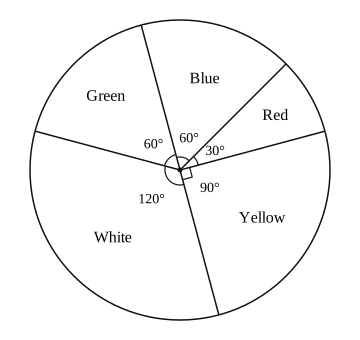
Some students were asked to list their favourite colour. The measure of each colour is shown by the central angle of a pie chart given below : Study the pie chart and answer the following questions : (i) If a student is chosen at random, then find the probability of his/her favourite colour being white ? (1) (ii) What is the probability of his/her favourite colour being blue or green ? (1) (iii) (a) If 15 students liked the colour yellow, how many students participated in the survey ? (2) OR (iii) (b) What is the probability of the favourite colour being red or blue ? (2)
Show answer & solution
Answer: (i) 31 (ii) 31 (iii) (a) 60 OR (b) 41
(i) P(white) =360120=31.
(ii) P(blue or green) =36060+60=31.
(iii) (a) Yellow has 90∘, i.e. 36090=41 of the students. So total =15×4=60.