Polynomials: CBSE Class 10 Previous Year Questions
190 different questions from Polynomials (NCERT Chapter 2) asked in CBSE Class 10 Maths board exams 2022–2026.
Pick a mark group to practise, each with answers and step-by-step solutions.
Assertion (A) : The polynomial p(y)=y2+4y+3 has two zeroes. Reason (R) : A quadratic polynomial can have at most two zeroes.
(A)Both, Assertion (A) and Reason (R) are true and Reason (R) is the correct explanation of the Assertion (A).
(B)Both, Assertion (A) and Reason (R) are true, but Reason (R) is not the correct explanation of the Assertion (A).
(C)Assertion (A) is true, but Reason (R) is false.
(D)Assertion (A) is false, but Reason (R) is true.
Show answer & solution
Answer: (B) Both, Assertion (A) and Reason (R) are true, but Reason (R) is not the correct explanation of the Assertion (A).
y2+4y+3=(y+1)(y+3), so the zeroes are −1 and −3. A is true.
A quadratic polynomial has at most two zeroes, so R is true.
R only gives an upper limit; it does not show that this polynomial actually has two zeroes (that comes from the factorisation). So R does not explain A.
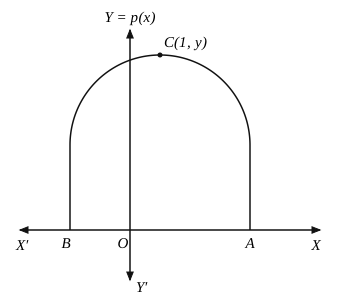
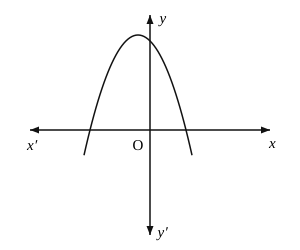
During a theatre drama, a backdrop of building arches was used. The shape of the curve shown below can be represented by the polynomial p(x)=−x2+2x+8, where x is the length (in feet) on stage level. Based on the figure given above, answer the following questions : (i) Determine the height of the arch. (1) (ii) (a) Find zeroes of the polynomial p(x). Which points on the graph represent the zeroes ? (2) OR (ii) (b) Find the span of the arch on the stage floor. (2) (iii) Write the coordinates of the point of intersection of the above curve with the y-axis. (1)
Show answer & solution
Answer: (i) 9 feet (ii) (a) Zeroes 4 and – 2, shown by points A(4, 0) and B(– 2, 0); OR (b) 6 feet (iii) (0, 8)
(i) Highest point C has x=1: p(1)=−1+2+8=9, so height =9 feet
(ii) (a) −x2+2x+8=0 gives x2−2x−8=0, (x−4)(x+2)=0
Zeroes: 4 and −2; they are the points A(4, 0) and B(– 2, 0) where the curve meets the x-axis
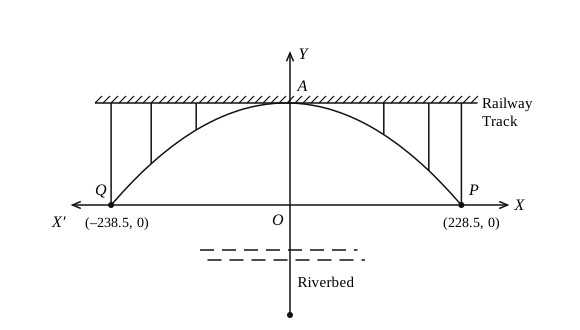
An arch of a railway bridge, built on Chenab riverbed, is shown in the above diagram. It is a parabolic arch connecting two hills at P and Q. If the parabolic curve is represented by the polynomial p(x)=−0.0025x2−0.025x+136. Observe the diagram and based on above information, answer the following questions : (i) Write the co-ordinates of point A. (1) (ii) Find the span of the arch. (1) (iii) (a) Write the zeroes of the polynomial using diagram and verify the relationship between sum of zeroes and polynomials. (2) OR (iii) (b) Find the values of p(x) at x=100 and x=−100. Are they same ? (2)
Show answer & solution
Answer: (i) A(0, 136) (ii) 467 m (iii) (a) Zeroes 228.5 and −238.5; sum = −10 = −ab OR (iii) (b) p(100) = 108.5, p(−100) = 113.5; not the same
(i) A lies on the y-axis, so x = 0 and p(0)=136. A = (0, 136).
(ii) Span = PQ = 228.5 − (−238.5) = 467 m.
(iii) (a) From the diagram the zeroes are 228.5 and −238.5.
Sum of zeroes = 228.5 + (−238.5) = −10.
−ab=−−0.0025−0.025=−10. Hence sum of zeroes =−ab, verified.