MonoMath CBSE
CBSE Maths › Class 10 PYQs › 2026

CBSE Class 10 Maths Standard 2026 Question Paper 30/3/3 with Solutions

All 44 questions from the CBSE Class 10 Mathematics Standard board paper, Set 30/3/3 (2026), with answers and step-by-step solutions. Total 80 marks. Tap “Show answer & solution” under any question.

Set 30/1/1Set 30/1/2Set 30/1/3Set 30/2/1Set 30/2/2Set 30/2/3Set 30/3/1Set 30/3/2Set 30/3/3Set 30/4/1Set 30/4/2Set 30/4/3Set 30/5/1Set 30/5/2Set 30/5/3

The number of multiples of 6 lying between 25 and 363 is :

  1. (A)56
  2. (B)56.5
  3. (C)57
  4. (D)58
Show answer & solution
Answer: (A) 56
  1. Multiples of 6 between 25 and 363: 30, 36, ..., 360
  2. , so ,
Q21 markMCQProbability

Two dice are rolled together. The probability that the sum of the numbers obtained is divisible by 6, is :

  1. (A)
  2. (B)
  3. (C)
  4. (D)
Show answer & solution
Answer: (A)
  1. Total outcomes
  2. Sum 6: (1, 5), (2, 4), (3, 3), (4, 2), (5, 1), i.e. 5 outcomes
  3. Sum 12: (6, 6), i.e. 1 outcome
  4. P
Also asked in: 2026 Standard 30/3/1

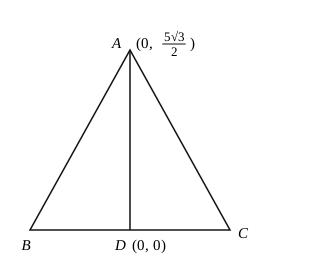
In the given figure, ABC is an equilateral triangle. AD is a median of the triangle joining the points A, D(0, 0). Points B and C are (in same order) :

Diagram for CBSE 2026 Class 10 Maths question 3
  1. (A)(– 5, 0), (5, 0)
  2. (B)
  3. (C)(– 10, 0), (10, 0)
  4. (D)
Show answer & solution
Answer: (B)
  1. AD is the height of the equilateral triangle
  2. Height side, so side
  3. D is the midpoint of BC on the x-axis, so BD = DC
  4. B, C
Q41 markMCQStatistics

The median and mode of a distribution are 25.2 and 26.1 respectively. The mean of the distribution is :

  1. (A)24.75
  2. (B)24.25
  3. (C)24.3
  4. (D)25.5
Show answer & solution
Answer: (A) 24.75
  1. Empirical relation: Mode Median Mean
  2. Mean Mean
  3. Mean
Q51 markMCQTriangles

It is given that ABC ~ QRP such that AB = 9 cm, BC = 5 cm and PR = 2 cm. Length of side QR is :

  1. (A)0.9 cm
  2. (B) cm
  3. (C) cm
  4. (D)3.6 cm
Show answer & solution
Answer: (D) 3.6 cm
  1. gives
  2. , so cm
Q61 markMCQPolynomials

A polynomial p(x), which has sum of its zeroes equal to their product, is :

  1. (A)
  2. (B)
  3. (C)
  4. (D)
Show answer & solution
Answer: (C)
  1. For : sum , product ; equal when
  2. (A) sum , product ; (B) sum , product ; (D) sum 3, product 2
  3. (C) sum , product : equal
Q71 markMCQCircles

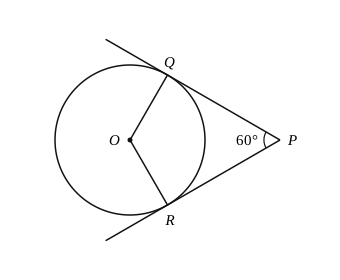
In the given figure, PQ and PR are tangents to a circle with centre O and radius 3 cm. If , then the length of each tangent is :

Diagram for CBSE 2026 Class 10 Maths question 7
  1. (A) cm
  2. (B)3 cm
  3. (C)6 cm
  4. (D) cm
Show answer & solution
Answer: (A) cm
  1. OP bisects , so
  2. (radius tangent), so in right :
  3. , so cm
Also asked in: 2026 Standard 30/3/1
Q81 markMCQTriangles

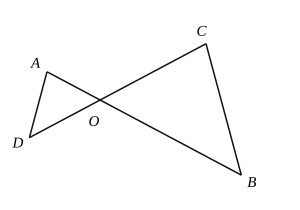
In the given figure, OA OB = OC OD. Which of the following option is correct ?

Diagram for CBSE 2026 Class 10 Maths question 8
  1. (A)
  2. (B)
  3. (C)
  4. (D)
Show answer & solution
Answer: (A)
  1. OA OB = OC OD gives
  2. (vertically opposite angles)
  3. So (SAS similarity), with A ↔ C, D ↔ B
  4. Hence (and )
  5. (D) would need , which is not given

The value of is :

  1. (A)0
  2. (B)
  3. (C)
  4. (D)
Show answer & solution
Answer: (C)
  1. ,
Also asked in: 2026 Standard 30/3/1

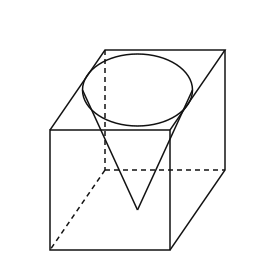
A cone of maximum size is carved out from a solid cube of edge length . The volume of the cone is :

Diagram for CBSE 2026 Class 10 Maths question 10
  1. (A)
  2. (B)
  3. (C)
  4. (D)
Show answer & solution
Answer: (A)
  1. Largest cone: base radius , height
  2. Volume
Q111 markMCQReal Numbers

is :

  1. (A)a prime number
  2. (B)divisible by 13
  3. (C)a composite number
  4. (D)an odd number
Show answer & solution
Answer: (C) a composite number
  1. It has factors other than 1 and itself, so it is composite
  2. (432 is even and , so it is not odd and not divisible by 13)

Given that , the value of is :

  1. (A)
  2. (B)
  3. (C)1
  4. (D)
Show answer & solution
Answer: (C) 1
  1. , so ,

If the length of the shadow of a tower is times that of its height, then altitude of the Sun is :

  1. (A)
  2. (B)
  3. (C)
  4. (D)
Show answer & solution
Answer: (B)
  1. Let height , shadow
  2. , so

Equation of a line coincident with is :

  1. (A)
  2. (B)
  3. (C)
  4. (D)
Show answer & solution
Answer: (D)
  1. Multiply by 2: , i.e.
  2. Coincident lines need , which holds only for (D)

The term of the A.P. is :

  1. (A)
  2. (B)
  3. (C)
  4. (D)
Show answer & solution
Answer: (B)
  1. ,
Q161 markMCQCircles

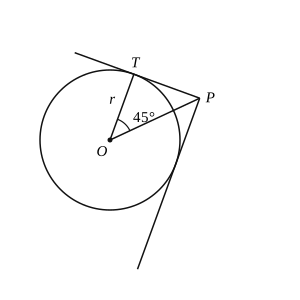
In the given figure, PT is a tangent to the circle with centre O and radius r. If , then the length of OP is :

Diagram for CBSE 2026 Class 10 Maths question 16
  1. (A)
  2. (B)
  3. (C)2r
  4. (D)
Show answer & solution
Answer: (A)
  1. , so is right-angled at T
  2. , so

The roots of the quadratic equation are :

  1. (A)5, 3
  2. (B)4, – 4
  3. (C)5, – 3
  4. (D)– 5, 3
Show answer & solution
Answer: (C) 5, – 3
  1. gives
  2. or
  3. Roots: 5 and
Also asked in: 2026 Standard 30/3/1

If the roots of the quadratic equation are real and equal, then the value(s) of is/are :

  1. (A)
  2. (B)0
  3. (C)4
  4. (D)– 5
Show answer & solution
Answer: (A)
  1. Equal roots:
  2. , so
Q191 markAssertion–ReasonIntroduction to Trigonometry

Assertion (A) : is not defined at .
Reason (R) : .

  1. (A)Both Assertion (A) and Reason (R) are true and Reason (R) is the correct explanation of the Assertion (A).
  2. (B)Both Assertion (A) and Reason (R) are true, but Reason (R) is not the correct explanation of the Assertion (A).
  3. (C)Assertion (A) is true, but Reason (R) is false.
  4. (D)Assertion (A) is false, but Reason (R) is true.
Show answer & solution
Answer: (B) Both A and R are true, but R is not the correct explanation of A.
  1. At , , not defined: A is true
  2. , , so R is true
  3. is undefined because , not because , so R does not explain A
Q201 markAssertion–ReasonCircles

Assertion (A) : Radius is the smallest distance of a tangent from the centre of the circle.
Reason (R) : Radius is perpendicular to the tangent.

  1. (A)Both Assertion (A) and Reason (R) are true and Reason (R) is the correct explanation of the Assertion (A).
  2. (B)Both Assertion (A) and Reason (R) are true, but Reason (R) is not the correct explanation of the Assertion (A).
  3. (C)Assertion (A) is true, but Reason (R) is false.
  4. (D)Assertion (A) is false, but Reason (R) is true.
Show answer & solution
Answer: (A) Both A and R are true and R is the correct explanation of A.
  1. The radius to the point of contact is perpendicular to the tangent, so R is true
  2. The perpendicular is the shortest distance from a point to a line, so the radius is the shortest distance from the centre to the tangent: A is true
  3. A follows from R, so R explains A
Q212 marksVery Short AnswerSurface Areas and Volumes

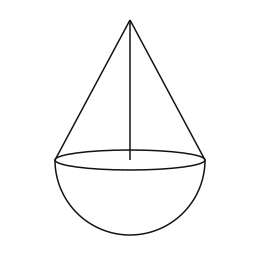
A toy is in the form of a cone mounted on a hemisphere of radius 7 cm. The total height of the toy is 31 cm. Find the total surface area of the toy.

Diagram for CBSE 2026 Class 10 Maths question 21
Show answer & solution
Answer: 858 cm
  1. Height of cone cm, radius cm
  2. Slant height cm
  3. TSA = CSA of cone + CSA of hemisphere
  4. cm
Also asked in: 2026 Standard 30/3/1
Q222 marksVery Short AnswerTriangles

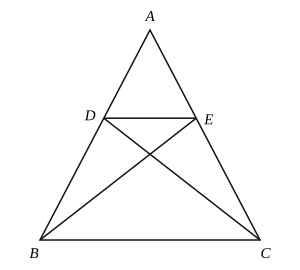
In the given figure, . Prove that .

Diagram for CBSE 2026 Class 10 Maths question 22
Show answer & solution
Answer: Proved.
  1. , so AB = AC and AE = AD (CPCT)
  2. Hence
  3. In and , (common)
  4. So (SAS similarity)
Q232 marksVery Short AnswerArithmetic Progressions

In an A.P., the first term is 4 and the last term is 31. If sum of all the terms is 175, find the number of terms and the common difference.

Show answer & solution
Answer: ,
  1. : , so
  2. : , so
OR
Q23 (OR) (OR)2 marksVery Short AnswerArithmetic Progressions

How many terms of the A.P. 21, 18, 15, .... must be added to get the sum zero ?

Show answer & solution
Answer: 15
  1. ,
  2. (as ), so
Q242 marksVery Short AnswerReal Numbers

Find the length of the plank that can be used to measure the lengths 4 m 20 cm and 5 m 4 cm exactly, in the least time.

Show answer & solution
Answer: 84 cm
  1. Lengths: 420 cm and 504 cm; the required length is their HCF
  2. HCF
  3. Length of plank cm
Q252 marksVery Short AnswerCoordinate Geometry

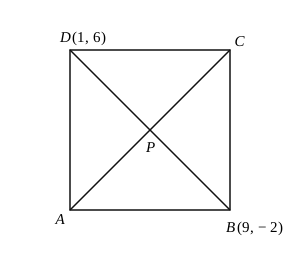
Diagonals AC and BD of square ABCD intersect at P. Coordinates of points B and D are (9, – 2) and (1, 6) respectively.
(i) Find the co-ordinates of point P.
(ii) Find the length of the side of the square.

Diagram for CBSE 2026 Class 10 Maths question 25
Show answer & solution
Answer: (i) P(5, 2) (ii) 8 units
  1. (i) Diagonals of a square bisect each other, so P is the midpoint of BD
  2. P
  3. (ii) BD
  4. Diagonal side, so side units
OR
Q25 (OR) (OR)2 marksVery Short AnswerCoordinate Geometry

Find the coordinates of a point on the line which is equidistant from (6, 4) and (5, 2).

Show answer & solution
Answer:
  1. Let the point be
  2. , so
  3. With : , so ,
  4. Point:
Q263 marksShort AnswerReal Numbers

Prove that is an irrational number.

Show answer & solution
Answer: Proved.
  1. Suppose is rational: , where are coprime integers,
  2. Then , so 2 divides , hence 2 divides (2 is prime)
  3. Let : , so , hence 2 divides
  4. So 2 divides both and , contradicting that they are coprime
  5. Hence is irrational
Q273 marksShort AnswerCircles

Two tangents PA and PB are drawn to a circle with centre O from an external point P. Prove that .

Show answer & solution
Answer: Proved.
  1. Let
  2. PA = PB (tangents from an external point), so
  3. , so
  4. Hence
OR
Q27 (OR) (OR)3 marksShort AnswerCircles

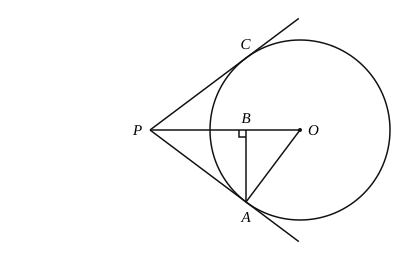
In the given figure, PA is the tangent to the circle with centre O such that OA = 10 cm, AB = 8 cm and AB OP. Find the length of PB.

Diagram for CBSE 2026 Class 10 Maths question 27 (OR)
Show answer & solution
Answer: cm (about 10.67 cm)
  1. In right : cm
  2. , so is right-angled at A, and AB is the altitude to OP
  3. (AA), so
  4. cm
Q283 marksShort AnswerCoordinate Geometry

Determine the ratio in which the line divides the line segment joining the points (1, 3) and (2, 5). Find the point of intersection.

Show answer & solution
Answer: 3 : 2; point
  1. Let the line divide the segment in the ratio
  2. Point
  3. It lies on the line: , so ,
  4. Ratio
  5. Point
Q293 marksShort AnswerIntroduction to Trigonometry

If , then prove that

Show answer & solution
Answer: Proved.
  1. Square both sides:
  2. , so
  3. Hence proved
OR
Q29 (OR) (OR)3 marksShort AnswerIntroduction to Trigonometry

Prove that :

Show answer & solution
Answer: Proved.
  1. LHS
  2. LHS RHS
Q303 marksShort AnswerAreas Related to Circles

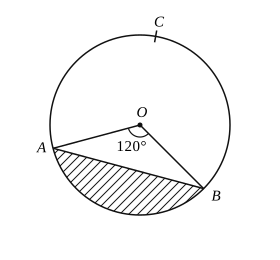
In the given figure, chord AB subtends an angle of at the centre of the circle with radius 7 cm. Find (i) perimeter of major sector OACB, and (ii) area of the shaded segment, if area of OAB = 21.2 cm.

Diagram for CBSE 2026 Class 10 Maths question 30
Show answer & solution
Answer: (i) cm (ii) cm
  1. (i) Major sector angle
  2. Arc ACB cm
  3. Perimeter cm
  4. (ii) Area of minor sector OAB cm
  5. Shaded segment cm (approx.)
Q313 marksShort AnswerQuadratic Equations

Find two consecutive negative integers, sum of whose squares is 481.

Show answer & solution
Answer: – 16 and – 15
  1. Let the integers be and ( negative)
  2. , so , i.e.
  3. , so (negative)
  4. Integers: and (check: )

Solve the following system of equations graphically :
,

Show answer & solution
Answer: ,
  1. : points (3, 0), (5, 1), (1, – 1)
  2. : points (5, 1), (– 3, – 2), (1, – 0.5)
  3. Plot both lines on the same axes
  4. The lines intersect at (5, 1)
  5. Check: and
  6. Solution: ,
Also asked in: 2026 Standard 30/3/1
OR
Q32 (OR) (OR)5 marksLong AnswerPair of Linear Equations in Two Variables

Five years ago, Adil was thrice as old as Bharat. Ten years later Adil shall be twice as old as Bharat. To know the present ages of Adil and Bharat :
(i) form the linear equations representing the above information.
(ii) show that the system of equations is consistent with unique solution.
(iii) find the present ages of Adil and Bharat.

Show answer & solution
Answer: (i) , (ii) , so unique solution (iii) Adil 50 years, Bharat 20 years
  1. (i) Let present ages: Adil , Bharat years
  2. gives
  3. gives
  4. (ii) ,
  5. Since , the system is consistent with a unique solution
  6. (iii) Subtract: , so
  7. Adil is 50 years, Bharat is 20 years
Also asked in: 2026 Standard 30/3/1
Q335 marksLong AnswerStatistics

Find the mean and the mode of the following frequency distribution :
Class: 0 – 15, 15 – 30, 30 – 45, 45 – 60, 60 – 75, 75 – 90, 90 – 105
Frequency: 9, 15, 35, 20, 11, 13, 17

Show answer & solution
Answer: Mean ; Mode
  1. Class marks : 7.5, 22.5, 37.5, 52.5, 67.5, 82.5, 97.5
  2. : 67.5, 337.5, 1312.5, 1050, 742.5, 1072.5, 1657.5
  3. ,
  4. Mean
  5. Modal class 30 – 45 (highest frequency 35): , , , ,
  6. Mode

The angle of elevation of the top of a building from a point A, on the ground, is . On moving a distance of 24 m towards its base to the point B, the angle of elevation changes to . Find the height of the building and distance of point A from the base of the building. (Take = 1.73)

Show answer & solution
Answer: Height m; distance of A from base m
  1. Let the building be CD (C the base), height , and BC
  2. From B: , so
  3. From A: , so
  4. m, m
  5. Distance of A from the base m
OR
Q34 (OR) (OR)5 marksLong AnswerSome Applications of Trigonometry

A tower stands vertically on the ground. A man standing at the top of the tower observes his friend at an angle of depression of , who is approaching the foot of the tower with a uniform speed. 30 seconds later, the angle of depression changes to . Find the time taken by his friend to reach the foot of the tower from this point.

Show answer & solution
Answer: 15 seconds
  1. Let the height of the tower be
  2. At depression: distance from foot
  3. At depression: distance from foot
  4. Distance covered in 30 s
  5. Remaining distance , which is half of that
  6. At the same speed, time seconds
Q355 marksLong AnswerTriangles

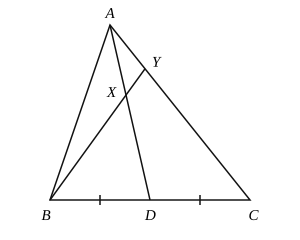
In ABC, AD is a median. X is a point on AD such that AX : XD = 2 : 3. BX is extended so that it intersects AC at Y. Prove that BX = 4 XY.

Diagram for CBSE 2026 Class 10 Maths question 35
Show answer & solution
Answer: Proved.
  1. Through D draw DZ BY meeting AC at Z
  2. In , D is the midpoint of BC and DZ BY, so DZ BY
  3. In , XY DZ, so (AA)
  4. , so XY DZ BY BY
  5. BX = BY − XY XY − XY XY
  6. Hence BX = 4 XY
Q364 marksCase StudySurface Areas and Volumes

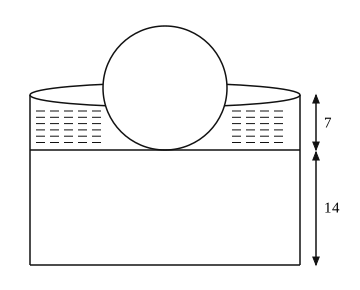
A model of Leafy Ball Fountain is made to be kept on the tabletop. Water gently cascades down the ball into a decorative cylindrical pool where it is recycled.
The diameter of spherical ball is 21 cm.
Cylindrical pool – Outer diameter is 50 cm and inner diameter is 40 cm.
Height of solid base is 14 cm.
Height of water filled is 7 cm.
Observe the figure and answer the following questions :
(i) Determine the total height of the fountain. (1)
(ii) Find the volume of the ball. (1)
(iii) (a) If one-third of the ball is submerged in the water, find the volume of the water filled in the pool. (2)
OR (iii) (b) Find the sum of the outer curved surface area of the cylindrical part and surface area of the ball. (2)

Diagram for CBSE 2026 Class 10 Maths question 36
Show answer & solution
Answer: (i) 35 cm (ii) 4851 cm (iii) (a) 7183 cm; OR (b) 4686 cm
  1. (i) The ball rests on the solid base: total height cm
  2. (ii) cm: cm
  3. (iii) (a) Water region: inner radius 20 cm, height 7 cm: cm
  4. Submerged part of ball cm
  5. Water cm
  6. (iii) (b) Outer radius 25 cm, height of cylindrical part cm
  7. Outer CSA cm
  8. Surface area of ball cm
  9. Sum cm
Q374 marksCase StudyPolynomials

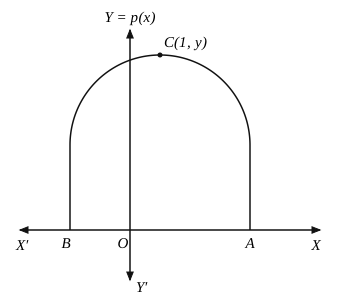
During a theatre drama, a backdrop of building arches was used. The shape of the curve shown below can be represented by the polynomial , where is the length (in feet) on stage level.
Based on the figure given above, answer the following questions :
(i) Determine the height of the arch. (1)
(ii) (a) Find zeroes of the polynomial p(x). Which points on the graph represent the zeroes ? (2)
OR (ii) (b) Find the span of the arch on the stage floor. (2)
(iii) Write the coordinates of the point of intersection of the above curve with the y-axis. (1)

Diagram for CBSE 2026 Class 10 Maths question 37
Show answer & solution
Answer: (i) 9 feet (ii) (a) Zeroes 4 and – 2, shown by points A(4, 0) and B(– 2, 0); OR (b) 6 feet (iii) (0, 8)
  1. (i) Highest point C has : , so height feet
  2. (ii) (a) gives ,
  3. Zeroes: 4 and ; they are the points A(4, 0) and B(– 2, 0) where the curve meets the x-axis
  4. (ii) (b) Span AB feet
  5. (iii) At : , so the point is (0, 8)
Q384 marksCase StudyProbability

A group of friends wanted to play cards with two identical packs together. While shuffling the cards, three cards are dropped. Rest of the cards are shuffled and one card is drawn at random. Assuming that the dropped cards were a queen of hearts, a ten of spades and an ace of clubs, answer the following questions :
(i) Find the probability that the drawn card is a face card. (1)
(ii) Find the probability that the drawn card is either a king or a queen. (1)
(iii) (a) Do you think that the probability of getting a queen was higher if none of the cards were dropped ? Justify your answer. (2)
OR (iii) (b) Find the probability that the drawn card is a jack. Compare it with the probability when none of the cards were dropped. In which case is the probability of getting a jack higher ? (2)

Show answer & solution
Answer: (i) (ii) (iii) (a) Yes: ; OR (b) , which is higher than when no card is dropped
  1. Two packs: 104 cards; after dropping 3, 101 cards remain
  2. (i) Face cards: 24, one (queen of hearts) dropped, so 23; P
  3. (ii) Kings 8, queens : P
  4. (iii) (a) Now P(queen) ; with no card dropped P(queen)
  5. So yes, the probability was higher if no card was dropped
  6. (iii) (b) All 8 jacks remain: P(jack) ; with no card dropped P(jack)
  7. , so the probability of a jack is higher in the present case (cards dropped)
← 2026 Standard 30/3/2 2026 Standard 30/4/1 →
Practise smarter: chapter-wise revision, formula sheets and step-by-step NCERT solutions on MonoMath CBSE →