CBSE Class 10 Maths Standard 2023 Question Paper 30/5/3 with Solutions
All 44 questions from the CBSE Class 10 Mathematics Standard board paper, Set 30/5/3 (2023),
with answers and step-by-step solutions. Total 80 marks. Tap “Show answer & solution” under any question.
Assertion (A) : The number 5n cannot end with the digit 0, where n is a natural number. Reason (R): Prime factorisation of 5 has only two factors, 1 and 5.
(A)Both Assertion (A) and Reason (R) are true and Reason (R) is the correct explanation of the Assertion (A).
(B)Both Assertion (A) and Reason (R) are true, but Reason (R) is not the correct explanation of the Assertion (A).
(C)Assertion (A) is true, but Reason (R) is false.
(D)Assertion (A) is false, but Reason (R) is true.
Show answer & solution
Answer: (C) Assertion (A) is true, but Reason (R) is false.
To end in 0 a number must have both 2 and 5 as prime factors.
5n has only the prime 5 in its factorisation, so it never ends in 0. A is true.
The prime factorisation of 5 is just 5; 1 is not a prime factor. So R, as stated, is false (and it does not explain A anyway).
Assertion (A) : If the points A(4, 3) and B(x, 5) lie on a circle with centre O(2, 3), then the value of x is 2. Reason (R) : Centre of a circle is the mid-point of each chord of the circle.
(A)Both Assertion (A) and Reason (R) are true and Reason (R) is the correct explanation of the Assertion (A).
(B)Both Assertion (A) and Reason (R) are true, but Reason (R) is not the correct explanation of the Assertion (A).
(C)Assertion (A) is true, but Reason (R) is false.
(D)Assertion (A) is false, but Reason (R) is true.
Show answer & solution
Answer: (C) Assertion (A) is true, but Reason (R) is false.
OA = (4−2)2+02=2.
OB = OA: (x−2)2+(5−3)2=4, so (x−2)2=0, x = 2. A is true.
The centre is the mid-point only of a diameter, not of every chord. R is false.
The traffic lights at three different road crossings change after every 48 seconds, 72 seconds and 108 seconds respectively. If they change simultaneously at 7 a.m., at what time will they change together next ?
Show answer & solution
Answer: At 7:07:12 a.m.
48=24×3, 72=23×32, 108=22×33.
LCM =24×33=432 seconds = 7 minutes 12 seconds.
They change together next at 7 hours 7 minutes 12 seconds a.m.
A train travels at a certain average speed for a distance of 54 km and then travels a distance of 63 km at an average speed of 6 km/h more than the first speed. If it takes 3 hours to complete the journey, what was its first average speed ?
Two pipes together can fill a tank in 815 hours. The pipe with larger diameter takes 2 hours less than the pipe with smaller diameter to fill the tank separately. Find the time in which each pipe can fill the tank separately.
A horse is tied to a peg at one corner of a square shaped grass field of side 15 m by means of a 5 m long rope. Find the area of that part of the field in which the horse can graze. Also, find the increase in grazing area if length of rope is increased to 10 m. (Use π=3.14)
Show answer & solution
Answer: 19.625 m2; increase = 58.875 m2
The horse grazes a quadrant (angle 90∘) of radius equal to the rope.
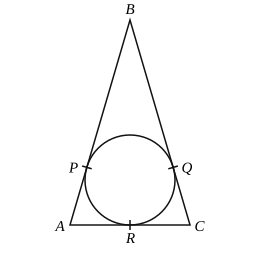
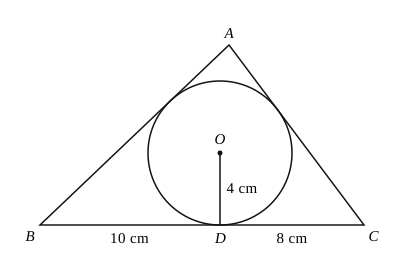
A triangle ABC is drawn to circumscribe a circle of radius 4 cm such that the segments BD and DC are of lengths 10 cm and 8 cm respectively. Find the lengths of the sides AB and AC, if it is given that area △ABC=90 cm2.
Show answer & solution
Answer: AB = 14.5 cm, AC = 12.5 cm
Tangents from an external point are equal. Let the tangent length from A be x.
Then AB = x + 10, AC = x + 8, BC = 18 cm.
Area △ABC = area OBC + area OCA + area OAB =21×4×(AB+BC+CA).
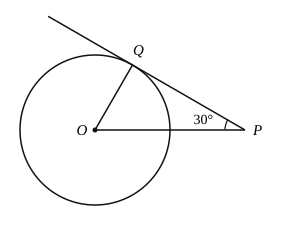
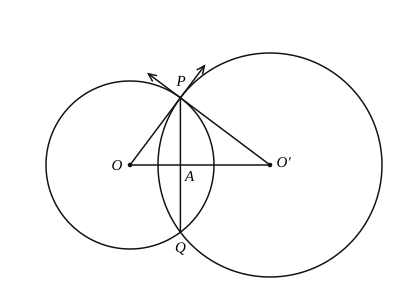
Two circles with centres O and O′ of radii 6 cm and 8 cm, respectively intersect at two points P and Q such that OP and O′P are tangents to the two circles. Find the length of the common chord PQ.
Show answer & solution
Answer: PQ = 9.6 cm
O′P is tangent to the circle with centre O at P, so OP ⊥ O′P; ∠OPO′=90∘.
OO′=62+82=10 cm.
The common chord PQ is perpendicular to OO′ and bisected by it at A.
Area of △OPO′: 21×OP×O′P=21×OO′×PA, so PA=106×8=4.8 cm.
Two pillars are standing on either side of a 80 m wide road. Height of one pillar is 20 m more than the height of the other pillar. From a point on the road between the pillars, the angle of elevation of the higher pillar is 60∘, whereas that of the other pillar is 30∘. Find the position of the point between the pillars and the height of each pillar. (Use 3=1.73)
Show answer & solution
Answer: The point is 20+53≈28.65 m from the higher pillar (51.35 m from the other); heights ≈ 49.6 m and 29.6 m
Let the shorter pillar have height h m, so the higher one is (h + 20) m. Let the point be x m from the foot of the higher pillar, so (80 – x) m from the other.
Higher pillar: tan60∘=xh+20, so h+20=3x.
Other pillar: tan30∘=80−xh, so h=380−x.
3x−20=380−x gives 3x−203=80−x, so 4x=80+203, x=20+53.
x = 20 + 5(1.73) = 28.65 m; distance from the other pillar = 80 – 28.65 = 51.35 m.
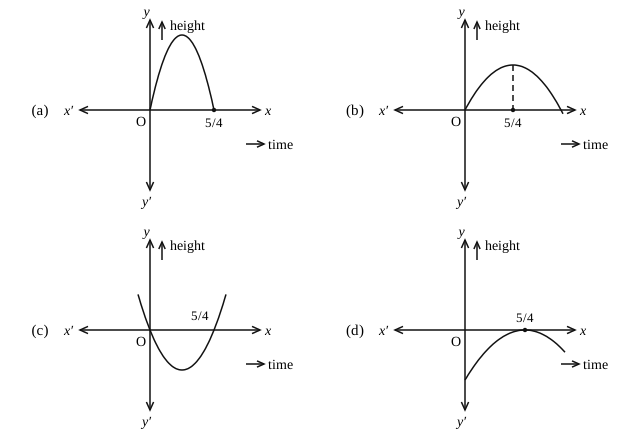
In a pool at an aquarium, a dolphin jumps out of the water travelling at 20 cm per second. Its height above water level after t seconds is given by h=20t−16t2. Based on the above, answer the following questions : (i) Find zeroes of polynomial p(t)=20t−16t2. (1) (ii) Which of the following types of graph represents p(t) ? (1) (iii) What would be the value of h at t=23 ? Interpret the result. (2) OR (iii) How much distance has the dolphin covered before hitting the water level again ? (2)
Show answer & solution
Answer: (i) 0 and 45 (ii) Graph (a) (iii) h = −6 cm: the dolphin is 6 cm below the water level at t=23 s; OR: 25 cm
(i) p(t)=4t(5−4t)=0 gives t = 0 or t=45.
(ii) The leading coefficient is negative, so the graph is a downward parabola cutting the time axis at 0 and 45: graph (a).
(iii) h=20×23−16×49=30−36=−6 cm.
Negative height means the dolphin has re-entered the water (at t=45 s) and is 6 cm below the water level.
OR: The dolphin is out of the water from t = 0 to t=45 s.
Distance covered at 20 cm per second =20×45=25 cm.
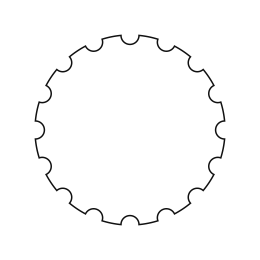
A golf ball is spherical with about 300 – 500 dimples that help increase its velocity while in play. Golf balls are traditionally white but available in colours also. In the given figure, a golf ball has diameter 4.2 cm and the surface has 315 dimples (hemi-spherical) of radius 2 mm. Based on the above, answer the following questions : (i) Find the surface area of one such dimple. (1) (ii) Find the volume of the material dug out to make one dimple. (1) (iii) Find the total surface area exposed to the surroundings. (2) OR (iii) Find the volume of the golf ball. (2)
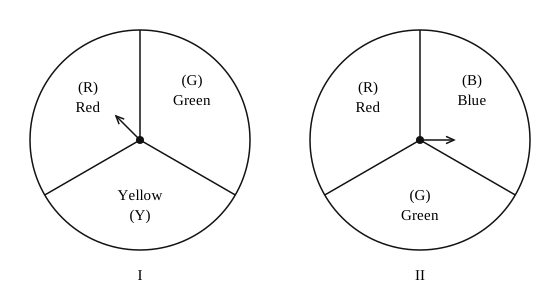
A middle school decided to run the following spinner game as a fund-raiser on Christmas Carnival. Making Purple : Spin each spinner once. Blue and red make purple. So, if one spinner shows Red (R) and another Blue (B), then you ‘win’. One such outcome is written as ‘RB’. Based on the above, answer the following questions : (i) List all possible outcomes of the game. (1) (ii) Find the probability of ‘Making Purple’. (1) (iii) For each win, a participant gets ₹ 10, but if he/she loses, he/she has to pay ₹ 5 to the school. If 99 participants played, calculate how much fund could the school have collected. (2) OR (iii) If the same amount of ₹ 5 has been decided for winning or losing the game, then how much fund had been collected by school ? (Number of participants = 99) (2)