CBSE Class 10 Maths Standard 2026 Question Paper 30/3/1 with Solutions
All 44 questions from the CBSE Class 10 Mathematics Standard board paper, Set 30/3/1 (2026),
with answers and step-by-step solutions. Total 80 marks. Tap “Show answer & solution” under any question.
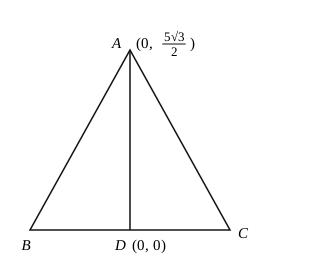
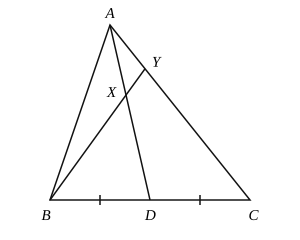
In the given figure, Δ ABC is an equilateral triangle. AD is a median of the triangle joining the points A(0,253), D(0, 0). Points B and C are (in same order) :
(A)(– 5, 0), (5, 0)
(B)(−25,0),(25,0)
(C)(– 10, 0), (10, 0)
(D)(−53,0),(53,0)
Show answer & solution
Answer: (B) (−25,0),(25,0)
AD =253 is the height of the equilateral triangle
Height =23× side, so side =5
D is the midpoint of BC on the x-axis, so BD = DC =25
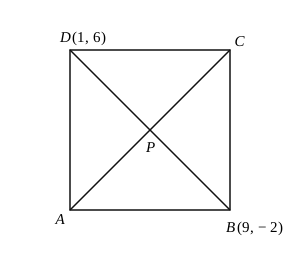
Diagonals AC and BD of square ABCD intersect at P. Coordinates of points B and D are (9, – 2) and (1, 6) respectively. (i) Find the co-ordinates of point P. (ii) Find the length of the side of the square.
Show answer & solution
Answer: (i) P(5, 2) (ii) 8 units
(i) Diagonals of a square bisect each other, so P is the midpoint of BD
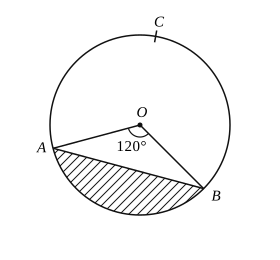
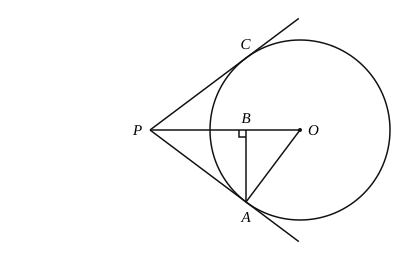
In the given figure, chord AB subtends an angle of 120∘ at the centre of the circle with radius 7 cm. Find (i) perimeter of major sector OACB, and (ii) area of the shaded segment, if area of Δ OAB = 21.2 cm2.
Show answer & solution
Answer: (i) 3130≈43.33 cm (ii) ≈30.13 cm2
(i) Major sector angle =360∘−120∘=240∘
Arc ACB =360240×2×722×7=388 cm
Perimeter =7+7+388=3130≈43.33 cm
(ii) Area of minor sector OAB =360120×722×72=3154≈51.33 cm2
The median of the following data is 137. Find the values of x and y, given that total of frequencies is 68. Class: 65 – 85, 85 – 105, 105 – 125, 125 – 145, 145 – 165, 165 – 185, 185 – 205 Frequency: 4, 5, x, 20, 14, y, 4
Five years ago, Adil was thrice as old as Bharat. Ten years later Adil shall be twice as old as Bharat. To know the present ages of Adil and Bharat : (i) form the linear equations representing the above information. (ii) show that the system of equations is consistent with unique solution. (iii) find the present ages of Adil and Bharat.
Show answer & solution
Answer: (i) x−3y=−10, x−2y=10 (ii) a2a1=b2b1, so unique solution (iii) Adil 50 years, Bharat 20 years
(i) Let present ages: Adil =x, Bharat =y years
x−5=3(y−5) gives x−3y=−10
x+10=2(y+10) gives x−2y=10
(ii) a2a1=11=1, b2b1=−2−3=23
Since a2a1=b2b1, the system is consistent with a unique solution
A boy standing on a horizontal plane is flying a kite with a string of length 60 m, at an angle of elevation of 30∘. Another boy standing on the roof of a 20 m high building, finds the angle of elevation of same kite to be 45∘. If both the boys are on opposite sides of the kite, find the distance of the first boy from the base of the building. Also, find the height of the kite from the ground. (Use 3 = 1.73)
Show answer & solution
Answer: Distance = 61.9 m; height of kite = 30 m
Let K be the kite and M the point on the ground directly below it
First boy at A: AK =60 m, ∠KAM=30∘
KM =60sin30∘=30 m (height of kite)
AM =60cos30∘=303=51.9 m
Second boy at roof point R, 20 m high: height of kite above roof =30−20=10 m
tan45∘=horizontal distance10, so horizontal distance from building to M =10 m
Boys are on opposite sides, so distance of first boy from base of building =51.9+10=61.9 m
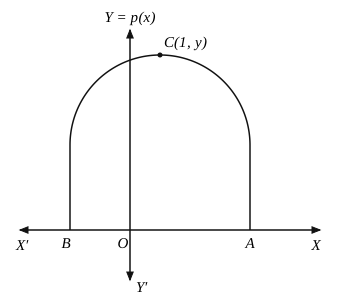
During a theatre drama, a backdrop of building arches was used. The shape of the curve shown below can be represented by the polynomial p(x)=−x2+2x+8, where x is the length (in feet) on stage level. Based on the figure given above, answer the following questions : (i) Determine the height of the arch. (1) (ii) (a) Find zeroes of the polynomial p(x). Which points on the graph represent the zeroes ? (2) OR (ii) (b) Find the span of the arch on the stage floor. (2) (iii) Write the coordinates of the point of intersection of the above curve with the y-axis. (1)
Show answer & solution
Answer: (i) 9 feet (ii) (a) Zeroes 4 and – 2, shown by points A(4, 0) and B(– 2, 0); OR (b) 6 feet (iii) (0, 8)
(i) Highest point C has x=1: p(1)=−1+2+8=9, so height =9 feet
(ii) (a) −x2+2x+8=0 gives x2−2x−8=0, (x−4)(x+2)=0
Zeroes: 4 and −2; they are the points A(4, 0) and B(– 2, 0) where the curve meets the x-axis
A group of friends wanted to play cards with two identical packs together. While shuffling the cards, three cards are dropped. Rest of the cards are shuffled and one card is drawn at random. Assuming that the dropped cards were a queen of hearts, a ten of spades and an ace of clubs, answer the following questions : (i) Find the probability that the drawn card is a face card. (1) (ii) Find the probability that the drawn card is either a king or a queen. (1) (iii) (a) Do you think that the probability of getting a queen was higher if none of the cards were dropped ? Justify your answer. (2) OR (iii) (b) Find the probability that the drawn card is a jack. Compare it with the probability when none of the cards were dropped. In which case is the probability of getting a jack higher ? (2)
Show answer & solution
Answer: (i) 10123 (ii) 10115 (iii) (a) Yes: 131>1017; OR (b) 1018, which is higher than 1048=131 when no card is dropped
Two packs: 104 cards; after dropping 3, 101 cards remain
(i) Face cards: 24, one (queen of hearts) dropped, so 23; P =10123
(ii) Kings 8, queens 8−1=7: P =10115
(iii) (a) Now P(queen) =1017≈0.069; with no card dropped P(queen) =1048=131≈0.077
So yes, the probability was higher if no card was dropped
(iii) (b) All 8 jacks remain: P(jack) =1018; with no card dropped P(jack) =1048=131
1018>1048, so the probability of a jack is higher in the present case (cards dropped)
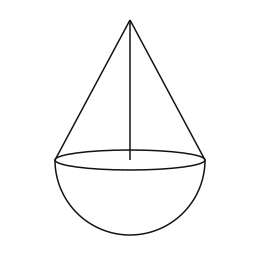
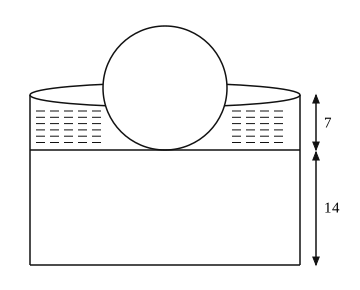
A model of Leafy Ball Fountain is made to be kept on the tabletop. Water gently cascades down the ball into a decorative cylindrical pool where it is recycled. The diameter of spherical ball is 21 cm. Cylindrical pool – Outer diameter is 50 cm and inner diameter is 40 cm. Height of solid base is 14 cm. Height of water filled is 7 cm. Observe the figure and answer the following questions : (i) Determine the total height of the fountain. (1) (ii) Find the volume of the ball. (1) (iii) (a) If one-third of the ball is submerged in the water, find the volume of the water filled in the pool. (2) OR (iii) (b) Find the sum of the outer curved surface area of the cylindrical part and surface area of the ball. (2)
Show answer & solution
Answer: (i) 35 cm (ii) 4851 cm3 (iii) (a) 7183 cm3; OR (b) 4686 cm2
(i) The ball rests on the solid base: total height =14+21=35 cm
(ii) r=10.5 cm: V=34×722×10.53=4851 cm3
(iii) (a) Water region: inner radius 20 cm, height 7 cm: 722×202×7=8800 cm3
Submerged part of ball =31×4851=1617 cm3
Water =8800−1617=7183 cm3
(iii) (b) Outer radius 25 cm, height of cylindrical part =14+7=21 cm