Polynomials: 1 mark Questions (CBSE Class 10)
104 different 1 mark questions on Polynomials from CBSE Class 10 Maths board exams 2022–2026, newest first.
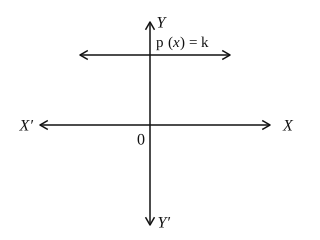
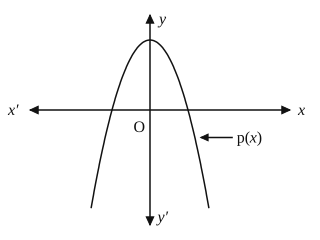
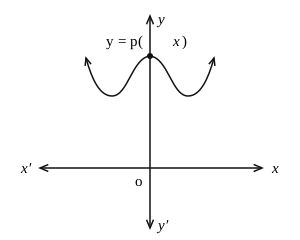
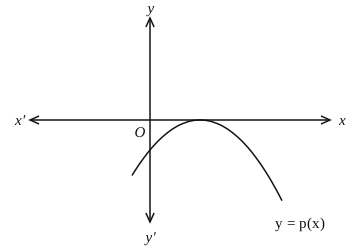
The graph of polynomial p(x x
(A) 0(B) 1(C) 2(D) infinitely manyShow answer & solution
Answer: (A) 0
The zeroes are the x-coordinates where the graph meets the x-axis. The graph of p(x Number of zeroes = 0.
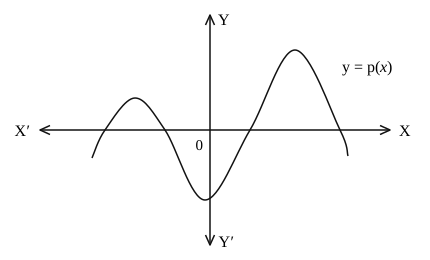
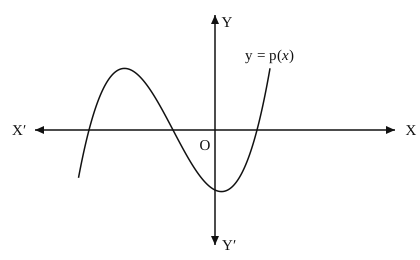
The graph of a polynomial p ( x ) p ( x )
(A) 5(B) 1(C) 0(D) 4Show answer & solution
Answer: (D) 4
The number of zeroes equals the number of points where the graph meets the x-axis. The graph cuts the x-axis at 4 points, so p(x) has 4 zeroes.
The value of k for which sum of the zeroes of the polynomial p ( x ) = 3 x 2 − k x + 6
(A) 2(B) − 6 (C) − 2 (D) 6Show answer & solution
Answer: (D) 6
Sum of zeroes = − a b = 3 k 3 k = 2 k = 6
If the zeroes of the polynomial p ( x ) = 2 x 2 − 7 x + 6 α β α 1 + β 1
(A) 2 7 (B) 7 6 (C) 6 − 7 (D) 6 7 Show answer & solution
Answer: (D) 6 7
α + β = 2 7 α β = 2 6 = 3 α 1 + β 1 = α β α + β = 3 7/2 = 6 7
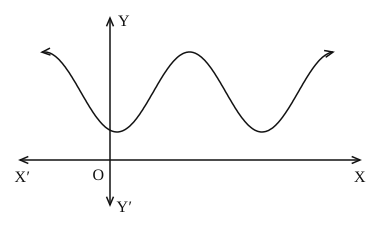
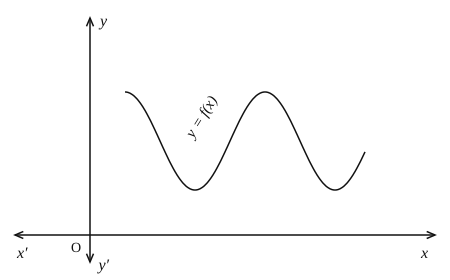
The graph of y = f ( x ) f ( x )
(A) 0(B) 1(C) 2(D) 4Show answer & solution
Answer: (A) 0
The zeroes of f ( x ) x x The given curve lies wholly above the x So f ( x )
Assertion (A) : The polynomial p ( y ) = y 2 + 4 y + 3
(A) Both, Assertion (A) and Reason (R) are true and Reason (R) is the correct explanation of the Assertion (A).(B) Both, Assertion (A) and Reason (R) are true, but Reason (R) is not the correct explanation of the Assertion (A).(C) Assertion (A) is true, but Reason (R) is false.(D) Assertion (A) is false, but Reason (R) is true.Show answer & solution
Answer: (B) Both, Assertion (A) and Reason (R) are true, but Reason (R) is not the correct explanation of the Assertion (A).
y 2 + 4 y + 3 = ( y + 1 ) ( y + 3 ) − 1 − 3 A quadratic polynomial has at most two zeroes, so R is true. R only gives an upper limit; it does not show that this polynomial actually has two zeroes (that comes from the factorisation). So R does not explain A.
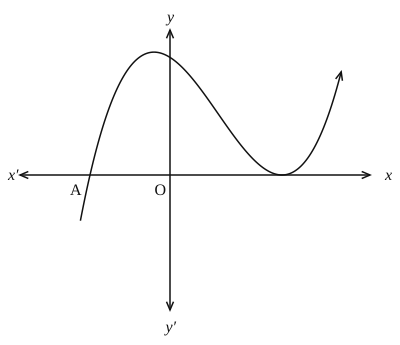
The graph of y = f ( x ) y = f ( x )
(A) 0(B) 1(C) 2(D) 3Show answer & solution
Answer: (C) 2
The zeroes are the x-coordinates of the points where the graph meets the x-axis. The graph cuts the x-axis at A and touches it at one more point on the right of O. So there are 2 distinct zeroes.
If α β f ( x ) = p x 2 − 2 x + 3 p α + β = α β
(A) − 3 2 (B) 3 2 (C) 3 1 (D) − 3 1 Show answer & solution
Answer: (B) 3 2
α + β = p 2 α β = p 3 p = 3 p 2 = 3 p = 3 2
How many zeroes does p(x) = (x - 2) (x + 3) have ?
(A) Zero(B) One(C) Two(D) ThreeShow answer & solution
Answer: (C) Two
p(x) = 0 when x = 2 or x = -3. So p(x) has two zeroes.
The sum and product of zeroes of a quadratic polynomial p(x) are 3 − 1
(A) 3 x 2 − x + 6 (B) x 2 + 3 1 x − 2 (C) 3 x 2 − x + 2 (D) − 3 x 2 − x − 6 Show answer & solution
Answer: (D) − 3 x 2 − x − 6
p ( x ) = k [ x 2 − ( sum ) x + product ] = k [ x 2 + 3 1 x + 2 ] With k = − 3 p ( x ) = − 3 x 2 − x − 6 Check: sum = − − 3 − 1 = − 3 1 = − 3 − 6 = 2
A polynomial p(x), which has sum of its zeroes equal to their product, is :
(A) 3 x 2 + 2 x + 2 (B) 3 x 2 − 2 x − 3 (C) 3 x 2 − 2 x + 2 (D) x 2 − 3 x + 2 Show answer & solution
Answer: (C) 3 x 2 − 2 x + 2
For a x 2 + b x + c = − a b = a c − b = c (A) sum − 3 2 3 2 3 2 − 1 (C) sum = 3 2 = 3 2
Observe the graph of polynomial p ( x ) p ( x )
(A) 5(B) 4(C) 6(D) 3Show answer & solution
Answer: (D) 3
The number of zeroes equals the number of points where the graph meets the x-axis. The curve cuts the x-axis at 3 points, so p ( x )
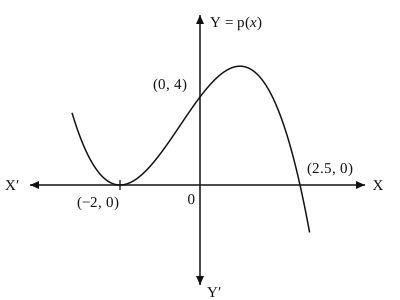
Observe the graph of polynomial p ( x )
(A) − 2 (B) − 2 (C) 0, 4(D) − 2 Show answer & solution
Answer: (B) − 2
Zeroes are the x-coordinates of the points where the graph meets the x-axis. The graph touches the x-axis at ( − 2 , 0 ) (0, 4) is the y-intercept, not a zero. Zeroes: − 2
If the zeroes of a polynomial p ( x ) − 3 p ( x )
(A) x 2 + 5 x − 4 (B) ( x + 3 ) ( − x + 8 ) (C) a ( x 2 + 5 x − 24 ) (D) x 2 − 24 Show answer & solution
Answer: (B) ( x + 3 ) ( − x + 8 )
A polynomial with zeroes − 3 k ( x + 3 ) ( x − 8 ) With k = − 1 − ( x + 3 ) ( x − 8 ) = ( x + 3 ) ( − x + 8 ) − 3 Option (C) a ( x 2 + 5 x − 24 ) = a ( x + 8 ) ( x − 3 ) − 8
If sum and product of zeroes of a polynomial are ( − 3 ) ( − 2 )
(A) x 2 − 3 x − 2 (B) − x 2 − 3 x + 2 (C) − x 2 + 3 x − 2 (D) x 2 + 3 x + 2 Show answer & solution
Answer: (B) − x 2 − 3 x + 2
Required polynomial = k [ x 2 − ( sum ) x + product ] = k ( x 2 + 3 x − 2 ) With k = − 1 − x 2 − 3 x + 2 Check: sum = − a b = − − 1 − 3 = − 3 = a c = − 1 2 = − 2
One of the zeroes of the polynomial p ( x ) = k x 2 − 9 x + 3 ( − 2 3 ) k
(A) 3 22 (B) − 3 14 (C) 3 14 (D) − 3 22 Show answer & solution
Answer: (D) − 3 22
p ( − 2 3 ) = 0 k × 4 9 + 2 27 + 3 = 0 4 9 k = − 2 33 k = − 2 33 × 9 4 = − 3 22
α , β 2 x 2 + 5 x + 1 ( α 1 + β 1 )
(A) − 4 5 (B) 5(C) 4 5 (D) − 5 Show answer & solution
Answer: (D) − 5
α + β = − 2 5 α β = 2 1 α 1 + β 1 = α β α + β = 1/2 − 5/2 = − 5
In the given figure, graph of p ( x ) p ( x )
(A) 0(B) 1(C) 2(D) manyShow answer & solution
Answer: (B) 1
The zeroes are the x x The graph only touches the x p ( x )
If α , β 3 x 2 + 14 x − 5 3 ( α β α + β )
(A) 5 14 (B) 5 42 (C) − 5 14 (D) − 5 42 Show answer & solution
Answer: (B) 5 42
α + β = − 3 14 α β = − 3 5 α β α + β = − 5/3 − 14/3 = 5 14 3 × 5 14 = 5 42
Observe the given graph of polynomial p(x x
(A) 0(B) 1(C) 3(D) 2Show answer & solution
Answer: (D) 2
The number of zeroes equals the number of points where the graph meets the x The curve cuts the x x
A quadratic polynomial having only zero (–2) is
(A) ( x − 2 ) 2 (B) x 2 − 2 (C) x 2 + 2 x (D) ( x + 2 ) 2 Show answer & solution
Answer: (D) ( x + 2 ) 2
A quadratic with − 2 k ( x + 2 ) 2 ( x + 2 ) 2 = 0 x = − 2
In the given figure, graph of polynomial p ( x ) p ( x )
(A) 3(B) 2(C) 1(D) 4Show answer & solution
Answer: (A) 3
The number of zeroes equals the number of points where the graph meets the x The graph meets the x So p ( x )
A quadratic polynomial having zeroes 0 and −
(A) x ( x − 2 ) (B) 4 x ( x + 2 ) (C) x 2 + 2 (D) 2 x 2 + 2 x Show answer & solution
Answer: (B) 4 x ( x + 2 )
A quadratic with zeroes 0 and − 2 k ⋅ x ( x + 2 ) k = 0 4 x ( x + 2 ) Check others: x ( x − 2 ) x 2 + 2 2 x 2 + 2 x = 2 x ( x + 1 ) − 1
In the given graph, the polynomial p ( x ) p ( x )
(A) 3(B) 2(C) 1(D) 4Show answer & solution
Answer: (B) 2
The graph (a downward parabola) cuts the x So p ( x )
If α β 3 x 2 + 6 x + k α + β + α β = − 3 2 k
(A) − 8 (B) 8 (C) − 4 (D) 4 Show answer & solution
Answer: (D) 4
α + β = − 3 6 = − 2 α β = 3 k − 2 + 3 k = − 3 2 3 k = 3 4 k = 4
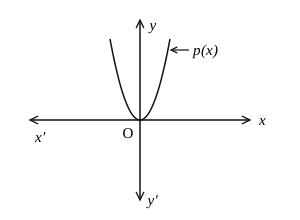
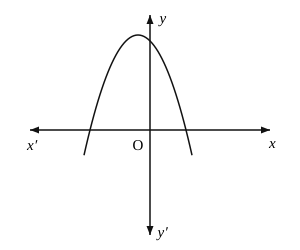
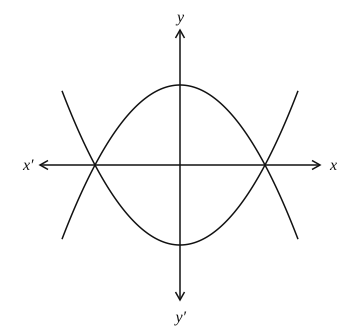
Two polynomials are shown in the graph below. The number of distinct zeroes of both the polynomials is :
(A) 3 (B) 5 (C) 2 (D) 4 Show answer & solution
Answer: (C) 2
Zeroes are the x-coordinates of the points where a graph meets the x-axis. Both parabolas cut the x-axis at the same two points. So the two polynomials together have 2
The sum of the zeroes of the polynomial p ( x ) = 5 x − 7 x 2 + 3
(A) 5 − 7 (B) 5 7 (C) 7 5 (D) 7 − 5 Show answer & solution
Answer: (C) 7 5
Write p ( x ) = − 7 x 2 + 5 x + 3 a = − 7 b = 5 Sum of zeroes = − a b = − − 7 5 = 7 5
If − 4 p ( x ) = x 2 − x − ( 2 + 2 k )
(A) 3(B) 9(C) 6(D) − 9 Show answer & solution
Answer: (B) 9
p ( − 4 ) = 16 + 4 − ( 2 + 2 k ) = 18 − 2 k 18 − 2 k = 0 k = 9
If one zero of the polynomial q ( x ) = ( p 2 + 4 ) x 2 + 65 x + 4 p p
(A) − 1 (B) 1(C) − 2 (D) 2Show answer & solution
Answer: (D) 2
If the zeroes are α α 1 Product of zeroes = p 2 + 4 4 p = 1 p 2 − 4 p + 4 = 0 ( p − 2 ) 2 = 0 p = 2
If α β p ( x ) = x 2 − a x − b ( α + β + α β )
(A) a + b (B) − a − b (C) a − b (D) − a + b Show answer & solution
Answer: (C) a − b
α + β = − 1 − a = a α β = 1 − b = − b α + β + α β = a − b
Zeroes of the polynomial p ( x ) = x 2 − 3 2 x + 4
(A) 2 , 2 (B) 2 2 , 2 (C) 4 2 , − 2 (D) 2 , 2 Show answer & solution
x 2 − 3 2 x + 4 = x 2 − 2 2 x − 2 x + 4 = x ( x − 2 2 ) − 2 ( x − 2 2 ) = ( x − 2 2 ) ( x − 2 ) Zeroes: 2 2 2
Zeroes of the polynomial p ( y ) = 7 y 2 − 3 11 y − 3 2
(A) − 3 2 , − 7 1 (B) − 7 2 , − 3 1 (C) 3 2 , 7 1 (D) 3 2 , − 7 1 Show answer & solution
Answer: (D) 3 2 , − 7 1
p ( y ) = 3 1 ( 21 y 2 − 11 y − 2 ) 21 y 2 − 11 y − 2 = 21 y 2 − 14 y + 3 y − 2 = 7 y ( 3 y − 2 ) + 1 ( 3 y − 2 ) = ( 3 y − 2 ) ( 7 y + 1 ) Zeroes: y = 3 2 y = − 7 1
If α β p ( x ) = k x 2 − 30 x + 45 k α + β = α β
(A) − 3 2 (B) − 2 3 (C) 2 3 (D) 3 2 Show answer & solution
Answer: (D) 3 2
α + β = k 30 α β = k 45 k = 45 k 30 = 45 k = 45 30 = 3 2
Which of the following statements is true for a polynomial p ( x )
(A) p ( x ) (B) p ( x ) (C) p ( x ) (D) p ( x ) Show answer & solution
Answer: (D) p ( x )
A polynomial of degree n n A cubic can have 1, 2 or 3 distinct real zeroes (e.g. x 3
If the zeroes of the polynomial a x 2 + b x + b 2 a b
(A) 2(B) 2 1 (C) − 2 (D) − 2 1 Show answer & solution
Answer: (A) 2
If the zeroes are α α 1 Product of zeroes = a 2 a / b = b 2 b 2 = 1 ⇒ b = 2
If one of the zeroes of the quadratic polynomial ( α − 1 ) x 2 + α x + 1 − 3 α
(A) − 3 2 (B) 3 2 (C) 3 4 (D) 4 3 Show answer & solution
Answer: (C) 3 4
Put x = − 3 9 ( α − 1 ) − 3 α + 1 = 0 6 α − 8 = 0 α = 3 4
For what value of k k x 2 − 4 x − 7
(A) − 14 1 (B) − 2 7 (C) 2 7 (D) − 7 2 Show answer & solution
Answer: (B) − 2 7
Product of zeroes = a c = k − 7 k − 7 = 2 k = − 2 7
Assertion (A) : Zeroes of a polynomial p ( x ) = x 2 − 2 x − 3 − 1 p ( x ) = x 2 − 2 x − 3 x ( − 1 , 0 ) ( 3 , 0 )
(A) Both, Assertion (A) and Reason (R) are true. Reason (R) explains Assertion (A) completely.(B) Both, Assertion (A) and Reason (R) are true. Reason (R) does not explain Assertion (A).(C) Assertion (A) is true but Reason (R) is false.(D) Assertion (A) is false but Reason (R) is true.Show answer & solution
Answer: (A) Both, Assertion (A) and Reason (R) are true. Reason (R) explains Assertion (A) completely.
x 2 − 2 x − 3 = ( x − 3 ) ( x + 1 ) − 1 p ( − 1 ) = 0 p ( 3 ) = 0 ( − 1 , 0 ) ( 3 , 0 ) The zeroes of a polynomial are exactly the x-coordinates of the points where its graph meets the x-axis, so R explains A.
A quadratic polynomial, the sum of whose zeroes is − 5
(A) x 2 + 5 x + 6 (B) x 2 − 5 x + 6 (C) x 2 − 5 x − 6 (D) − x 2 + 5 x + 6 Show answer & solution
Answer: (A) x 2 + 5 x + 6
Required polynomial = x 2 − ( sum ) x + product = x 2 − ( − 5 ) x + 6 = x 2 + 5 x + 6
The zeroes of the polynomial 3 x 2 + 11 x − 4
(A) 3 1 , 4 (B) 3 − 1 , − 4 (C) 3 1 , − 4 (D) 3 − 1 , 4 Show answer & solution
Answer: (C) 3 1 , − 4
3 x 2 + 11 x − 4 = 3 x 2 + 12 x − x − 4 = ( 3 x − 1 ) ( x + 4 ) Zeroes: x = 3 1 x = − 4
The zeroes of the polynomial 3 x 2 − 5 x − 2
(A) 3 1 , 2 (B) 3 − 1 , 2 (C) 3 − 1 , − 2 (D) 3 1 , − 2 Show answer & solution
Answer: (B) 3 − 1 , 2
3 x 2 − 5 x − 2 = 3 x 2 − 6 x + x − 2 = ( 3 x + 1 ) ( x − 2 ) Zeroes: − 3 1
The zeroes of the polynomial 3 x 2 + 8 x − 3
(A) 3 1 , 3 (B) 3 1 , − 3 (C) 3 − 1 , 3 (D) 3 − 1 , − 3 Show answer & solution
Answer: (B) 3 1 , − 3
3 x 2 + 8 x − 3 = 3 x 2 + 9 x − x − 3 = ( 3 x − 1 ) ( x + 3 ) Zeroes: 3 1 − 3
A quadratic polynomial whose zeroes are 3 and − 2
(A) x 2 − x − 6 (B) x 2 + x − 6 (C) 2 x 2 − x − 12 (D) x 2 + x + 6 Show answer & solution
Answer: (A) x 2 − x − 6
Sum of zeroes = 3 + ( − 2 ) = 1 = 3 × ( − 2 ) = − 6 Polynomial = x 2 − ( sum ) x + product = x 2 − x − 6
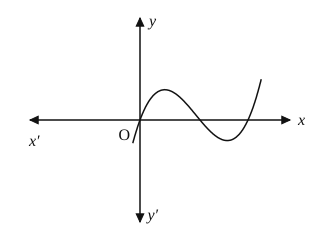
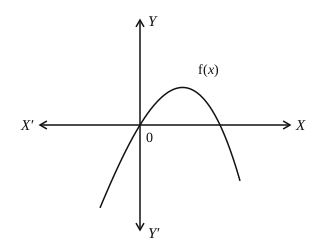
In the given figure, graph of a polynomial f ( x ) f ( x )
(A) 3(B) 1(C) 0(D) 2Show answer & solution
Answer: (D) 2
The zeroes are the x-coordinates where the graph meets the x-axis. The curve cuts the x-axis at the origin and at one point on the positive x-axis, so there are 2 zeroes.
A quadratic polynomial whose zeroes are − 8
(A) ( x + 8 ) ( x + 3 ) (B) x 2 + 5 x + 24 (C) ( x − 8 ) ( x − 3 ) (D) x 2 + 5 x − 24 Show answer & solution
Answer: (D) x 2 + 5 x − 24
Sum of zeroes = − 8 + 3 = − 5 = − 24 Polynomial = x 2 − ( − 5 ) x + ( − 24 ) = x 2 + 5 x − 24
If the two zeroes of a quadratic polynomial are ± 5
(A) x 2 + 5 (B) ( x + 5 ) 2 (C) 4 ( x 2 − 5 ) (D) x 2 − 5 Show answer & solution
Answer: (C) 4 ( x 2 − 5 )
Sum of zeroes = 0 = − 5 k ( x 2 − 5 ) k With k = 4 4 ( x 2 − 5 ) ± 5
If one zero of a quadratic polynomial k x 2 + 4 x + k k
(A) 2 (B) − 2 (C) 4 (D) − 4 Show answer & solution
Answer: (B) − 2
Put x = 1 k ( 1 ) 2 + 4 ( 1 ) + k = 0 2 k + 4 = 0 ⇒ k = − 2
The number of quadratic polynomials having zeroes − 1
(A) 1(B) 2(C) 3(D) more than 3Show answer & solution
Answer: (D) more than 3
Every polynomial k ( x + 1 ) ( x − 3 ) = k ( x 2 − 2 x − 3 ) k = 0 − 1 Since k
What should be added to the polynomial x 2 − 5 x + 4
(A) 1(B) 2(C) 4(D) 5Show answer & solution
Answer: (B) 2
Value at x = 3 9 − 15 + 4 = − 2 Adding k − 2 + k = 0 k = 2
If the sum of zeroes of the polynomial p ( x ) = 2 x 2 − k 2 x + 1 2 k
(A) 2 (B) 2(C) 2 2 (D) 2 1 Show answer & solution
Answer: (B) 2
Sum of zeroes = − a b = 2 k 2 2 k 2 = 2 k = 2
The zeroes of a polynomial x 2 + p x + q 4 x 2 − 5 x − 6 p
(A) − 2 5 (B) 2 5 (C) − 5 (D) 10Show answer & solution
Answer: (A) − 2 5
Sum of zeroes of 4 x 2 − 5 x − 6 4 5 Zeroes of x 2 + p x + q 2 × 4 5 = 2 5 Sum of zeroes of x 2 + p x + q − p − p = 2 5 p = − 2 5
Assertion (A) : If the graph of a polynomial touches x n ( n > 1 ) n
(A) Both, Assertion (A) and Reason (R) are true and Reason (R) is correct explanation of Assertion (A).(B) Both, Assertion (A) and Reason (R) are true but Reason (R) is not correct explanation for Assertion (A).(C) Assertion (A) is true but Reason (R) is false.(D) Assertion (A) is false but Reason (R) is true.Show answer & solution
Answer: (D) Assertion (A) is false but Reason (R) is true.
A: The graph of x 2 x x 2 R: A polynomial of degree n n
If the sum and the product of zeroes of a quadratic polynomial are 2 3
(A) x 2 + 2 3 x − 3 (B) ( x − 3 ) 2 (C) x 2 − 2 3 x − 3 (D) x 2 + 2 3 x + 3 Show answer & solution
Required polynomial = x 2 − ( sum ) x + product = x 2 − 2 3 x + 3 x 2 − 2 3 x + 3 = ( x − 3 ) 2
If α , β 6 x 2 − 5 x − 4 α 1 + β 1
(A) 4 5 (B) − 4 5 (C) 5 4 (D) 24 5 Show answer & solution
Answer: (B) − 4 5
α + β = 6 5 α β = − 6 4 α 1 + β 1 = α β α + β = − 4/6 5/6 = − 4 5
If α β 5 x 2 + 3 x − 7 α 1 + β 1
(A) − 7 3 (B) 5 3 (C) 7 3 (D) − 7 5 Show answer & solution
Answer: (C) 7 3
α + β = − 5 3 α β = − 5 7 α 1 + β 1 = α β α + β = − 7/5 − 3/5 = 7 3
If α β 2 x 2 − 9 x + 5 α 2 + β 2
(A) 4 1 (B) 4 61 (C) 1(D) 4 71 Show answer & solution
Answer: (B) 4 61
α + β = 2 9 α β = 2 5 α 2 + β 2 = ( α + β ) 2 − 2 α β = 4 81 − 5 = 4 61
If α β ( α > β ) − x 2 + 8 x + 9 ( α − β )
(A) − 10 (B) 10(C) ± 10 (D) 8Show answer & solution
Answer: (B) 10
− x 2 + 8 x + 9 = − ( x 2 − 8 x − 9 ) = − ( x − 9 ) ( x + 1 ) Zeroes: 9 and − 1 α > β α = 9 β = − 1 α − β = 9 − ( − 1 ) = 10
The zeroes of the quadratic polynomial 2 x 2 − 3 x − 9
(A) 3 , 2 − 3 (B) − 3 , 2 − 3 (C) − 3 , 2 3 (D) 3 , 2 3 Show answer & solution
Answer: (A) 3 , 2 − 3
2 x 2 − 3 x − 9 = 2 x 2 − 6 x + 3 x − 9 = 2 x ( x − 3 ) + 3 ( x − 3 ) = ( x − 3 ) ( 2 x + 3 ) Zeroes: x = 3 x = 2 − 3
What should be subtracted from the polynomial x 2 − 16 x + 30
(A) 30(B) 14(C) 15(D) 16Show answer & solution
Answer: (C) 15
Let k p ( x ) = x 2 − 16 x + 30 − k 15 is a zero: 225 − 240 + 30 − k = 0 ⇒ 15 − k = 0 k = 15
What should be added from the polynomial x 2 − 5 x + 4
(A) 1(B) 2(C) 4(D) 5Show answer & solution
Answer: (B) 2
Let k p ( x ) = x 2 − 5 x + 4 + k 3 is a zero: 9 − 15 + 4 + k = 0 ⇒ − 2 + k = 0 k = 2
If a polynomial p ( x ) p ( x ) = x 2 − 5 x + 6 p ( 1 ) + p ( 4 )
(A) 0(B) 4(C) 2(D) − 4 Show answer & solution
Answer: (B) 4
p ( 1 ) = 1 − 5 + 6 = 2 p ( 4 ) = 16 − 20 + 6 = 2 p ( 1 ) + p ( 4 ) = 4
A quadratic polynomial, one of whose zeroes is 2 + 5
(A) x 2 + 4 x − 1 (B) x 2 − 4 x − 1 (C) x 2 − 4 x + 1 (D) x 2 + 4 x + 1 Show answer & solution
Answer: (B) x 2 − 4 x − 1
Other zero = 4 − ( 2 + 5 ) = 2 − 5 Product = ( 2 + 5 ) ( 2 − 5 ) = 4 − 5 = − 1 Polynomial = x 2 − ( sum ) x + product = x 2 − 4 x − 1
The ratio of the sum and product of the roots of the quadratic equation 5 x 2 − 6 x + 21 = 0
(A) 5 : 21(B) 2 : 7(C) 21 : 5(D) 7 : 2Show answer & solution
Answer: (B) 2 : 7
Sum of roots = 5 6 = 5 21 Ratio = 6 : 21 = 2 : 7
If α β p ( x ) = k x 2 − 30 x + 45 k α + β = α β k
(A) − 3 2 (B) − 2 3 (C) 2 3 (D) 3 2 Show answer & solution
Answer: (D) 3 2
α + β = k 30 α β = k 45 k = 45 k 30 = 45 ⇒ k = 3 2
Assertion (A) : Degree of a zero polynomial is not defined.
(A) Both Assertion (A) and Reason (R) are true and Reason (R) is the correct explanation of Assertion (A).(B) Both Assertion (A) and Reason (R) are true, but Reason (R) is not the correct explanation of Assertion (A).(C) Assertion (A) is true, but Reason (R) is false.(D) Assertion (A) is false, but Reason (R) is true.Show answer & solution
Answer: (B) Both Assertion (A) and Reason (R) are true, but Reason (R) is not the correct explanation of Assertion (A).
A is true: the zero polynomial has no non-zero term, so its degree is not defined. R is true: a non-zero constant c = c x 0 R is about non-zero constants, so it does not explain A.
The graph of y = p ( x ) p ( x ) p ( x )
(A) 0(B) 1(C) 2(D) 3Show answer & solution
Answer: (A) 0
The number of zeroes is the number of points where the graph meets the x-axis. The graph lies entirely above the x-axis and never meets it. So p ( x )
The sum and the product of zeroes of the polynomial p ( x ) = x 2 + 5 x + 6
(A) 5 , − 6 (B) − 5 , 6 (C) 2, 3(D) − 2 , − 3 Show answer & solution
Answer: (B) − 5 , 6
For a x 2 + b x + c = − a b = a c Sum = − 1 5 = − 5 = 1 6 = 6
The zeroes of the polynomial p ( x ) = x 2 + 3 x + 2
(A) 1, 2(B) 2 , − 1 (C) − 2 , 1 (D) − 2 , − 1 Show answer & solution
Answer: (D) − 2 , − 1
x 2 + 3 x + 2 = ( x + 1 ) ( x + 2 ) Zeroes: x = − 1 x = − 2
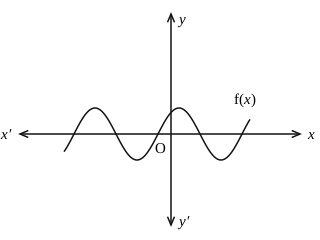
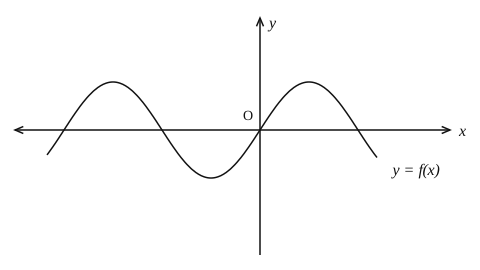
The graph of y = f ( x ) f ( x ) f ( x )
(A) 5(B) 6(C) 4(D) 8Show answer & solution
Answer: (A) 5
The number of zeroes equals the number of points where the graph meets the x-axis. The wave-shaped graph crosses the x-axis at 5 points. So f ( x )
The sum and product of zeroes of the polynomial p ( x ) = 3 x 2 − 5 x + 2
(A) 3 5 , 3 2 (B) 3 − 5 , 3 2 (C) 1 , 3 2 (D) 3 − 5 , 3 − 2 Show answer & solution
Answer: (A) 3 5 , 3 2
For a x 2 + b x + c = − a b = a c Here a = 3 b = − 5 c = 2 Sum = 3 5 = 3 2
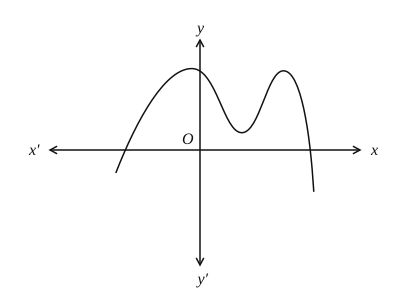
Graph of a polynomial p(x) is given in the figure. The number of zeroes of p(x) is :
(A) 2(B) 3(C) 4(D) 5Show answer & solution
Answer: (a) 2
The number of zeroes equals the number of points where the graph meets the x-axis. The graph cuts the x-axis at two points (the dip between the two humps stays above the axis). Number of zeroes = 2
Assertion (A) : Polynomial x 2 + 4 x x 2 + a x ( a = 0 )
(A) Both Assertion (A) and Reason (R) are true and Reason (R) is the correct explanation of the Assertion (A).(B) Both Assertion (A) and Reason (R) are true, but Reason (R) is not the correct explanation of the Assertion (A).(C) Assertion (A) is true, but Reason (R) is false.(D) Assertion (A) is false, but Reason (R) is true.Show answer & solution
Answer: (c) Assertion (A) is true, but Reason (R) is false.
x 2 + 4 x = x ( x + 4 ) − 4 x 2 + a x = x ( x + a ) − a Hence (c).
A quadratic polynomial the sum and product of whose zeroes are − 3
(A) x 2 + 3 x + 2 (B) x 2 − 3 x + 2 (C) x 2 − 3 x − 2 (D) x 2 + 3 x − 2 Show answer & solution
Answer: (A) x 2 + 3 x + 2
Required polynomial = x 2 − ( sum ) x + product = x 2 − ( − 3 ) x + 2 = x 2 + 3 x + 2
If p ( x ) = x 2 + 5 x + 6 p ( − 2 )
(A) 20(B) 0(C) − 8 (D) 8Show answer & solution
Answer: (B) 0
p ( − 2 ) = ( − 2 ) 2 + 5 ( − 2 ) + 6 = 4 − 10 + 6 = 0
A quadratic polynomial whose sum and product of zeroes are 2 and − 1
(A) x 2 + 2 x + 1 (B) x 2 − 2 x − 1 (C) x 2 + 2 x − 1 (D) x 2 − 2 x + 1 Show answer & solution
Answer: (B) x 2 − 2 x − 1
Required polynomial = x 2 − ( sum ) x + product = x 2 − 2 x + ( − 1 ) = x 2 − 2 x − 1
The number of polynomials having zeroes − 3
(A) 1(B) 2(C) 3(D) more than 3Show answer & solution
Answer: (D) more than 3
Every polynomial k ( x + 3 ) ( x − 4 ) k = 0 − 3 So there are infinitely many such polynomials, i.e. more than 3.
If one zero of the quadratic polynomial k x 2 + 3 x + k
(A) − 5 6 (B) 5 6 (C) 6 5 (D) − 6 5 Show answer & solution
Answer: (A) − 5 6
Put x = 2 4 k + 6 + k = 0 5 k = − 6 k = − 5 6
The graph of y = f ( x ) f ( x ) f ( x )
(A) 0(B) 2(C) 3(D) 4Show answer & solution
Answer: (A) 0
The zeroes of f ( x ) The graph lies entirely above the x-axis and never meets it, so there are no zeroes.
The zeroes of the quadratic polynomial 16 x 2 − 9
(A) 4 3 , 4 3 (B) − 4 3 , 4 3 (C) 16 9 , 16 9 (D) − 4 3 , − 4 3 Show answer & solution
Answer: (B) − 4 3 , 4 3
16 x 2 − 9 = ( 4 x − 3 ) ( 4 x + 3 ) Zeroes: x = 4 3 x = − 4 3
The zeroes of the polynomial p ( x ) = 25 x 2 − 49
(A) 25 49 , 25 49 (B) − 25 49 , + 25 49 (C) 5 7 , − 5 7 (D) 5 7 , 5 7 Show answer & solution
Answer: (C) 5 7 , − 5 7
25 x 2 − 49 = ( 5 x − 7 ) ( 5 x + 7 ) Zeroes: x = 5 7 x = − 5 7
The zeroes of the polynomial p ( x ) = 2 x 2 − x − 3
(A) − 2 3 , 1 (B) 2 3 , 1 (C) − 2 3 , − 1 (D) 2 3 , − 1 Show answer & solution
Answer: (D) 2 3 , − 1
2 x 2 − x − 3 = 2 x 2 − 3 x + 2 x − 3 = ( 2 x − 3 ) ( x + 1 ) Zeroes: x = 2 3 x = − 1
The graph of y = f ( x ) f ( x ) f ( x )
(A) 4(B) 3(C) 2(D) 1Show answer & solution
Answer: (A) 4
The zeroes are the x-coordinates of the points where the graph meets the x-axis. The graph crosses the x-axis at 4 points (one of them the origin), so f ( x )
The graph of y = p ( x ) p ( x ) p ( x )
(A) 3(B) 1(C) 2(D) 0Show answer & solution
Answer: (B) 1
The zeroes of p ( x ) The graph touches the x-axis at exactly one point. So p ( x )
If α β p ( x ) = x 2 + x − 1 α 1 + β 1
(A) 1(B) 2(C) –1(D) 2 − 1 Show answer & solution
Answer: (A) 1
α + β = − 1 α β = − 1 α 1 + β 1 = α β α + β = − 1 − 1 = 1
Which of the following is a quadratic polynomial having zeroes 3 − 2 3 2
(A) 4 x 2 − 9 (B) 9 4 ( 9 x 2 + 4 ) (C) x 2 + 4 9 (D) 5 ( 9 x 2 − 4 ) Show answer & solution
Answer: (D) 5 ( 9 x 2 − 4 )
Sum of zeroes = 0, product = − 9 4 Polynomial: k ( x 2 − 9 4 ) 9 x 2 − 4 5 ( 9 x 2 − 4 ) ± 3 2
Which of the following is a quadratic polynomial with zeroes 3 5
(A) 3 x ( 3 x − 5 ) (B) 3 x ( x − 5 ) (C) x 2 − 3 5 (D) 3 5 x 2 Show answer & solution
Answer: (A) 3 x ( 3 x − 5 )
3 x ( 3 x − 5 ) = 0 x = 0 x = 3 5 (B) has zeroes 0 and 5, (C) has zeroes ± 3 5 So the answer is 3 x ( 3 x − 5 )
If α β p ( x ) = 2 x 2 − x − 1 α 2 + β 2
(A) 4 − 3 (B) 4 5 (C) 4 1 (D) 4 3 Show answer & solution
Answer: (B) 4 5
α + β = 2 1 α β = − 2 1 α 2 + β 2 = ( α + β ) 2 − 2 α β = 4 1 + 1 = 4 5
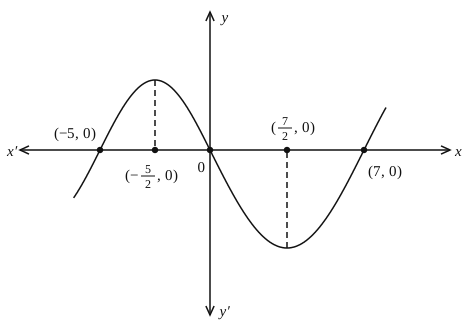
The graph of y = p ( x ) p ( x )
(A) –5, 7(B) 2 − 5 , 2 − 7 (C) –5, 0, 7(D) –5, 2 − 5 , 2 7 Show answer & solution
Answer: (C) –5, 0, 7
Zeroes are the x-coordinates of the points where the graph cuts the x-axis. The graph cuts the x-axis at (–5, 0), (0, 0) and (7, 0). Zeroes: –5, 0, 7. (The points ( − 2 5 , 0 ) ( 2 7 , 0 )
If one zero of the polynomial 6 x 2 + 37 x − ( k − 2 )
(A) − 4 (B) − 6 (C) 6(D) 4Show answer & solution
Answer: (A) − 4
Let the zeroes be α α 1 Product of zeroes = 6 − ( k − 2 ) = 1 − ( k − 2 ) = 6 k = − 4
The zeroes of the polynomial p ( x ) = x 2 + 4 x + 3
(A) 1, 3(B) − 1 (C) 1, − 3 (D) − 1 − 3 Show answer & solution
Answer: (D) − 1 − 3
x 2 + 4 x + 3 = ( x + 1 ) ( x + 3 ) Zeroes are − 1 − 3
If α β p ( x ) = x 2 − a x − b α 2 + β 2
(A) a 2 − 2 b (B) a 2 + 2 b (C) b 2 − 2 a (D) b 2 + 2 a Show answer & solution
Answer: (B) a 2 + 2 b
α + β = a α β = − b α 2 + β 2 = ( α + β ) 2 − 2 α β = a 2 + 2 b
Assertion (A) : The polynomial p ( x ) = x 2 + 3 x + 3
(A) Both Assertion (A) and Reason (R) are true and Reason (R) is the correct explanation of the Assertion (A).(B) Both Assertion (A) and Reason (R) are true, but Reason (R) is not the correct explanation of the Assertion (A).(C) Assertion (A) is true, but Reason (R) is false.(D) Assertion (A) is false, but Reason (R) is true.Show answer & solution
Answer: (D) A is false, but R is true.
Discriminant of x 2 + 3 x + 3 9 − 12 = − 3 < 0 A quadratic polynomial has at most two zeroes, so R is true.
If one zero of the polynomial x 2 − 3 k x + 4 k
(A) − 2 (B) 2(C) 2 1 (D) − 2 1 Show answer & solution
Answer: (B) 2
Let the zeroes be α 2 α Sum: 3 α = 3 k α = k Product: 2 α 2 = 4 k 2 k 2 = 4 k So k = 0 k = 2 k = 0 x 2 k = 2
If ‘α β a x 2 − 5 x + c α + β = α β = 10
(A) a = 5 c = 2 1 (B) a = 1 c = 2 5 (C) a = 2 5 c = 1 (D) a = 2 1 c = 5 Show answer & solution
Answer: (D) a = 2 1 c = 5
α + β = a 5 = 10 a = 2 1 α β = a c = 10 c = 10 × 2 1 = 5
The sum of zeroes of the polynomial 2 x 2 − 17
(A) 2 17 2 (B) − 2 17 2 (C) 0(D) 1Show answer & solution
Answer: (C) 0
Here a = 2 b = 0 c = − 17 Sum of zeroes = − a b = 0
If α β x 2 − 1 ( α + β )
(A) 2(B) 1(C) − 1 (D) 0Show answer & solution
Answer: (D) 0
For x 2 + 0 x − 1 = − 1 0 = 0 (The zeroes are 1 and − 1
If α β p ( x ) = 4 x 2 − 3 x − 7 ( α 1 + β 1 )
(A) 3 7 (B) 3 − 7 (C) 7 3 (D) 7 − 3 Show answer & solution
Answer: (D) 7 − 3
α + β = 4 3 α β = 4 − 7 α 1 + β 1 = α β α + β = − 7/4 3/4 = 7 − 3
The number of polynomials having zeroes − 3
(A) only one(B) infinite(C) exactly two(D) at most twoShow answer & solution
Answer: (B) infinite
Any polynomial k ( x + 3 ) ( x − 5 ) k = 0 − 3 Higher-degree polynomials such as k ( x + 3 ) ( x − 5 ) ( x − a ) Since k can be any non-zero real number, there are infinitely many such polynomials.
The number of polynomials having zeroes − 1
(A) exactly 2(B) only 1(C) at most 2(D) infiniteShow answer & solution
Answer: (D) infinite
Any polynomial k ( x + 1 ) ( x − 2 ) k = 0 − 1 Higher-degree polynomials with these factors also work. So there are infinitely many such polynomials.
The number of quadratic polynomials having zeroes –5 and –3 is
(A) 1(B) 2(C) 3(D) more than 3Show answer & solution
Answer: (D) more than 3
Any polynomial k ( x + 5 ) ( x + 3 ) = k ( x 2 + 8 x + 15 ) k = 0 k can take infinitely many values, so there are more than 3 such polynomials.
If α β x 2 − 1 ( α + β )
(A) 2(B) 1(C) –1(D) 0Show answer & solution
Answer: (D) 0
For a x 2 + b x + c = − a b Here a = 1 b = 0 α + β = 0 (The zeroes are 1 and –1.)
If the zeroes of the quadratic polynomial x 2 + ( a + 1 ) x + b
(A) a = –7, b = –1(B) a = 5, b = –1(C) a = 2, b = – 6(D) a = 0, b = – 6Show answer & solution
Answer: (D) a = 0, b = – 6
Sum of zeroes: 2 + ( − 3 ) = − 1 = − ( a + 1 ) a = 0 Product of zeroes: 2 × ( − 3 ) = − 6 = b
If one zero of the polynomial x 2 + 3 x + k
(A) – 10(B) 10(C) 5(D) – 5Show answer & solution
Answer: (A) – 10
Put x = 2: 4 + 6 + k = 0 k = –10
The zeroes of the polynomial 3 x 2 + 11 x − 4
(A) 3 1 (B) 3 − 1 (C) 3 1 (D) 3 − 1 Show answer & solution
Answer: (A) 3 1
3 x 2 + 11 x − 4 = 3 x 2 + 12 x − x − 4 = ( 3 x − 1 ) ( x + 4 ) Zeroes: x = 3 1 x = − 4
Practise smarter: chapter-wise revision, formula sheets and step-by-step NCERT solutions on
MonoMath CBSE →