CBSE Class 10 Maths Standard 2026 Question Paper 30/5/3 with Solutions
All 43 questions from the CBSE Class 10 Mathematics Standard board paper, Set 30/5/3 (2026),
with answers and step-by-step solutions. Total 80 marks. Tap “Show answer & solution” under any question.
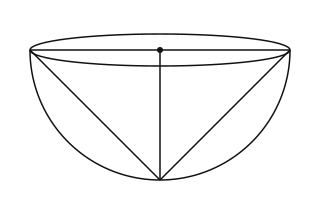
A conical cavity of maximum volume is carved out from a wooden solid hemisphere of radius 10 cm. Curved surface area of the cavity carved out is (use π=3.14)
(A)3142cm2
(B)314 cm2
(C)33140cm2
(D)31402cm2
Show answer & solution
Answer: (A) 3142cm2
The largest cone has radius r=10 cm and height h=10 cm (radius of hemisphere).
Meena calculates that the probability of her winning the first prize in a lottery is 0.08. If total 800 tickets were sold, the number of tickets bought by her, is
A wire is attached from a point A on the ground to the top of a pole BC, making an angle of elevation as 60∘. If AB = 53 m, then length of the wire is
While calculating mean of a grouped frequency distribution, step deviation method was used (hx−a=u). It was found that xˉ=64, h = 5 and a = 62.5. The value of uˉ is
Assertion (A): The system of linear equations 3x−5y+7=0 and −6x+10y+14=0 is inconsistent. Reason (R): When two linear equations don’t have unique solution, they always represent parallel lines.
(A)Both Assertion (A) and Reason (R) are true and Reason (R) is the correct explanation of the Assertion (A).
(B)Both Assertion (A) and Reason (R) are true, but Reason (R) is not the correct explanation of the Assertion (A).
(C)Assertion (A) is true, but Reason (R) is false.
(D)Assertion (A) is false, but Reason (R) is true.
Show answer & solution
Answer: (C) Assertion (A) is true, but Reason (R) is false.
A bag contains 25 balls. Some of them are yellow and others are green. One ball is drawn at random. If probability of getting a green ball is 3/5, then find the number of yellow balls.
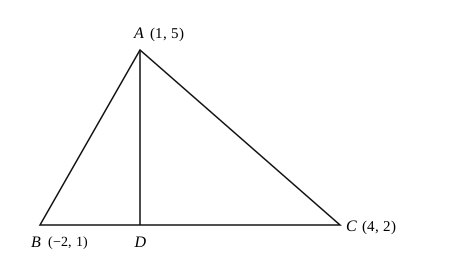
Prove that the point P dividing the line segment joining the points A(−1,7) and B(4,−3) in the ratio 3 : 2, lies on the line x−3y=−1. Also find length of PA and PB.
Show answer & solution
Answer: P(2, 1) lies on the line; PA = 35 units, PB = 25 units
P=(3+23(4)+2(−1),3+23(−3)+2(7))=(2,1)
Check: x−3y=2−3=−1. So P lies on the line x−3y=−1.
The dimensions of a window are 156 cm × 216 cm. Arjun wants to put grill on the window creating complete squares of maximum size. Determine the side length of the square and hence find the number of squares formed.
Show answer & solution
Answer: Side = 12 cm; number of squares = 234
156=22×3×13, 216=23×33
HCF =22×3=12, so the side of each square is 12 cm.
A chord of a circle, of radius 14 cm, subtends an angle of 60∘ at the centre. Find the area of the smaller sector and perimeter of the smaller segment.
Show answer & solution
Answer: Area of sector =3308cm2 (≈ 102.67 cm2); perimeter of segment =386 cm (≈ 28.67 cm)
Area of smaller sector =360∘60∘×722×14×14=6616=3308cm2 ≈ 102.67 cm2
Arc length =360∘60∘×2×722×14=344 cm
The triangle formed by the two radii and the chord is equilateral (angle 60∘, two sides 14 cm), so chord = 14 cm.
Perimeter of smaller segment =344+14=386 cm ≈ 28.67 cm
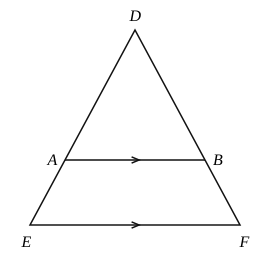
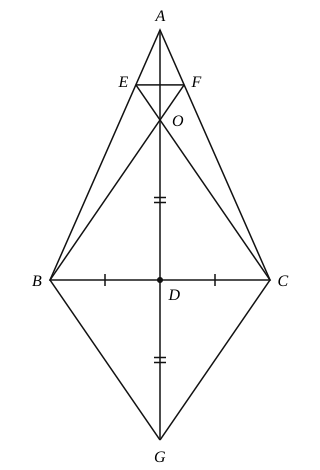
D is the mid-point of side BC of △ABC. CE and BF intersect at O, a point on AD. AD is produced to G such that OD = DG. Prove that (i) OBGC is a parallelogram. (ii) EF∥BC (iii) △AEF∼△ABC
Show answer & solution
Answer: Proved.
(i) BD = DC (D is the mid-point of BC) and OD = DG (given). So the diagonals BC and OG of quadrilateral OBGC bisect each other. Hence OBGC is a parallelogram.
(ii) As OBGC is a parallelogram, OC∥BG and OB∥CG, i.e. OE∥BG and OF∥CG.
In △ABG, OE∥BG, so by BPT EBAE=OGAO.
In △ACG, OF∥CG, so by BPT FCAF=OGAO.
Hence EBAE=FCAF, and by the converse of BPT in △ABC, EF∥BC.
(iii) In △AEF and △ABC: ∠A is common, and ∠AEF=∠ABC (corresponding angles, EF∥BC).
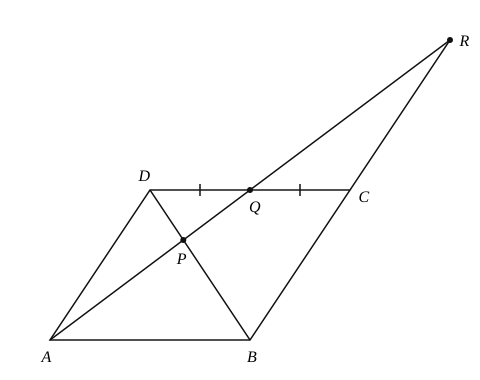
Through the mid-point Q of side CD of a parallelogram ABCD, the line AR is drawn which intersects BD at P and produced BC at R. Prove that (i) AQ = QR (ii) AP = 2PQ (iii) PR = 2AP
Show answer & solution
Answer: Proved.
(i) In △ADQ and △RCQ: DQ = CQ (Q is the mid-point of CD), ∠AQD=∠RQC (vertically opposite), ∠ADQ=∠RCQ (alternate angles, AD∥BR).
So △ADQ≅△RCQ (ASA), hence AQ = QR.
(ii) In △APB and △QPD: ∠PAB=∠PQD and ∠PBA=∠PDQ (alternate angles, AB∥DC).
So △APB∼△QPD (AA), and PQAP=DQAB.
DQ=21CD=21AB, so PQAP=2, i.e. AP = 2PQ.
(iii) PR = PQ + QR = PQ + AQ (from (i)) = PQ + (AP + PQ) = AP + 2PQ = AP + AP = 2AP (using (ii)).
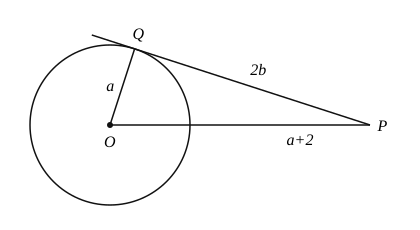
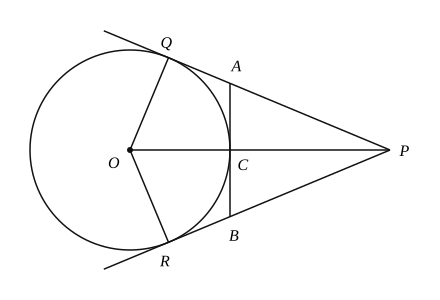
PQ and PR are two tangents to a circle with centre O and radius 5 cm. AB is another tangent to the circle at C which lies on OP. If OP = 13 cm, then find the length AB and PA.
Show answer & solution
Answer: AB = 320 cm, PA = 326 cm
OQ⊥PQ, so PQ=OP2−OQ2=169−25=12 cm.
C lies on OP and OC = 5 cm, so PC = 13 − 5 = 8 cm. AB⊥OP at C.
Let AC = x. Tangents from A are equal, so AQ = AC = x and PA = 12 − x.
Two water taps together can fill a tank in 898 hours. The tap of larger diameter takes 4 hours less than the smaller one to fill the tank separately. Find the time in which each tap can separately fill the tank.
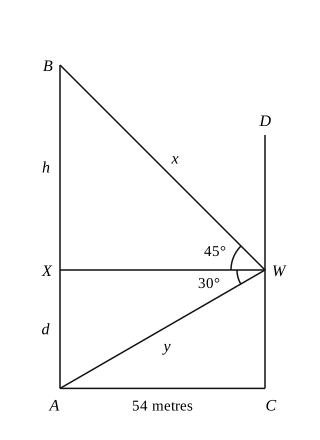
Elevated water storage tanks are built to store and supply water to nearby colonies. In the diagram given above, AB is an elevated water tank and CD is a nearby multistorey building. The building is 54 metres away from the water tank. From a window (W) of the building, the angle of elevation of top of the tank is 45∘ and angle of depression of its foot is 30∘. (i) Write a relation between d (the height of window) and y. (1) (ii) Determine the value of h. (1) (iii) (a) Determine height of the water tank. (2) OR (iii) (b) Find the value of x and height of the window above ground level. (2)
Show answer & solution
Answer: (i) y = 2d (ii) h = 54 m (iii) (a) 54+183 m ≈ 85.18 m OR (iii) (b) x=542 m, window height =183 m ≈ 31.18 m
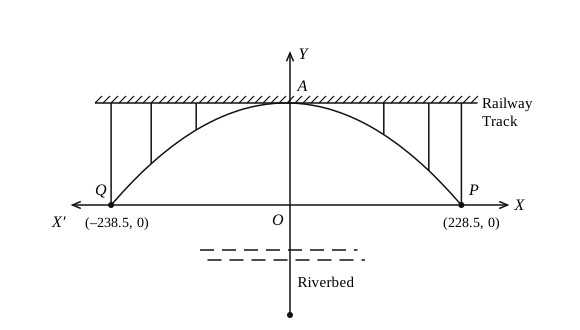
An arch of a railway bridge, built on Chenab riverbed, is shown in the above diagram. It is a parabolic arch connecting two hills at P and Q. If the parabolic curve is represented by the polynomial p(x)=−0.0025x2−0.025x+136. Observe the diagram and based on above information, answer the following questions : (i) Write the co-ordinates of point A. (1) (ii) Find the span of the arch. (1) (iii) (a) Write the zeroes of the polynomial using diagram and verify the relationship between sum of zeroes and polynomials. (2) OR (iii) (b) Find the values of p(x) at x=100 and x=−100. Are they same ? (2)
Show answer & solution
Answer: (i) A(0, 136) (ii) 467 m (iii) (a) Zeroes 228.5 and −238.5; sum = −10 = −ab OR (iii) (b) p(100) = 108.5, p(−100) = 113.5; not the same
(i) A lies on the y-axis, so x = 0 and p(0)=136. A = (0, 136).
(ii) Span = PQ = 228.5 − (−238.5) = 467 m.
(iii) (a) From the diagram the zeroes are 228.5 and −238.5.
Sum of zeroes = 228.5 + (−238.5) = −10.
−ab=−−0.0025−0.025=−10. Hence sum of zeroes =−ab, verified.
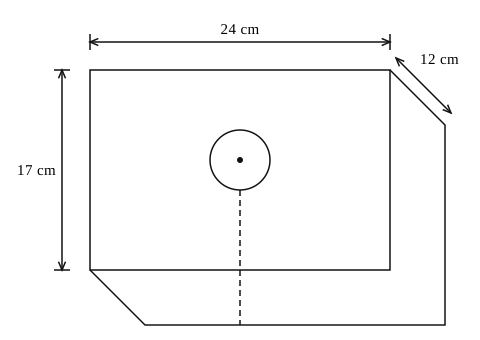
A wall mounted lamp, made of fabric, is shown below. Lamp has cuboidal shape, open from top and bottom. A spherical bulb of diameter 7 cm is latched with a very thin rod. (Ignore the rod while making calculations.) Dimensions of the cuboid are 24 cm × 12 cm × 17 cm. (i) Find the surface area of the bulb. (1) (ii) What could be the maximum diameter of the bulb if at least 1 cm space is left from each side ? (1) (iii) (a) Find the area of the fabric used if there is a fold of 2 cm on top and bottom edges. (2) OR (iii) (b) Find the space available inside the lamp. (2)
Show answer & solution
Answer: (i) 154 cm2 (ii) 10 cm (iii) (a) 1512 cm2 OR (iii) (b) 4896 cm3 (lamp volume); 4716.33 cm3 after excluding the bulb
(i) r = 3.5 cm. Surface area =4πr2=4×722×3.5×3.5=154cm2
(ii) The smallest dimension of the lamp is 12 cm. Leaving 1 cm on each side, maximum diameter = 12 − 2 = 10 cm.
(iii) (a) The fabric covers the four vertical faces (open top and bottom). Height with folds = 17 + 2 + 2 = 21 cm.
Area =2(24+12)×21=72×21=1512cm2
(iii) (b) Volume of the lamp =24×12×17=4896cm3
Volume of bulb =34×722×(3.5)3=3539≈179.67cm3
Space available (excluding the bulb) =4896−179.67=4716.33cm3