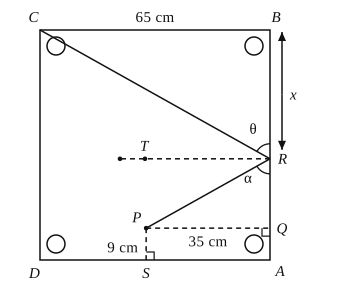
Carom board is a very popular game. The board is a square of side length 65 cm. It has circular pockets in each corner. Ansh strikes a disc, kept at position P with a striker. The disc, hits the boundary of the board at R and goes straight to pocket at corner C. It is given that PS = 9 cm, PQ = 35 cm, BR = x, ∠PRQ=α and ∠CRB=θ. Based on the above information, answer the following questions : (i) Using law of reflection i.e. ∠PRT=∠CRT, prove that θ=α. (1) (ii) Prove that △PQR∼△CBR given that PQ is perpendicular to AB. (1) (iii) (a) Find the value of x using similarity of triangles. (2) OR (b) If Area △CBRArea △PQR=CB2PQ2, then find the value of x.
Show answer & solution
Answer: (i) Proved. (ii) Proved. (iii) (a) x=36.4 cm OR (b) x=36.4 cm
(i) RT is perpendicular to AB at R, so θ=90∘−∠CRT and α=90∘−∠PRT. As ∠PRT=∠CRT, θ=α.
(ii) In △PQR and △CBR: ∠PQR=∠CBR=90∘ and ∠PRQ=∠CRB (part (i)). So △PQR∼△CBR (AA).
(iii)(a) AQ = PS = 9 cm, so QR=65−9−x=56−x.
CBPQ=BRQR⇒6535=x56−x
35x=3640−65x⇒100x=3640⇒x=36.4 cm
(iii)(b) For similar triangles the area ratio equals the square of the ratio of corresponding sides, so CB2PQ2=BR2QR2, i.e. 6535=x56−x, giving x=36.4 cm.
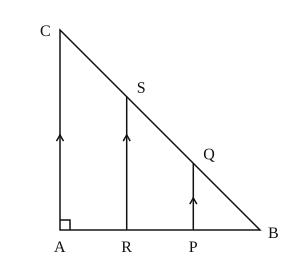
A triangular window of a building is shown above. Its diagram represents a △ABC with ∠A=90∘ and AB = AC. Points P and R trisect AB and PQ ∥ RS ∥ AC. Based on the above, answer the following questions : (i) Show that △BPQ∼△BAC. (1) (ii) Prove that PQ =31AC. (1) (iii) (a) If AB = 3 m, find length BQ and BS. Verify that BQ =21BS. (2) OR (iii) (b) Prove that BR2 + RS2=94BC2. (2)
Show answer & solution
Answer: (i) Proved (AA similarity) (ii) Proved (iii) (a) BQ =2 m, BS =22 m, so BQ =21BS OR (b) Proved
(i) In △BPQ and △BAC: ∠B is common and ∠BPQ=∠BAC (corresponding angles, PQ ∥ AC). So △BPQ∼△BAC (AA).
(ii) From (i), ACPQ=BABP. P and R trisect AB with P nearer B, so BP =31AB. Hence PQ =31AC.
(iii) (a) AC = AB = 3 m, so BC =9+9=32 m. From the similarity, BQ =31BC =2 m.
Similarly △BRS∼△BAC with BR =32AB, so BS =32BC =22 m. Thus BQ =21BS.
(iii) (b) △BRS∼△BAC with ratio BABR=32, so BR =32AB and RS =32AC.
BR2 + RS2=94(AB2 + AC2) =94BC2 (Pythagoras in △ABC, right-angled at A).
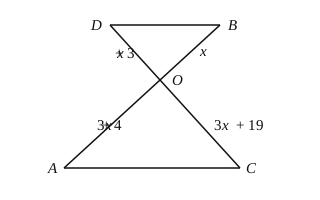
In the figure given below, a folding table is shown : The legs of the table are represented by line segments AB and CD intersecting at O. Join AC and BD. Considering table top is parallel to the ground, and OB=x, OD=x+3, OC=3x+19 and OA=3x+4, answer the following questions : (i) Prove that △OAC is similar to △OBD. (1) (ii) Prove that ACOA=BDOB. (1) (iii) Observe the figure and find the value of x. Hence, find the length of OC. (2) OR Observe the figure and find ACBD. (2)
Show answer & solution
Answer: (i) Proved (AA) (ii) Proved (iii) x=2, OC=25; OR ACBD=51
(i) DB∥AC, so ∠OBD=∠OAC and ∠ODB=∠OCA (alternate angles); also ∠AOC=∠BOD (vertically opposite). Hence △OAC∼△OBD (AA).
(ii) From the similarity, OBOA=BDAC, so ACOA=BDOB.
(iii) OBOA=ODOC: x3x+4=x+33x+19.
(3x+4)(x+3)=x(3x+19) gives 3x2+13x+12=3x2+19x, so x=2.
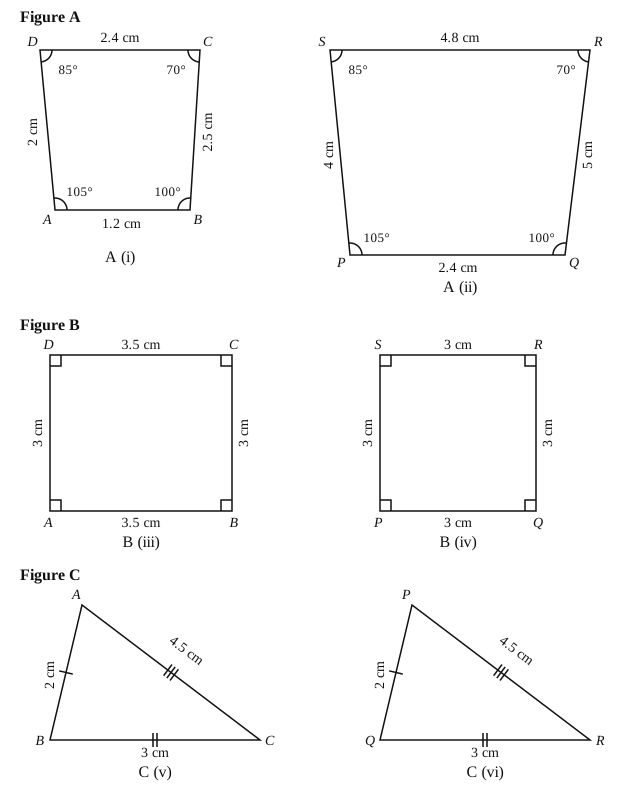
Observe the figures given below carefully and answer the questions : (i) Name the figure(s) wherein two figures are similar. (1) (ii) Name the figure(s) wherein the figures are congruent. (1) (iii) (a) Prove that congruent triangles are also similar but not the converse. (2) OR (b) What more is least needed for two similar triangles to be congruent ? (2)
Show answer & solution
Answer: (i) Figure A (and Figure C, since congruent figures are also similar) (ii) Figure C (iii) (a) Proved. OR (b) At least one pair of corresponding sides must be equal.
(i) In Figure A, corresponding angles are equal (85∘, 70∘, 105∘, 100∘) and sides are in the same ratio: 4.82.4=42=52.5=2.41.2=21, so A(i) and A(ii) are similar. In Figure B the sides are not proportional (33.5=33). Figure C triangles are congruent, hence also similar.
(ii) In Figure C, AB = PQ = 2 cm, BC = QR = 3 cm, AC = PR = 4.5 cm, so △ABC≅△PQR (SSS).
(iii) (a) If △ABC≅△PQR, then corresponding angles are equal and PQAB=QRBC=RPCA=1, so the triangles are similar. Converse: an equilateral triangle of side 1 cm and one of side 2 cm are similar (equal angles) but not congruent, since their sides are unequal.
(iii) (b) Similar triangles already have equal angles and proportional sides; if one pair of corresponding sides is equal, the ratio is 1 and all sides are equal, so they are congruent.