Triangles: 1 mark Questions (CBSE Class 10)
70 different 1 mark questions on Triangles from CBSE Class 10 Maths board exams 2022–2026, newest first.
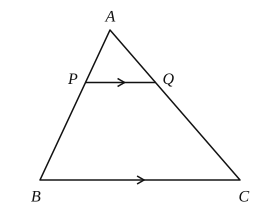
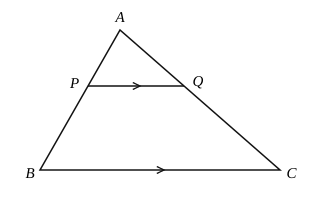
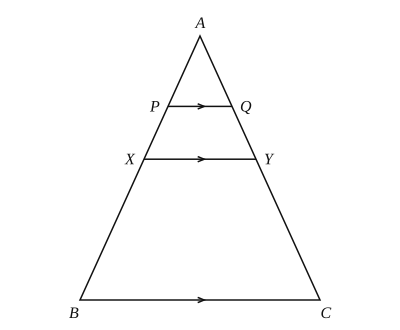
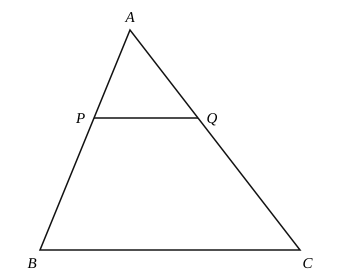
In the given figure, PQ ∥
(A) 3 : 7(B) 3 : 10(C) 7 : 3(D) 3 : 4Show answer & solution
Answer: (D) 3 : 4
AP : AB = 3 : 7, so AP : PB = 3 : 4. By BPT, QC A Q = P B A P = 4 3
Which of the following statements is not always true ?
(A) Two circles are similar.(B) Two isosceles right triangles are similar.(C) Two rectangles are similar.(D) Two equilateral triangles are similar.Show answer & solution
Answer: (C) Two rectangles are similar.
All circles, all isosceles right triangles (angles 45°, 45°, 90°) and all equilateral triangles have the same shape, so they are always similar. Two rectangles have equal angles, but their sides need not be in the same ratio (e.g. 1 × 2 and 1 × 3). So 'Two rectangles are similar' is not always true.
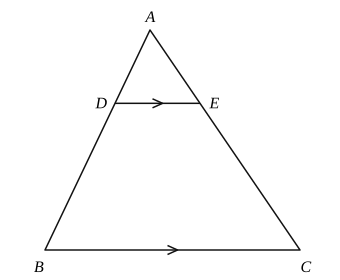
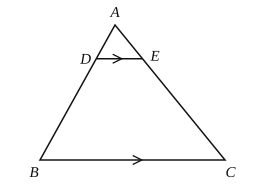
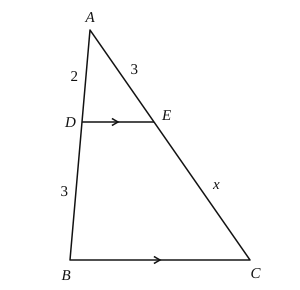
In the given figure, DE ∥
(A) 7.5 cm(B) 5 cm(C) 10 cm(D) 2.5 cmShow answer & solution
Answer: (A) 7.5 cm
Since DE ∥ A B A D = A C A E 3 1 = A C 2.5
If △ A B C △ D E F 2 A B = D E B C = 8
(A) 4 cm(B) 8 cm(C) 12 cm(D) 16 cmShow answer & solution
Answer: (D) 16 cm
Since △ A B C ∼ △ D E F D E A B = E F B C D E A B = 2 1 E F 8 = 2 1 E F = 16
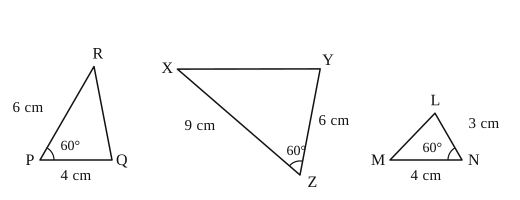
Shown below are three triangles. The measures of two adjacent sides and included angle are given for each triangle :
(A) △ R P Q △ X Z Y (B) △ R P Q △ M N L (C) △ X Z Y △ M N L (D) △ R P Q △ X Z Y △ M N L Show answer & solution
Answer: (A) △ R P Q △ X Z Y
Each triangle has an included angle of 6 0 ∘ △ R P Q P R : P Q = 6 : 4 = 3 : 2 △ X Z Y Z X : Z Y = 9 : 6 = 3 : 2 △ M N L N M : N L = 4 : 3 So Z X P R = Z Y P Q = 3 2 ∠ P = ∠ Z △ R P Q ∼ △ X Z Y △ M N L
In triangles ABC and PQR, ∠ A = ∠ Q ∠ B = ∠ R
(A) PQ : PR(B) PQ : QR(C) QR : QP(D) PR : QRShow answer & solution
Answer: (C) QR : QP
By AA similarity, △ A B C ∼ △ QR P So QR A B = QP A C Hence AB : AC = QR : QP.
In the given figure △ A B C ∥
(A) 10 cm(B) 6 cm(C) 12 cm(D) 7.5 cmShow answer & solution
Answer: (C) 12 cm
Since DE ∥ △ A D E ∼ △ A B C B C D E = A B A D = 7.5 5 = 3 2 B C = 2 3 × 8 = 12
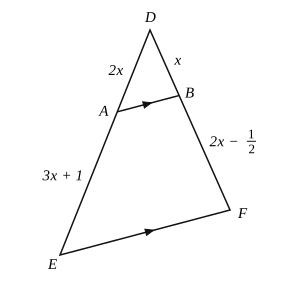
In Δ ∥ x
(A) 0, 2(B) 2 only(C) – 2(D) 1Show answer & solution
Answer: (B) 2 only
From the figure: DA = 2 x = 3 x + 1 = x = 2 x − 2 1 By BPT, A E D A = B F D B 3 x + 1 2 x = 2 x − 2 1 x 2 x ( 2 x − 2 1 ) = x ( 3 x + 1 ) 4 x 2 − x = 3 x 2 + x x 2 − 2 x = 0 x = 0 x = 2 x = 0 = 0 x = 2
It is given that Δ Δ
(A) 0.9 cm(B) 18 5 (C) 9 10 (D) 3.6 cmShow answer & solution
Answer: (D) 3.6 cm
△ A B C ∼ △ QR P QR A B = R P B C QR 9 = 2 5 QR = 5 18 = 3.6
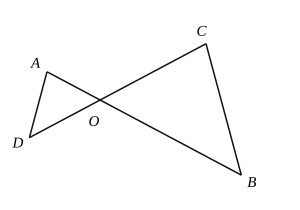
In the given figure, OA × ×
(A) ∠ A = ∠ C (B) ∠ A = ∠ B (C) ∠ A = ∠ D (D) Δ O A D ∼ Δ O B C Show answer & solution
Answer: (A) ∠ A = ∠ C
OA × × O C O A = O B O D ∠ A O D = ∠ C O B So △ A O D ∼ △ C O B Hence ∠ A = ∠ C ∠ D = ∠ B (D) would need O B O A = O C O D
It is given that △ A B C ∼ △ E D F
(A) Perimeter of △ E D F Perimeter of △ A B C = E D A B (B) E D A B = E F A C (C) ∠ A = ∠ D , ∠ C = ∠ F (D) A C A B + B C = E F D E + D F Show answer & solution
Answer: (C) ∠ A = ∠ D , ∠ C = ∠ F
△ A B C ∼ △ E D F A ↔ E B ↔ D C ↔ F So ∠ A = ∠ E ∠ D (A), (B) and (D) follow from E D A B = D F B C = E F A C Hence (C) is not true.
In the given figure, D E ∥ B C D B A D = 3 1
(A) 1.5 cm(B) 1 cm(C) 2 cm(D) 3 cmShow answer & solution
Answer: (A) 1.5 cm
By BPT, E C A E = D B A D = 3 1 So A E = 4 1 × A C = 4 1 × 6 = 1.5
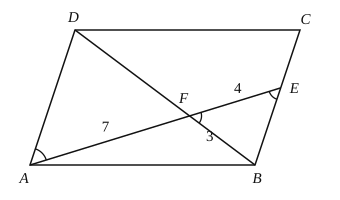
ABCD is a parallelogram such that AF = 7 cm, FB = 3 cm and EF = 4 cm, length FD = equals
(A) 4 21 (B) 3 28 (C) 7 12 (D) 5.5 cmShow answer & solution
Answer: (A) 4 21
A D ∥ B C △ A F D △ E F B ∠ D A F = ∠ B E F ∠ A F D = ∠ E F B △ A F D ∼ △ E F B E F A F = F B F D 4 7 = 3 F D ⇒ F D = 4 21
Devansh proved that △ A B C ∼ △ P QR ∠ C = ∠ R
(A) A B A C = P Q P R (B) A C B C = QR P R (C) B C A C = P Q P R (D) B C A C = QR P R Show answer & solution
Answer: (D) B C A C = QR P R
In SAS similarity, the sides including the equal angles must be proportional. The sides including ∠ C ∠ R So P R A C = QR B C B C A C = QR P R
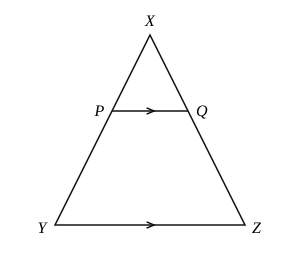
In the given figure, P Q ∥ Y Z
(A) 12.5 cm(B) 10 cm(C) 15 cm(D) 7.5 cmShow answer & solution
Answer: (A) 12.5 cm
P Q ∥ Y Z △ X P Q ∼ △ X Y Z X Y X P = 2 + 3 2 = 5 2 Y Z P Q = 5 2 Y Z = 2 5 × 5 = 12.5
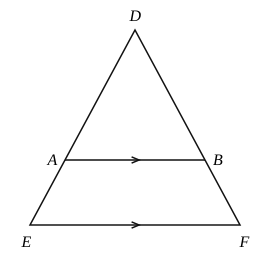
In the given figure, A B ∥ E F
(A) 2.5 cm(B) 10.5 cm(C) 3.5 cm(D) 3 14 Show answer & solution
Answer: (C) 3.5 cm
A B ∥ E F △ D A B ∼ △ D E F D E D A = E F A B = 36 24 = 3 2 D E = 2 3 × 7 = 10.5 A E = D E − D A = 10.5 − 7 = 3.5
Which of the following is not the criterion for similarity of triangles ?
(A) AAA(B) SSS(C) SAS(D) RHSShow answer & solution
Answer: (D) RHS
The criteria for similarity of triangles are AAA (AA), SSS and SAS. RHS is a criterion for congruence, not for similarity.
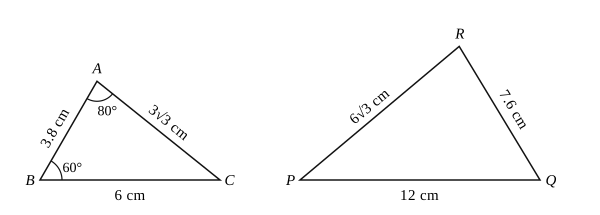
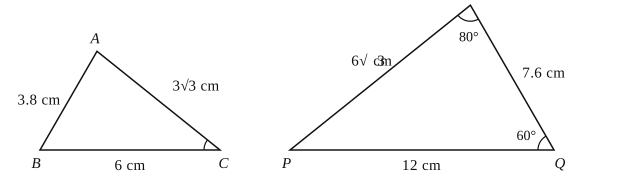
From the figures given below, which of the following is true about the measure of ∠ P
(A) ∠ P = 6 0 ∘ (B) ∠ P = 8 0 ∘ (C) ∠ P = 4 0 ∘ (D) The measure of ∠ P Show answer & solution
Answer: (C) ∠ P = 4 0 ∘
A B QR = 3.8 7.6 = 2 B C P Q = 6 12 = 2 A C P R = 3 3 6 3 = 2 So △ A B C ∼ △ QR P C ↔ P ∠ C = 18 0 ∘ − 8 0 ∘ − 6 0 ∘ = 4 0 ∘ Hence ∠ P = ∠ C = 4 0 ∘
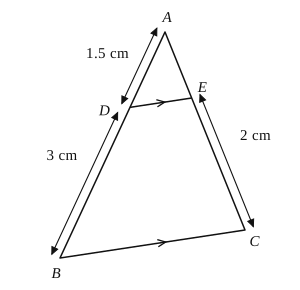
In the given figure, if DE ∥
(A) 1.5 cm(B) 3 cm(C) 3.5 cm(D) 4.5 cmShow answer & solution
Answer: (B) 3 cm
Since DE ∥ D B A D = E C A E 3 1.5 = 2 A E ⇒ A E = 1 AC = AE + EC = 1 + 2 = 3 cm.
Assertion (A) : All congruent triangles are similar.
(A) Both Assertion (A) and Reason (R) are true and Reason (R) is the correct explanation of Assertion (A).(B) Both Assertion (A) and Reason (R) are true, but Reason (R) is not the correct explanation of Assertion (A).(C) Assertion (A) is true, but Reason (R) is false.(D) Assertion (A) is false, but Reason (R) is true.Show answer & solution
Answer: (A) Both Assertion (A) and Reason (R) are true and Reason (R) is the correct explanation of Assertion (A).
Congruent triangles have equal corresponding angles and corresponding sides in the ratio 1 : 1. So their corresponding sides are proportional, which makes them similar. Both A and R are true and R explains A.
Which types of triangles are always similar ?
(A) Right-angled triangles(B) Acute-angled triangles(C) Isosceles triangles(D) Equilateral trianglesShow answer & solution
Answer: (D) Equilateral triangles
All angles of every equilateral triangle are 6 0 ∘ So any two equilateral triangles are similar (AAA). The other types need not have equal angles.
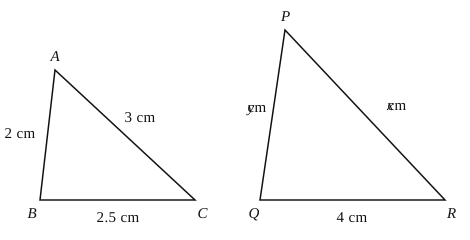
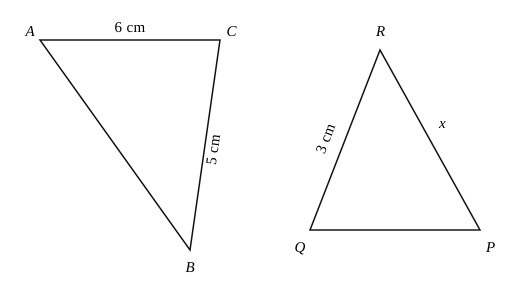
What values of x y △ A B C △ QR P
(A) x = 6 y = 5 (B) x = 5 y = 6 (C) x = 6 y = 6 (D) x = 12 y = 3.2 Show answer & solution
Answer: (B) x = 5 y = 6
△ A B C ∼ △ QR P So QR A B = R P B C = P Q C A 4 2 = x 2.5 = y 3 x = 5 y = 6
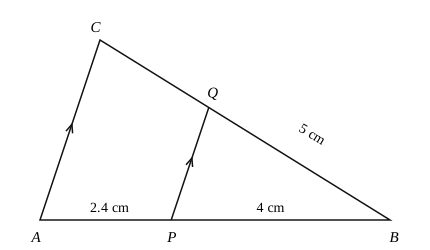
In △ ∥
(A) 2.7 cm(B) 1.8 cm(C) 3.6 cm(D) 2.16 cmShow answer & solution
Answer: (D) 2.16 cm
PQ ∥ △ A P Q ∼ △ A B C A B = 2.4 + 3.6 = 6 B C P Q = A B A P P Q = 6 2.4 × 5.4 = 2.16
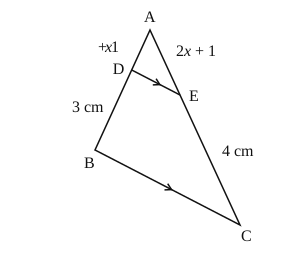
In △ A B C ∥ ( 2 x + 1 ) ( x + 1 ) x
(A) 1(B) 2 1 (C) − 1 (D) 3 1 Show answer & solution
Answer: (B) 2 1
By BPT, D B A D = E C A E 3 x + 1 = 4 2 x + 1 4 x + 4 = 6 x + 3 2 x = 1 x = 2 1
Assertion (A) : △ A B C ∼ △ P QR ∠ A = 6 5 ∘ ∠ C = 6 0 ∘ ∠ Q = 5 5 ∘ 18 0 ∘
(A) Both Assertion (A) and Reason (R) are true and Reason (R) is correct explanation of Assertion (A).(B) Both Assertion (A) and Reason (R) are true, but Reason (R) is not correct explanation for Assertion (A).(C) Assertion (A) is true, but Reason (R) is false.(D) Assertion (A) is false, but Reason (R) is true.Show answer & solution
Answer: (A) Both Assertion (A) and Reason (R) are true and Reason (R) is correct explanation of Assertion (A).
R is true (angle sum property). In △ A B C ∠ B = 18 0 ∘ − 6 5 ∘ − 6 0 ∘ = 5 5 ∘ Corresponding angles of similar triangles are equal, so ∠ Q = ∠ B = 5 5 ∘ R is used to find the angle, so R explains A.
In triangles A B C D E F ∠ B = ∠ E ∠ F = ∠ C A B = 3 D E
(A) congruent but not similar(B) congruent as well as similar(C) neither congruent nor similar(D) similar but not congruentShow answer & solution
Answer: (D) similar but not congruent
∠ B = ∠ E ∠ C = ∠ F △ A B C ∼ △ D E F A B = 3 D E
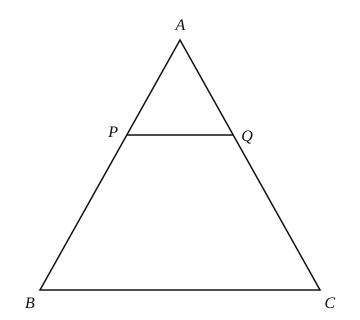
In the given figure, P Q ∥ B C P B A P = 13 4 A C = 20.4
(A) 2.8 cm(B) 5.8 cm(C) 3.8 cm(D) 4.8 cmShow answer & solution
Answer: (D) 4.8 cm
By BPT, QC A Q = P B A P = 13 4 So A C A Q = 17 4 A Q = 17 4 × 20.4 = 4.8
Which of the following statements is incorrect ?
(A) Two congruent figures are always similar.(B) A square and a rhombus of the same area are always similar.(C) Two equilateral triangles are always similar.(D) Two similar triangles need not be congruent.Show answer & solution
Answer: (B) A square and a rhombus of the same area are always similar.
Congruent figures are always similar, all equilateral triangles are similar, and similar triangles need not be congruent: (A), (C), (D) are correct. A rhombus need not have right angles, so its angles need not equal those of a square; equal area does not make them similar. So (B) is incorrect
If in two triangles △ D E F △ P QR ∠ D = ∠ Q ∠ R = ∠ E
(A) QR D E = P Q D F (B) P R E F = P Q D F (C) R P E F = QR D E (D) P Q D E = R P E F Show answer & solution
Answer: (D) P Q D E = R P E F
∠ D = ∠ Q ∠ E = ∠ R △ D E F ∼ △ QR P Hence QR D E = R P E F = QP D F Options (A), (B), (C) follow from this; (D) P Q D E = R P E F
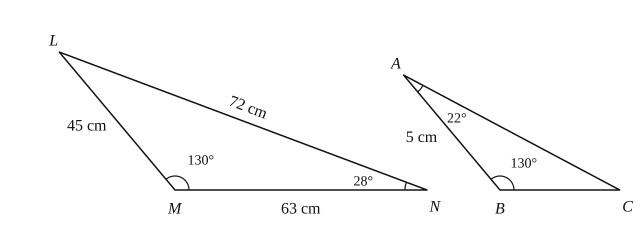
The measurements of △ L M N △ A B C
(A) 16 cm(B) 7 cm(C) 8 cm(D) 4 cmShow answer & solution
Answer: (C) 8 cm
In △ L M N ∠ L = 18 0 ∘ − 13 0 ∘ − 2 8 ∘ = 2 2 ∘ ∠ L = ∠ A = 2 2 ∘ ∠ M = ∠ B = 13 0 ∘ △ L M N ∼ △ A B C A B L M = A C L N 5 45 = A C 72 A C = 45 72 × 5 = 8
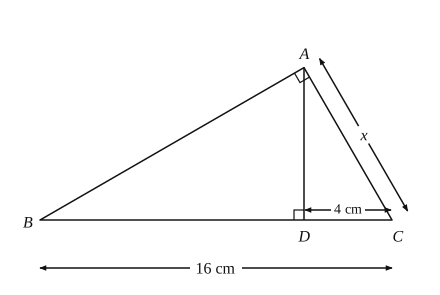
In the given figure, in △ A B C A D ⊥ B C ∠ B A C = 9 0 ∘ x
(A) 4 cm(B) 5 cm(C) 8 cm(D) 3 cmShow answer & solution
Answer: (C) 8 cm
△ A D C ∼ △ B A C ∠ C ∠ A D C = ∠ B A C = 9 0 ∘ So B C A C = A C D C A C 2 = B C × D C = 16 × 4 = 64 x = A C = 8
△ A B C △ P QR ∠ C
(A) 14 0 ∘ (B) 8 0 ∘ (C) 6 0 ∘ (D) 4 0 ∘ Show answer & solution
Answer: (D) 4 0 ∘
R Q A B = 7.6 3.8 = 2 1 QP B C = 12 6 = 2 1 P R C A = 6 3 3 3 = 2 1 So △ A B C ∼ △ R QP ∠ C = ∠ P ∠ P = 18 0 ∘ − 8 0 ∘ − 6 0 ∘ = 4 0 ∘ ∠ C = 4 0 ∘
E and F are points on the sides AB and AC respectively of a △ A B C E B A E = F C A F = 2 1
(A) E F = 2 B C (B) B C = 2 E F (C) E F = 3 B C (D) B C = 3 E F Show answer & solution
Answer: (D) B C = 3 E F
By the converse of BPT, E F ∥ B C △ A E F ∼ △ A B C A B A E = 1 + 2 1 = 3 1 B C E F = 3 1 B C = 3 E F
Which of the following statements is false ?
(A) Two right triangles are always similar.(B) Two squares are always similar.(C) Two equilateral triangles are always similar.(D) Two circles are always similar.Show answer & solution
Answer: (A) Two right triangles are always similar.
Squares, equilateral triangles and circles each have a fixed shape, so any two are similar. Two right triangles need not have equal acute angles (e.g. 3 0 ∘ 6 0 ∘ 9 0 ∘ 4 5 ∘ 4 5 ∘ 9 0 ∘
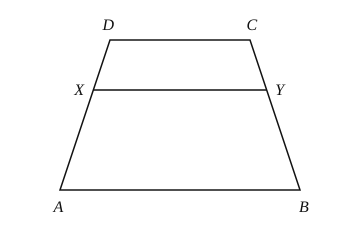
In the adjoining figure, ABCD is a trapezium in which X Y ∥ A B ∥ C D A X = 3 2 A D C Y : Y B =
(A) 2 : 3(B) 3 : 2(C) 1 : 3(D) 1 : 2Show answer & solution
Answer: (D) 1 : 2
A X = 3 2 A D ⇒ X D = 3 1 A D D X : X A = 1 : 2 Since X Y ∥ A B ∥ C D C Y : Y B = D X : X A = 1 : 2
In the adjoining figure, P Q ∥ X Y ∥ B C A P = 2 P X = 1.5 B X = 4 Q Y = 0.75 A Q + C Y =
(A) 6 cm(B) 4.5 cm(C) 3 cm(D) 5.25 cmShow answer & solution
Answer: (C) 3 cm
Parallel lines cut the two sides proportionally, so Q Y A Q = P X A P Q Y C Y = P X B X A Q = 1.5 2 × 0.75 = 1 C Y = 1.5 4 × 0.75 = 2 A Q + C Y = 1 + 2 = 3
Given △ A B C ∼ △ P QR ∠ A = 3 0 ∘ ∠ Q = 9 0 ∘ ( ∠ R + ∠ B )
(A) 9 0 ∘ (B) 12 0 ∘ (C) 15 0 ∘ (D) 18 0 ∘ Show answer & solution
Answer: (C) 15 0 ∘
Corresponding angles are equal: ∠ B = ∠ Q = 9 0 ∘ ∠ R = ∠ C ∠ C = 18 0 ∘ − 3 0 ∘ − 9 0 ∘ = 6 0 ∘ ∠ R = 6 0 ∘ ∠ R + ∠ B = 6 0 ∘ + 9 0 ∘ = 15 0 ∘
Assertion (A) : A line drawn parallel to any one side of a triangle intersects the other two sides in the same ratio.
(A) Both Assertion (A) and Reason (R) are correct and Reason (R) is the correct explanation of Assertion (A).(B) Both Assertion (A) and Reason (R) are correct but Reason (R) is not the correct explanation of Assertion (A).(C) Assertion (A) is true, but Reason (R) is false.(D) Assertion (A) is false, but Reason (R) is true.Show answer & solution
Answer: (C) Assertion (A) is true, but Reason (R) is false.
By the Basic Proportionality Theorem, a line parallel to one side of a triangle meeting the other two sides in distinct points divides them in the same ratio. So A is true. A line parallel to any side of a triangle can always be drawn, so R is false. Answer: (C)
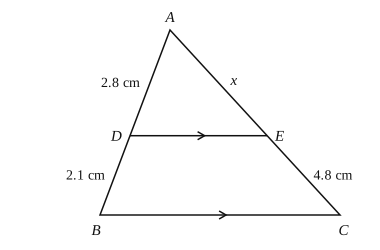
If in the given figure, D E ∥ B C A D = 2.8 D B = 2.1 E C = 4.8 x
(A) 3.6 cm(B) 2.4 cm(C) 6.4 cm(D) 4.8 cmShow answer & solution
Answer: (C) 6.4 cm
By the basic proportionality theorem, D B A D = E C A E 2.1 2.8 = 4.8 x x = 2.1 2.8 × 4.8 = 6.4
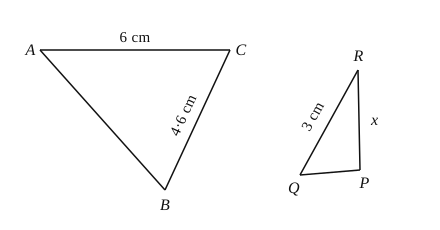
In the given figure, if △ A B C ∼ △ QP R x
(A) 5.3 (B) 4.6 (C) 2.3 (D) 4 cmShow answer & solution
Answer: (C) 2.3
△ A B C ∼ △ QP R QP A B = P R B C = QR A C QR A C = 3 6 = 2 P R B C = 2 x = P R = 2 4.6 = 2.3
It is given that △ A B C ∼ △ D E F ∠ A = 5 5 ∘ ∠ E = 4 5 ∘ ∠ C
(A) 8 0 ∘ (B) 9 0 ∘ (C) 5 5 ∘ (D) 4 5 ∘ Show answer & solution
Answer: (A) 8 0 ∘
Corresponding angles are equal, so ∠ B = ∠ E = 4 5 ∘ ∠ C = 18 0 ∘ − 5 5 ∘ − 4 5 ∘ = 8 0 ∘
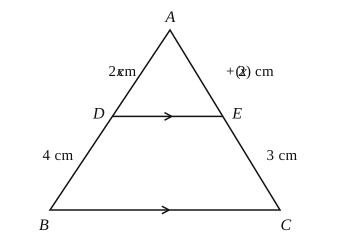
In the given figure, in △ A B C ∥
(A) 3(B) 2(C) 6(D) 4Show answer & solution
Answer: (D) 4
By BPT, D B A D = E C A E 4 2 x = 3 x + 2 6 x = 4 x + 8 x = 4
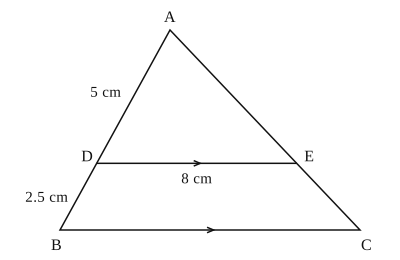
In the given figure △ A B C
(A) 10 cm(B) 6 cm(C) 8 cm(D) 7.5 cmShow answer & solution
Answer: (C) 8 cm
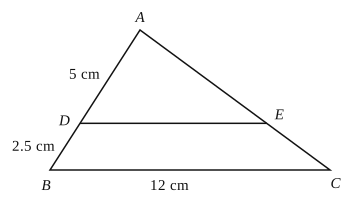
DE ∥ △ A D E ∼ △ A B C B C D E = A B A D = 5 + 2.5 5 = 3 2 DE = 3 2 × 12 = 8
The perimeters of two similar triangles ABC and PQR are 56 cm and 48 cm respectively. PQ/AB is equal to
(A) 8 7 (B) 7 6 (C) 6 7 (D) 7 8 Show answer & solution
Answer: (B) 7 6
For similar triangles, the ratio of perimeters equals the ratio of corresponding sides. A B P Q = 56 48 = 7 6
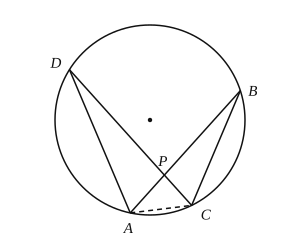
AB and CD are two chords of a circle intersecting at P. Choose the correct statement from the following :
(A) △ A D P ∼ △ C B A (B) △ A D P ∼ △ B P C (C) △ A D P ∼ △ B C P (D) △ A D P ∼ △ C B P Show answer & solution
Answer: (D) △ A D P ∼ △ C B P
∠ D A P = ∠ D A B = ∠ D C B = ∠ B C P ∠ A D P = ∠ A D C = ∠ A B C = ∠ C B P So A ↔ ↔ ↔ △ A D P ∼ △ C B P
If the diagonals of a quadrilateral divide each other proportionally, then it is a :
(A) parallelogram(B) rectangle(C) square(D) trapeziumShow answer & solution
Answer: (D) trapezium
Let diagonals AC and BD of quadrilateral ABCD meet at O with O C A O = O D B O Draw OE ∥ △ A D C E D A E = O C A O = O D B O By the converse of BPT in △ A B D ∥ ∥ Hence the quadrilateral is a trapezium.
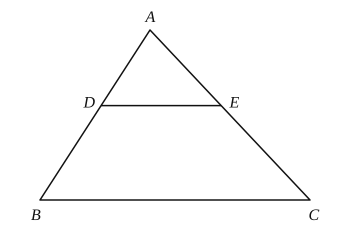
In △ A B C ∥
(A) 2.5(B) 3(C) 5(D) 6Show answer & solution
Answer: (B) 3
Since DE ∥ △ A D E ∼ △ A B C B C D E = A B A D = 2 + 3 2 = 5 2 D E = 5 2 × 7.5 = 3
In △ A B C ∥
(A) 6 cm(B) 7.5 cm(C) 9 cm(D) 5.7 cmShow answer & solution
Answer: (B) 7.5 cm
Since DE ∥ A B A D = A C A E 9 4 = 13.5 A E EC = AC − −
In the given figure, in △ A B C ∥
(A) 3 10 (B) 10 3 (C) 3 16 (D) 1.2 cmShow answer & solution
Answer: (C) 3 16
By BPT, D B A D = E C A E ⇒ 4 2.4 = E C 2 ⇒ E C = 3 10 A C = A E + E C = 2 + 3 10 = 3 16
If a vertical pole of length 7.5 m casts a shadow 5 m long on the ground and at the same time, a tower casts a shadow 24 m long, then the height of the tower is :
(A) 20 m(B) 40 m(C) 60 m(D) 36 mShow answer & solution
Answer: (D) 36 m
The pole and its shadow and the tower and its shadow form similar right triangles (same sun angle). 24 h = 5 7.5 ⇒ h = 36
Assertion (A) : ABCD is a trapezium with DC ∥ ∥ E D A E = F C B F
(A) Both Assertion (A) and Reason (R) are true and Reason (R) is the correct explanation of Assertion (A).(B) Both Assertion (A) and Reason (R) are true, but Reason (R) is not the correct explanation of Assertion (A).(C) Assertion (A) is true, but Reason (R) is false.(D) Assertion (A) is false, but Reason (R) is true.Show answer & solution
Answer: (A) Both Assertion (A) and Reason (R) are true and Reason (R) is the correct explanation of Assertion (A).
Join AC meeting EF at G. In △ A D C ∥ E D A E = GC A G In △ C A B ∥ GC A G = F C B F Hence E D A E = F C B F
The sides of two similar triangles are in the ratio 4 : 7. The ratio of their perimeters is
(A) 4 : 7(B) 12 : 21(C) 16 : 49(D) 7 : 4Show answer & solution
Answer: (A) 4 : 7
In similar triangles, the corresponding sides are proportional. So the ratio of the perimeters equals the ratio of the corresponding sides = 4 : 7.
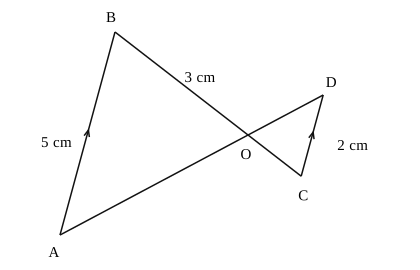
In the given figure, AB ∥
(A) 2 15 (B) 3 10 (C) 5 6 (D) 5 3 Show answer & solution
Answer: (C) 5 6
In △ A O B △ D O C ∠ A O B = ∠ D O C ∠ A B O = ∠ D C O ∥ So △ A O B ∼ △ D O C D C A B = O C O B 2 5 = O C 3 O C = 5 6
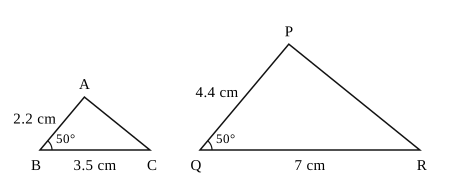
In the above figure, the criterion of similarity by which △ A B C ∼ △ P QR
(A) SSA (Side – Side – Angle) Similarity(B) ASA (Angle – Side – Angle) Similarity(C) SAS (Side – Angle – Side) Similarity(D) AA (Angle – Angle) SimilarityShow answer & solution
Answer: (C) SAS (Side – Angle – Side) Similarity
P Q A B = 4.4 2.2 = 2 1 QR B C = 7 3.5 = 2 1 The included angles are equal: ∠ B = ∠ Q = 5 0 ∘ So the triangles are similar by the SAS criterion.
If △ A B C ∼ △ D E F ∠ A = 4 7 ∘ ∠ E = 8 3 ∘ ∠ C
(A) 4 7 ∘ (B) 5 0 ∘ (C) 8 3 ∘ (D) 13 0 ∘ Show answer & solution
Answer: (B) 5 0 ∘
Corresponding angles of similar triangles are equal, so ∠ B = ∠ E = 8 3 ∘ ∠ C = 18 0 ∘ − 4 7 ∘ − 8 3 ∘ = 5 0 ∘
△ A B C ∼ △ D E F
(A) 8 cm(B) 7.5 cm(C) 15 cm(D) 5 3 Show answer & solution
Answer: (B) 7.5 cm
In similar triangles, the ratio of perimeters equals the ratio of corresponding sides. D E A B = 24 32 = 32 10 × 24 = 7.5
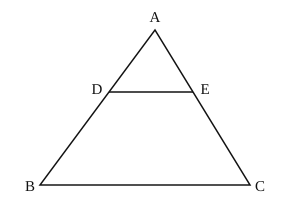
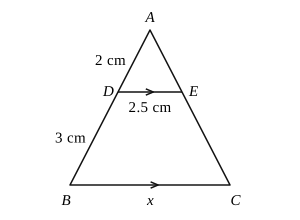
In the given figure, AD = 2 cm, DB = 3 cm, DE = 2.5 cm and DE ∥
(A) 6 cm(B) 3.75 cm(C) 6.25 cm(D) 7.5 cmShow answer & solution
Answer: (C) 6.25 cm
DE ∥ △ A D E ∼ △ A B C A B A D = B C D E 5 2 = x 2.5 x = 2 2.5 × 5 = 6.25
In two triangles △ P QR △ A B C B C A B = P R P Q
(A) ∠ A = ∠ P (B) ∠ B = ∠ Q (C) ∠ B = ∠ P (D) CA = QRShow answer & solution
Answer: (C) ∠ B = ∠ P
By SAS similarity, the angles included between the proportional sides must be equal. The angle between AB and BC is ∠ B ∠ P So we need ∠ B = ∠ P
In the given figure, ABC is a triangle in which AD = 1.6 cm, BD = 4.8 cm, AE = 1.1 cm and EC = 2.2 cm. Then :
(A) DE ∥ (B) DE = 2 1 (C) DE = BC(D) DE is not parallel to BC (DE ∦ Show answer & solution
Answer: (D) DE is not parallel to BC (DE ∦
D B A D = 4.8 1.6 = 3 1 E C A E = 2.2 1.1 = 2 1 Since D B A D = E C A E (Options B and C would need DE parallel to BC, so they are also ruled out.)
If △ A B C ∼ △ P QR ∠ A = 3 2 ∘ ∠ R = 6 5 ∘ ∠ B
(A) 3 2 ∘ (B) 6 5 ∘ (C) 8 3 ∘ (D) 9 7 ∘ Show answer & solution
Answer: (C) 8 3 ∘
Corresponding angles of similar triangles are equal, so ∠ C = ∠ R = 6 5 ∘ ∠ B = 18 0 ∘ − 3 2 ∘ − 6 5 ∘ = 8 3 ∘
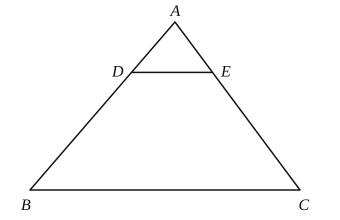
In the given figure, D E ∥ B C
(A) 2(B) 3(C) 5(D) 2 9 Show answer & solution
Answer: (D) 2 9
By BPT, D B A D = E C A E 3 2 = x 3 x = 2 9
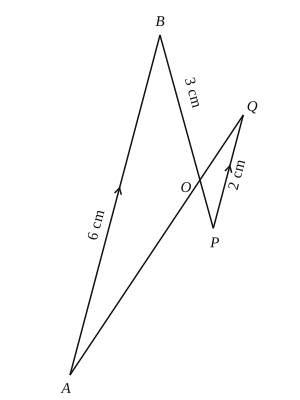
In the given figure, A B ∥ P Q
(A) 9 cm(B) 3 cm(C) 4 cm(D) 1 cmShow answer & solution
Answer: (D) 1 cm
∠ O A B = ∠ O QP ∠ O B A = ∠ O P Q △ O A B ∼ △ O QP O P O B = QP A B O P 3 = 2 6
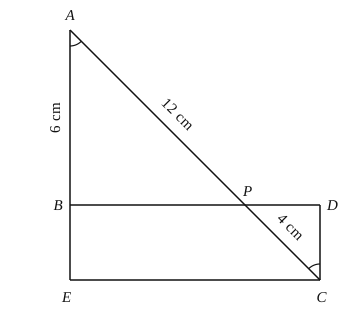
In the given figure, ∠ A = ∠ C
(A) 2 cm(B) 6 cm(C) 8 cm(D) 18 cmShow answer & solution
Answer: (A) 2 cm
In △ A B P △ C D P ∠ A = ∠ C ∠ A P B = ∠ C P D So △ A B P ∼ △ C D P C D A B = C P A P ⇒ C D 6 = 4 12 CD = 2 cm
In the given figure, △ A B C ∼ △ QP R
(A) 3.6 cm(B) 2.5 cm(C) 10 cm(D) 3.2 cmShow answer & solution
Answer: (B) 2.5 cm
△ A B C ∼ △ QP R So QR A C = P R B C 3 6 = x 5 x = 2.5
In △ A B C ∥
(A) 12 cm(B) 20 cm(C) 6 cm(D) 14 cmShow answer & solution
Answer: (B) 20 cm
By BPT, P B A P = QC A Q 6 4 = QC 8 ⇒ QC = 12 A C = A Q + QC = 8 + 12 = 20
In the given figure, PQ ∥
(A) 8 cm(B) 3 cm(C) 0.3 cm(D) 3 25 Show answer & solution
Answer: (A) 8 cm
PQ ∥ B A B P = B C B Q BA = BP + PA = 4 + 2.4 = 6.4 cm 6.4 4 = B C 5 ⇒ B C = 4 5 × 6.4 = 8
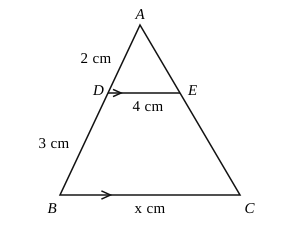
In the given figure, DE ∥
(A) 6(B) 12.5(C) 8(D) 10Show answer & solution
Answer: (D) 10
Since DE ∥ △ A D E ∼ △ A B C AB = AD + DB = 2 + 3 = 5 cm. A B A D = B C D E 5 2 = x 4 x = 10.
In △ A B C △ D E F D E A B = F D B C
(A) ∠ A = ∠ D (B) ∠ B = ∠ D (C) ∠ B = ∠ E (D) ∠ A = ∠ F Show answer & solution
Answer: (B) ∠ B = ∠ D
For SAS similarity, the included angles of the proportional sides must be equal. Angle included between AB and BC is ∠ B ∠ D So ∠ B = ∠ D
If △ P QR ∼ △ A B C △ A B C △ P QR
(A) 20.25 cm(B) 27 cm(C) 48 cm(D) 64 cmShow answer & solution
Answer: (B) 27 cm
Perimeters of similar triangles are in the ratio of corresponding sides. 36 Perimeter of △ P QR = 8 6 Perimeter of △ P QR = 36 × 4 3 = 27
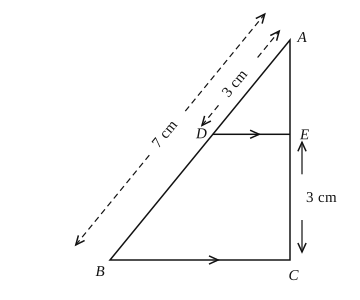
In the given figure, DE∥
(A) 2 cm(B) 2.25 cm(C) 3.5 cm(D) 4 cmShow answer & solution
Answer: (B) 2.25 cm
DB = AB – AD = 7 – 3 = 4 cm. By BPT, D B A D = E C A E 4 3 = 3 A E 4 9
Practise smarter: chapter-wise revision, formula sheets and step-by-step NCERT solutions on
MonoMath CBSE →