CBSE Class 10 Maths Basic 2025 Question Paper 430/6/1 with Solutions
All 44 questions from the CBSE Class 10 Mathematics Basic board paper, Set 430/6/1 (2025),
with answers and step-by-step solutions. Total 80 marks. Tap “Show answer & solution” under any question.
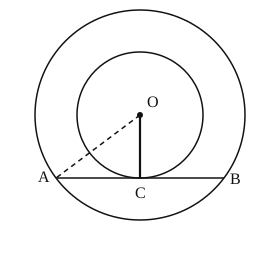
In two concentric circles centred at O, a chord AB of the larger circle touches the smaller circle at C. If OA = 3.5 cm, OC = 2.1 cm, then AB is equal to
(A)5.6 cm
(B)2.8 cm
(C)3.5 cm
(D)4.2 cm
Show answer & solution
Answer: (A) 5.6 cm
OC ⊥ AB (radius ⊥ tangent), and the perpendicular from the centre bisects the chord, so AB = 2AC.
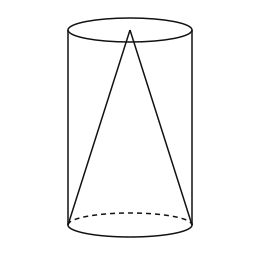
The volume of air in a hollow cylinder is 450 cm3. A cone of same height and radius as that of cylinder is kept inside it. The volume of empty space in the cylinder is
A box contains 120 discs, which are numbered from 1 to 120. If one disc is drawn at random from the box, find the probability that (i) it bears a 2– digit number (ii) the number is a perfect square.
Show answer & solution
Answer: (i) 43 (ii) 121
Total outcomes = 120.
(i) 2-digit numbers are 10 to 99, i.e. 90 numbers. P = 12090=43.
(ii) Perfect squares up to 120: 1, 4, 9, ..., 100, i.e. 10 numbers (112=121>120). P =12010=121.
Three measuring rods are of lengths 120 cm, 100 cm and 150 cm. Find the least length of a fence that can be measured an exact number of times, using any of the rods. How many times each rod will be used to measure the length of the fence ?
Show answer & solution
Answer: Least length = 600 cm (6 m); the rods are used 5, 6 and 4 times respectively.
120=23×3×5, 100=22×52, 150=2×3×52.
LCM =23×3×52=600 cm.
Rod of 120 cm: 600÷120=5 times; rod of 100 cm: 600÷100=6 times; rod of 150 cm: 600÷150=4 times.
Nidhi received simple interest of ₹ 1,200 when invested ₹ x at 6% p.a. and ₹ y at 5% p.a. for 1 year. Had she invested ₹ x at 3% p.a. and ₹ y at 8% p.a. for that year, she would have received simple interest of ₹ 1,260. Find the values of x and y.
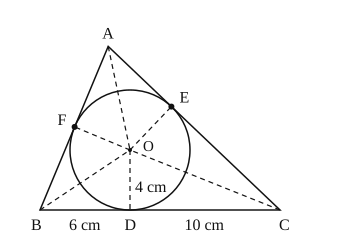
The given figure shows a circle with centre O and radius 4 cm circumscribed by △ABC. BC touches the circle at D such that BD = 6 cm, DC = 10 cm. Find the length of AE.
Show answer & solution
Answer: AE =1164 cm (about 5.82 cm)
Tangents from an external point are equal: BF = BD = 6, CE = CD = 10, AE = AF = x (say).
Sides: BC = 16, CA = x+10, AB = x+6; semi-perimeter s=x+16.
Area =21×r× perimeter =4(x+16).
By Heron: Area =s(s−a)(s−b)(s−c)=(x+16)(x)(6)(10).
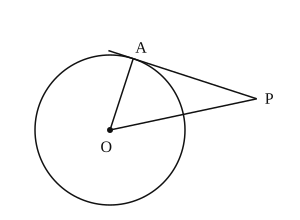
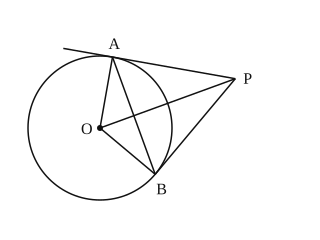
PA and PB are tangents drawn to a circle with centre O. If ∠AOB=120∘ and OA = 10 cm, then (i) Find ∠OPA. (1) (ii) Find the perimeter of △OAP. (3) (iii) Find the length of chord AB. (1)
Show answer & solution
Answer: (i) ∠OPA=30∘ (ii) (30+103) cm (about 47.3 cm) (iii) AB =103 cm
(i) ∠OAP=∠OBP=90∘, so ∠APB=360∘−90∘−90∘−120∘=60∘. OP bisects ∠APB, so ∠OPA=30∘.
(ii) In right △OAP: sin30∘=OPOA, so OP = 20 cm; tan30∘=APOA, so AP =103 cm.
Perimeter =10+20+103=(30+103) cm.
(iii) △AOB is isosceles with OA = OB = 10 and ∠AOB=120∘. The perpendicular from O to AB bisects AB and ∠AOB.
The angles of depression of the top and the foot of a 9 m tall building from the top of a multi-storeyed building are 30∘ and 60∘ respectively. Find the height of the multi-storeyed building and the distance between the two buildings. (Use 3=1.73)
Show answer & solution
Answer: Height = 13.5 m; distance =293≈7.79 m (7.785 m)
Let the multi-storeyed building be h m high and the distance between the buildings be d m.
Foot of the 9 m building (depression 60∘): tan60∘=dh, so h=3d.
Top of the 9 m building (depression 30∘): tan30∘=dh−9, so h−9=3d.
3d−3d=9, so 32d=9 and d=293=29×1.73=7.785 m.
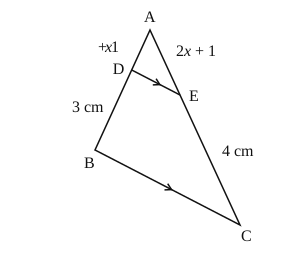
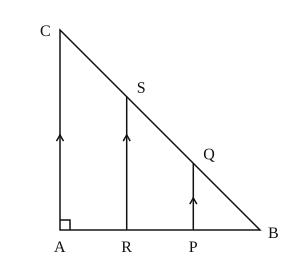
A triangular window of a building is shown above. Its diagram represents a △ABC with ∠A=90∘ and AB = AC. Points P and R trisect AB and PQ ∥ RS ∥ AC. Based on the above, answer the following questions : (i) Show that △BPQ∼△BAC. (1) (ii) Prove that PQ =31AC. (1) (iii) (a) If AB = 3 m, find length BQ and BS. Verify that BQ =21BS. (2) OR (iii) (b) Prove that BR2 + RS2=94BC2. (2)
Show answer & solution
Answer: (i) Proved (AA similarity) (ii) Proved (iii) (a) BQ =2 m, BS =22 m, so BQ =21BS OR (b) Proved
(i) In △BPQ and △BAC: ∠B is common and ∠BPQ=∠BAC (corresponding angles, PQ ∥ AC). So △BPQ∼△BAC (AA).
(ii) From (i), ACPQ=BABP. P and R trisect AB with P nearer B, so BP =31AB. Hence PQ =31AC.
(iii) (a) AC = AB = 3 m, so BC =9+9=32 m. From the similarity, BQ =31BC =2 m.
Similarly △BRS∼△BAC with BR =32AB, so BS =32BC =22 m. Thus BQ =21BS.
(iii) (b) △BRS∼△BAC with ratio BABR=32, so BR =32AB and RS =32AC.
BR2 + RS2=94(AB2 + AC2) =94BC2 (Pythagoras in △ABC, right-angled at A).
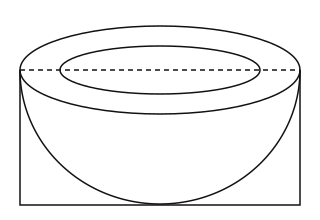
A hemispherical bowl is packed in a cuboidal box. The bowl just fits in the box. Inner radius of the bowl is 10 cm. Outer radius of the bowl is 10.5 cm. Based on the above, answer the following questions : (i) Find the dimensions of the cuboidal box. (1) (ii) Find the total outer surface area of the box. (1) (iii) (a) Find the difference between the capacity of the bowl and the volume of the box. (use π=3.14) (2) OR (iii) (b) The inner surface of the bowl and the thickness is to be painted. Find the area to be painted. (2)
Show answer & solution
Answer: (i) 21 cm × 21 cm × 10.5 cm (ii) 1764 cm2 (iii) (a) about 2537.17 cm3 OR (b) about 660.79 cm2
(i) The bowl just fits, so length = breadth = outer diameter = 21 cm and height = outer radius = 10.5 cm.
(ii) TSA =2(lb+bh+hl)=2(21×21+21×10.5+10.5×21)=2(441+220.5+220.5)=1764 cm2.
(iii) (a) Capacity of bowl =32πr3=32×3.14×1000≈2093.33 cm3.
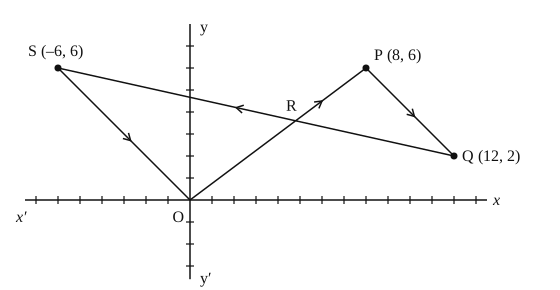
Gurveer and Arushi built a robot that can paint a path as it moves on a graph paper. Some co-ordinate of points are marked on it. It starts from (0, 0), moves to the points listed in order (in straight lines) and ends at (0, 0). Arushi entered the points P(8, 6), Q(12, 2) and S(− 6, 6) in order. The path drawn by robot is shown in the figure. Based on the above, answer the following questions : (i) Determine the distance OP. (1) (ii) QS is represented by equation 2x+9y=42. Find the co-ordinates of the point where it intersects y – axis. (1) (iii) (a) Point R(4.8, y) divides the line segment OP in a certain ratio, find the ratio. Hence, find the value of y. (2) OR (iii) (b) Using distance formula, show that OSPQ=32. (2)
Show answer & solution
Answer: (i) 10 units (ii) (0,314) (iii) (a) 3 : 2, y = 3.6 OR (b) Shown: PQ =42, OS =62
(i) OP =82+62=100=10 units.
(ii) On the y-axis x=0: 9y=42, y=314. Point (0,314).
(iii) (a) Let R divide OP in the ratio k:1. Then k+18k=4.8, so 8k=4.8k+4.8, k=1.5. Ratio =3:2.
y =53×6+2×0=3.6.
(iii) (b) PQ =(12−8)2+(2−6)2=32=42; OS =36+36=62.