CBSE Class 10 Maths Standard 2026 Question Paper 30/4/1 with Solutions
All 44 questions from the CBSE Class 10 Mathematics Standard board paper, Set 30/4/1 (2026),
with answers and step-by-step solutions. Total 80 marks. Tap “Show answer & solution” under any question.
An ice-cream cone of radius r and height h is completely filled by two spherical scoopes of ice-cream. If radius of each spherical scoop is 2r, then h : 2r equals
(A)1 : 8
(B)1 : 2
(C)1 : 1
(D)2 : 1
Show answer & solution
Answer: (B) 1 : 2
Volume of cone = volume of two scoops: 31πr2h=2×34π(2r)3=31πr3
In a class test, Veer scored 6 more than twice as many marks as Kevin scored. If one of them had scored 4 more marks, their total score would have been 40. Find the marks obtained by Veer and Kevin.
Show answer & solution
Answer: Veer: 26 marks, Kevin: 10 marks
Let Veer score x marks and Kevin score y marks.
x=2y+6 ... (1)
If one of them scored 4 more, total = 40: x+y+4=40⇒x+y=36 ... (2)
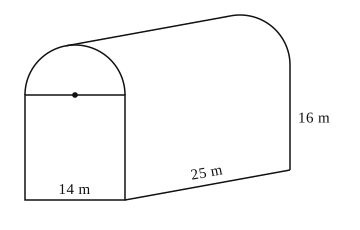
To protect plants from heat, a shed of iron rods covered with green cloth is made. The lower part of the shed is a cuboid mounted by semi-cylinder as shown in the figure. Find the area of the cloth required to make this shed, if dimensions of the cuboid are 14 m × 25 m × 16 m
Show answer & solution
Answer: 1952 m2
Cloth covers the four walls of the cuboid, the curved surface of the semi-cylinder and its two semicircular ends (not the floor).
Radius of semi-cylinder =7 m, length =25 m.
Four walls =2(14+25)×16=1248 m2
Curved surface of semi-cylinder =πrl=722×7×25=550 m2
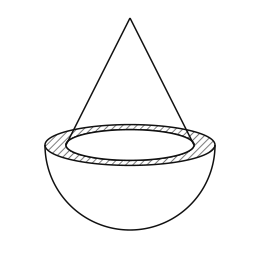
The internal and external radii of a hollow hemisphere are 52 cm and 10 cm respectively. A cone of height 57 cm and radius 52 cm is surmounted on the hemisphere as shown in the figure. Find the total surface area of the object in terms of π. (Use 2=1.4)
Show answer & solution
Answer:355π cm2
Outer curved surface of hemisphere =2πR2=2π×100=200π
Ring at the rim =π(R2−r2)=π(100−50)=50π
Slant height of cone l=(52)2+(57)2=50+175=15 cm
Curved surface of cone =πrl=π×52×15=752π=75×1.4π=105π
The cone closes the hollow, so the inner surface is not exposed.
A bag contains 30 balls out of which ‘m’ number of balls are blue in colour. (i) Find the probability that a ball drawn at random from the bag is not blue. (ii) If 6 more blue balls are added in the bag, then the probability of drawing a blue ball will be 45 times the probability of drawing a blue ball in the first case. Find the value of m.
A person on tour has ₹ 5,400 for his expenses. If he extends his tour by 5 days, he has to cut down his daily expenses by ₹ 180. Find the original duration of the tour and daily expense.
Show answer & solution
Answer: 10 days; ₹ 540 per day
Let the original duration be x days. Daily expense =x5400.
The total cost of certain piece of cloth was ₹ 2,100. During special sale time, the shopkeeper offered 2 m extra cloth for free thus reducing the price of cloth per metre by ₹ 120. What was the original per metre price of cloth and its length ?
Show answer & solution
Answer: Length 5 m; original price ₹ 420 per metre
Let the original length be x m. Original price per metre =x2100.
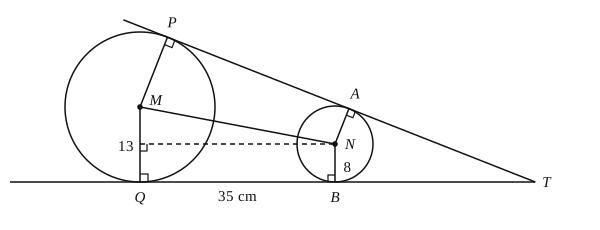
In the given figure, TP and TQ are tangents to a circle with centre M, touching another circle with centre N at A and B respectively. It is given that MQ = 13 cm, NB = 8 cm, BQ = 35 cm and TP = 80 cm. (i) Name the quadrilateral MQBN. (1) (ii) Is MN parallel to PA ? Justify your answer. (1) (iii) Find length TB. (1) (iv) Find length MN. (2)
Show answer & solution
Answer: (i) Trapezium (ii) No (iii) TB = 45 cm (iv) MN = 252 cm
(i) MQ⊥QT and NB⊥QT, so MQ∥NB; MQBN is a trapezium (right trapezium).
(ii) MP⊥PA and NA⊥PA, so MP∥NA. If also MN∥PA, MPAN would be a parallelogram and MP = NA; but MP = 13 cm = NA = 8 cm. So MN is not parallel to PA.
(iii) Tangents from T: TQ = TP = 80 cm, so TB = TQ − BQ = 80 − 35 = 45 cm.
(iv) Draw NL⊥MQ. Then LQ = NB = 8, ML = 13 − 8 = 5 cm and NL = BQ = 35 cm.
A kite is flying at a height of 60 m above the ground level. Ravi, standing at the roof of the house is holding the string straight and observes the angle of elevation of kite as 30∘. From the bottom of the same building, the angle of elevation of kite is 45∘. Find the length of the string and height of roof from the ground. (Use 3=1.73)
Show answer & solution
Answer: Length of string = 69.2 m; height of roof = 25.4 m
Let the building be AB (B at the ground, A at the roof) of height h, the kite at K, 60 m above the ground, and d the horizontal distance of the kite from the building.
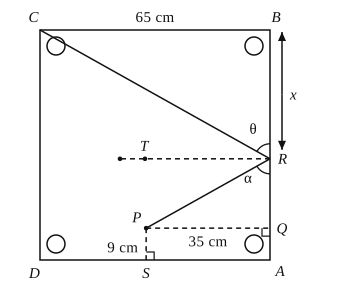
Carom board is a very popular game. The board is a square of side length 65 cm. It has circular pockets in each corner. Ansh strikes a disc, kept at position P with a striker. The disc, hits the boundary of the board at R and goes straight to pocket at corner C. It is given that PS = 9 cm, PQ = 35 cm, BR = x, ∠PRQ=α and ∠CRB=θ. Based on the above information, answer the following questions : (i) Using law of reflection i.e. ∠PRT=∠CRT, prove that θ=α. (1) (ii) Prove that △PQR∼△CBR given that PQ is perpendicular to AB. (1) (iii) (a) Find the value of x using similarity of triangles. (2) OR (b) If Area △CBRArea △PQR=CB2PQ2, then find the value of x.
Show answer & solution
Answer: (i) Proved. (ii) Proved. (iii) (a) x=36.4 cm OR (b) x=36.4 cm
(i) RT is perpendicular to AB at R, so θ=90∘−∠CRT and α=90∘−∠PRT. As ∠PRT=∠CRT, θ=α.
(ii) In △PQR and △CBR: ∠PQR=∠CBR=90∘ and ∠PRQ=∠CRB (part (i)). So △PQR∼△CBR (AA).
(iii)(a) AQ = PS = 9 cm, so QR=65−9−x=56−x.
CBPQ=BRQR⇒6535=x56−x
35x=3640−65x⇒100x=3640⇒x=36.4 cm
(iii)(b) For similar triangles the area ratio equals the square of the ratio of corresponding sides, so CB2PQ2=BR2QR2, i.e. 6535=x56−x, giving x=36.4 cm.
‘Kolam’ is a decorative art which is made with rice flour in South Indian States. It is drawn on grid pattern of dots. One such art work is shown below. Observe the given figure carefully. There are 4 dots in first square, 8 dots in second square, 12 dots in third square and so on. Based on the above, answer the following questions : (i) Show that number of dots given above form an A.P. Write the first term and common difference. (1) (ii) Write nth term of the A.P. formed. (1) (iii) (a) The pattern is expanded on a large ground. If total 220 dots are used, then find the number of squares formed. (2) OR (b) Is it possible to complete n number of squares using 100 dots ? If yes, then find the value of n.
Show answer & solution
Answer: (i) 4, 8, 12, ... is an A.P. with a = 4, d = 4 (ii) an=4n (iii) (a) 10 squares OR (b) No
(i) 8 − 4 = 12 − 8 = 4, a constant difference, so 4, 8, 12, ... is an A.P. with a = 4, d = 4.
(ii) an=4+(n−1)4=4n
(iii)(a) Sn=2n[8+4(n−1)]=2n(n+1)=220
n2+n−110=0⇒(n+11)(n−10)=0⇒n=10 squares
(iii)(b) 2n(n+1)=100⇒n2+n−50=0
D=1+200=201 is not a perfect square, so n is not a natural number. Not possible.
Observe the map of Jaipur city placed on a Cartesian plane. Taking Rambagh Palace as origin, the location of some places are given below : Point A : (−4,2) Rajasthan High Court Point B : (4,−4) Birla Mandir Point C : (4,3) Heera Bagh Point D : (−5,−2) Amar Jawan Jyoti Based on the above, answer the following questions : (i) Advocate Rehana stays at Heera Bagh. How much distance she has to cover daily to go to the court and coming back home ? (1) (ii) There is a crossing on X-axis which divides AD in a certain ratio. Find the ratio. (1) (iii) (a) Is Birla Mandir equidistant from Heera Bagh and Amar Jawan Jyoti ? Justify your answer. (2) OR (b) Using section formula, show that points A, O and B are not collinear.
Show answer & solution
Answer: (i) 265 units (ii) 1 : 1 (iii) (a) No (BC = 7, BD = 85) OR (b) Shown: O does not lie on AB
(i) AC=(4+4)2+(3−2)2=65; to and fro: 265 units.
(ii) Let the point on the x-axis divide AD in ratio k : 1. y-coordinate: k+1−2k+2=0⇒k=1. Ratio 1 : 1.
(iii)(a) BC=02+72=7, BD=92+22=85. As 7=85, B is not equidistant from C and D.
(iii)(b) If O(0, 0) lies on AB, let it divide AB in ratio k : 1. x: k+14k−4=0⇒k=1.
Then y =k+1−4k+2=2−2=−1=0. No single ratio works, so A, O and B are not collinear.