CBSE Class 10 Maths Basic 2024 Question Paper 430/3/3 with Solutions
All 44 questions from the CBSE Class 10 Mathematics Basic board paper, Set 430/3/3 (2024),
with answers and step-by-step solutions. Total 80 marks. Tap “Show answer & solution” under any question.
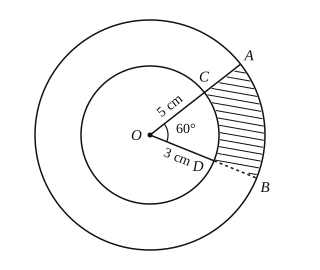
In the given figure, two concentric circles of radii 5 cm and 3 cm have their centre O. OAB is a sector of outer circle making an angle of 60∘ at the centre while OCD is the sector of smaller circle. The area of the shaded region is :
(A)27π cm2
(B)38π cm2
(C)625π cm2
(D)23π cm2
Show answer & solution
Answer: (B) 38π cm2
Shaded area = area of sector OAB − area of sector OCD.
Assertion (A) : The distance of P(a,b) from origin is a2+b2. Reason (R) : The distance between two points A(x1,y1) and B(x2,y2) is (x2−x1)2+(y2−y1)2.
(A)Both Assertion (A) and Reason (R) are true. Reason (R) is the correct explanation of Assertion (A).
(B)Both Assertion (A) and Reason (R) are true. Reason (R) is not the correct explanation of Assertion (A).
(C)Assertion (A) is true, but Reason (R) is false.
(D)Assertion (A) is false, but Reason (R) is true.
Show answer & solution
Answer: (D) Assertion (A) is false, but Reason (R) is true.
By the distance formula (R is true), OP=(a−0)2+(b−0)2=a2+b2.
Point P(x,y) divides the line segment joining the points A(−1,3) and B(9,8) such that AP:PB=k:1. If the co-ordinates of P are such that x=y, then find the value of k.
Show answer & solution
Answer:k=4
By the section formula, x=k+19k−1 and y=k+18k+3.
There are 80 cards numbered from 1 to 80. One card is drawn at random from them. Find the probability that the number on the selected card is not divisible by 8.
Show answer & solution
Answer:87
Numbers from 1 to 80 divisible by 8: 8, 16, ..., 80, i.e. 10 numbers.
A vessel is in the form of a hollow hemisphere surmounted by a hollow cylinder. The diameter of the hemisphere is 14 cm and the total height of the vessel is 13 cm. Find the inner surface area of the vessel.
Show answer & solution
Answer: 572 cm2
Radius r=7 cm; height of cylinder h=13−7=6 cm.
Inner surface area = CSA of hemisphere + CSA of cylinder =2πr2+2πrh.
A solid toy is in the form of a hemisphere surmounted by a right circular cone. The height of the cone is 2 cm and the diameter of the base is 4 cm. Determine the volume of the toy.
Show answer & solution
Answer:8π=7176 cm3 (about 25.14 cm3)
Radius r=2 cm, height of cone h=2 cm.
Volume = volume of cone + volume of hemisphere =31πr2h+32πr3.
The altitude of a right-angled triangle is 7 cm less than its base. If its hypotenuse is 17 cm long, then (a) represent the above information in the form of a quadratic equation; (b) find the length of the sides of the triangle.
Show answer & solution
Answer: (a) x2−7x−120=0 (base x cm) (b) base 15 cm, altitude 8 cm, hypotenuse 17 cm
Let the base be x cm; then the altitude is (x−7) cm.
By Pythagoras theorem, x2+(x−7)2=172.
2x2−14x+49−289=0, i.e. x2−7x−120=0.
(x−15)(x+8)=0, so x=15 (length cannot be negative).
Base = 15 cm, altitude = 8 cm, hypotenuse = 17 cm.
The sum of the digits of a 2-digit number is 9. Also, nine times this number is twice the number obtained by reversing the order of the digits. Find the number.
Show answer & solution
Answer: 18
Let the tens digit be x and the units digit be y; the number is 10x+y.
x+y=9 ... (1)
9(10x+y)=2(10y+x) gives 88x=11y, i.e. y=8x ... (2)
The marks obtained by 45 students of a class in a test are given below : Marks: 40 – 45, 45 – 50, 50 – 55, 55 – 60, 60 – 65, 65 – 70 No. of Students: 8, 9, 10, 9, 5, 4 Find the mean and median marks.
Show answer & solution
Answer: Mean =452392.5≈53.17; Median = 52.75
Class marks xi: 42.5, 47.5, 52.5, 57.5, 62.5, 67.5; fi: 8, 9, 10, 9, 5, 4; ∑fi=45.
The angle of elevation of a helicopter in air from a point A on the ground is 45∘. After a flight of 25 seconds, the angle of elevation changes to 30∘. If the helicopter is flying at a constant height of 2500 m, find the speed of the helicopter. (Use 3=1.73)
Show answer & solution
Answer: 73 m/s (= 262.8 km/h)
Let the first and second positions be above points C and D on the ground, with AC and AD the horizontal distances.
tan45∘=AC2500, so AC=2500 m.
tan30∘=AD2500, so AD=25003 m.
Distance flown =AD−AC=2500(3−1)=2500×0.73=1825 m.
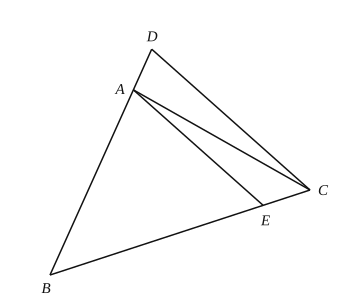
Prove that the parallelogram circumscribing a circle is a rhombus. Also, find area of the rhombus, if radius of circle is 3 cm and length of one side of the rhombus is 10 cm.
Show answer & solution
Answer: Proved; area of the rhombus = 60 cm2.
Let parallelogram ABCD touch the circle at P, Q, R, S on AB, BC, CD, DA.
Tangents from an external point are equal: AP=AS, BP=BQ, CR=CQ, DR=DS.
Adding, AB+CD=AD+BC.
In a parallelogram AB=CD and AD=BC, so 2AB=2BC, i.e. AB=BC.
So all sides are equal and ABCD is a rhombus.
The distance between opposite sides of the rhombus equals the diameter of the circle =6 cm.
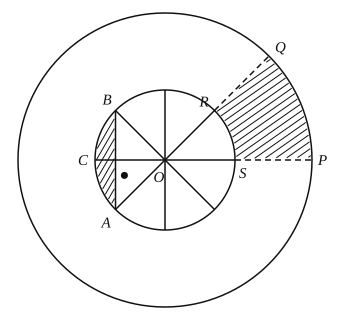
NSS (National Service Scheme) aims to connect the students to the community and to involve them in problem solving process. NSS symbol is based on the ‘Rath’ wheel of the Konark Sun Temple situated in Odisha. The wheel signifies the progress cycle of life. The diagramatic representation of the symbol is given below : Observe the figure given above. The diameters of inner circle are equally placed. Given that OP = 21 cm, OS = 10 cm. Based on the above information, answer the following questions : (i) Find m∠ROS. (1) (ii) Find the perimeter of sector OPQ. (1) (iii) Find the area of shaded region PQRS. (2) OR Find the area of shaded region ACB i.e. the segment ACB. (2)
Show answer & solution
Answer: (i) 45∘ (ii) 58.5 cm (iii) 283751≈133.96 cm2; OR 7200≈28.57 cm2
(i) Four equally placed diameters make 8 equal angles: ∠ROS=8360∘=45∘.
(ii) Arc PQ =36045×2×722×21=16.5 cm; perimeter =21+21+16.5=58.5 cm.
(iii) Area PQRS =36045×722×(212−102)=81×722×341=283751≈133.96 cm2.
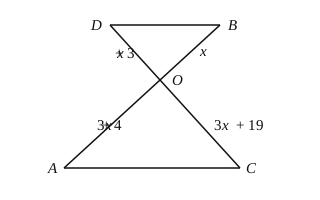
In the figure given below, a folding table is shown : The legs of the table are represented by line segments AB and CD intersecting at O. Join AC and BD. Considering table top is parallel to the ground, and OB=x, OD=x+3, OC=3x+19 and OA=3x+4, answer the following questions : (i) Prove that △OAC is similar to △OBD. (1) (ii) Prove that ACOA=BDOB. (1) (iii) Observe the figure and find the value of x. Hence, find the length of OC. (2) OR Observe the figure and find ACBD. (2)
Show answer & solution
Answer: (i) Proved (AA) (ii) Proved (iii) x=2, OC=25; OR ACBD=51
(i) DB∥AC, so ∠OBD=∠OAC and ∠ODB=∠OCA (alternate angles); also ∠AOC=∠BOD (vertically opposite). Hence △OAC∼△OBD (AA).
(ii) From the similarity, OBOA=BDAC, so ACOA=BDOB.
(iii) OBOA=ODOC: x3x+4=x+33x+19.
(3x+4)(x+3)=x(3x+19) gives 3x2+13x+12=3x2+19x, so x=2.
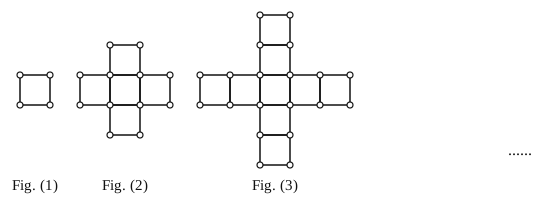
While preparing for a competitive examination, Akbar came across a match-stick pattern based question. The pattern is given below : Based on the above information, answer the following questions : (i) Write first term and common difference of the A.P. formed by number of squares in each figure. (1) (ii) Write first term and common difference of the A.P. formed by number of sticks used in each figure. (1) (iii) How many squares are there in Fig. (10) ? Also, write the number of sticks used in Fig. (10). (2) OR If 88 sticks are used to make mth figure (Fig. (m)), find the value of m. How many squares are formed in this figure ? (2)
Show answer & solution
Answer: (i) a=1, d=4 (ii) a=4, d=12 (iii) 37 squares, 112 sticks; OR m=8, 29 squares
(i) Squares: 1, 5, 9, ... so a=1, d=4.
(ii) Sticks: 4, 16, 28, ... (each new square adds 3 sticks) so a=4, d=12.
(iii) Squares in Fig. 10 =1+9×4=37; sticks =4+9×12=112.