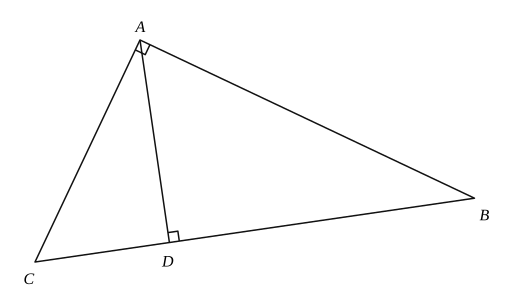
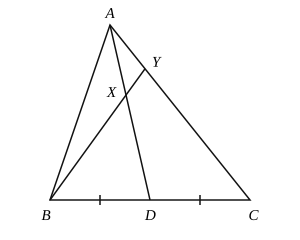
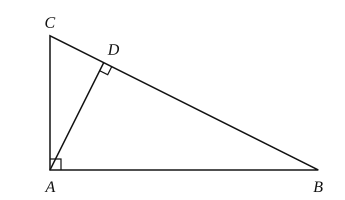
In the given figure, △ABC is right angled triangle with ∠A=90∘. AD is perpendicular to BC. Prove that : (i) △DBA∼△DAC (ii) DA2=DB×DC (iii) Find the area of △ABC when DB = 9 cm and DC = 16 cm.
Show answer & solution
Answer: (i) Proved. (ii) Proved. (iii) 150 cm2
(i) In △DBA and △DAC: ∠ADB=∠CDA=90∘.
∠DBA=90∘−∠DAB=∠DAC (since ∠DAB+∠DAC=90∘).
So △DBA∼△DAC (AA).
(ii) Corresponding sides are proportional: DADB=DCDA, so DA2=DB×DC.
(iii) DA2=9×16=144, so DA = 12 cm; BC = 9 + 16 = 25 cm.
Prove that if a line is drawn parallel to one side of a triangle to intersect the other two sides in distinct points, then the other two sides are divided in the same ratio.
Show answer & solution
Answer: Proved.
Given: In △ABC, DE ∥ BC meets AB at D and AC at E. To prove: DBAD=ECAE.
Construction: Join BE and CD; draw EN ⊥ AB and DM ⊥ AC.
ar(ADE)=21AD⋅EN and ar(BDE)=21DB⋅EN, so ar(BDE)ar(ADE)=DBAD.
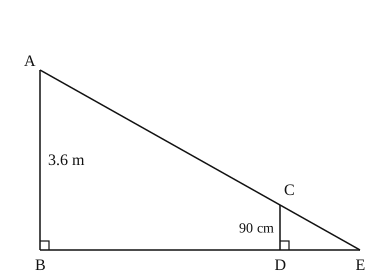
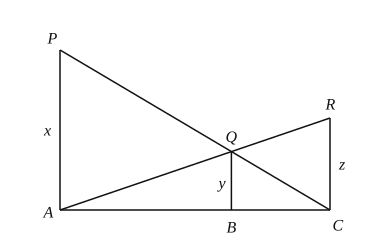
As shown in the given figure, a girl of height 90 cm is walking away from the base of a lamp post at a speed of 1.2 m/s. If the lamp is 3.6 m above the ground, find the length of her shadow after 4 seconds.
Show answer & solution
Answer: 1.6 m
Distance walked in 4 s: BD = 1.2 × 4 = 4.8 m. Let shadow DE = x m. CD = 90 cm = 0.9 m, AB = 3.6 m.
△ABE∼△CDE (AA: right angles at B and D, common ∠E).
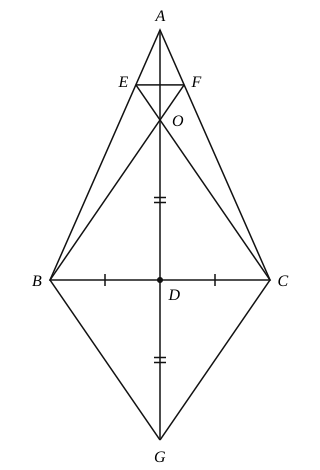
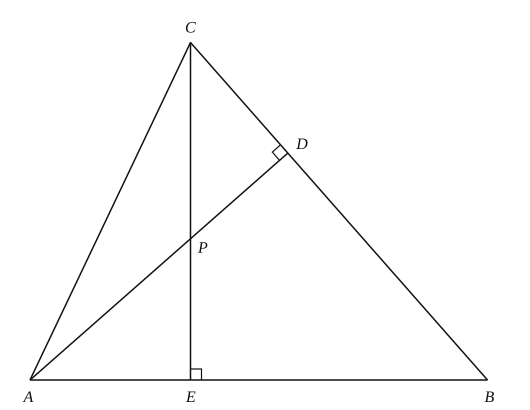
D is the mid-point of side BC of △ABC. CE and BF intersect at O, a point on AD. AD is produced to G such that OD = DG. Prove that (i) OBGC is a parallelogram. (ii) EF∥BC (iii) △AEF∼△ABC
Show answer & solution
Answer: Proved.
(i) BD = DC (D is the mid-point of BC) and OD = DG (given). So the diagonals BC and OG of quadrilateral OBGC bisect each other. Hence OBGC is a parallelogram.
(ii) As OBGC is a parallelogram, OC∥BG and OB∥CG, i.e. OE∥BG and OF∥CG.
In △ABG, OE∥BG, so by BPT EBAE=OGAO.
In △ACG, OF∥CG, so by BPT FCAF=OGAO.
Hence EBAE=FCAF, and by the converse of BPT in △ABC, EF∥BC.
(iii) In △AEF and △ABC: ∠A is common, and ∠AEF=∠ABC (corresponding angles, EF∥BC).
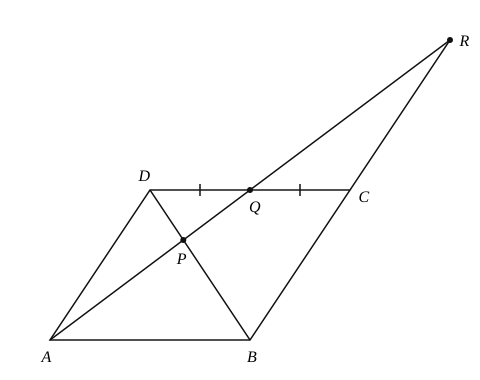
Through the mid-point Q of side CD of a parallelogram ABCD, the line AR is drawn which intersects BD at P and produced BC at R. Prove that (i) AQ = QR (ii) AP = 2PQ (iii) PR = 2AP
Show answer & solution
Answer: Proved.
(i) In △ADQ and △RCQ: DQ = CQ (Q is the mid-point of CD), ∠AQD=∠RQC (vertically opposite), ∠ADQ=∠RCQ (alternate angles, AD∥BR).
So △ADQ≅△RCQ (ASA), hence AQ = QR.
(ii) In △APB and △QPD: ∠PAB=∠PQD and ∠PBA=∠PDQ (alternate angles, AB∥DC).
So △APB∼△QPD (AA), and PQAP=DQAB.
DQ=21CD=21AB, so PQAP=2, i.e. AP = 2PQ.
(iii) PR = PQ + QR = PQ + AQ (from (i)) = PQ + (AP + PQ) = AP + 2PQ = AP + AP = 2AP (using (ii)).
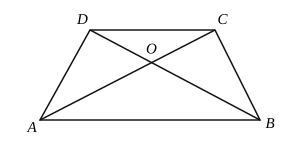
State “Basic Proportionality Theorem” and use it to prove the following : In a quadrilateral ABCD, diagonals AC and BD intersect each other at O such that BOAO=DOCO as shown in the given figure. Prove that ABCD is a trapezium.
Show answer & solution
Answer: Proved.
BPT: if a line is drawn parallel to one side of a triangle to intersect the other two sides in distinct points, it divides those two sides in the same ratio.
Proof of BPT: in △ABC let DE ∥ BC meet AB at D and AC at E. Join BE and CD and draw DM ⊥ AC, EN ⊥ AB.
ar(ADE) =21AD⋅EN and ar(BDE) =21DB⋅EN, so ar(BDE)ar(ADE)=DBAD; similarly ar(DEC)ar(ADE)=ECAE.
Triangles BDE and DEC are on the same base DE between the same parallels, so ar(BDE) = ar(DEC). Hence DBAD=ECAE.
Now in ABCD, draw OE ∥ AB meeting AD at E.
In △ABD, OE ∥ AB, so by BPT EDAE=ODBO.
Given BOAO=DOCO, i.e. COAO=DOBO. So EDAE=OCAO.
In △ADC, E and O divide AD and AC in the same ratio, so OE ∥ DC (converse of BPT).
Thus AB ∥ OE ∥ DC, so AB ∥ DC and ABCD is a trapezium.
State “Basic Proportionality Theorem” and use it to prove the following : A line through the mid-point of one side of a triangle, parallel to another side, bisects the third side.
Show answer & solution
Answer: Proved.
BPT: if a line is drawn parallel to one side of a triangle to intersect the other two sides in distinct points, it divides those two sides in the same ratio.
Proof of BPT: in △ABC let DE ∥ BC meet AB at D and AC at E. Join BE and CD and draw EN ⊥ AB, DM ⊥ AC.
ar(BDE)ar(ADE)=21DB⋅EN21AD⋅EN=DBAD and ar(DEC)ar(ADE)=21EC⋅DM21AE⋅DM=ECAE.
ar(BDE) = ar(DEC) (same base DE, between the same parallels DE and BC), so DBAD=ECAE.
Application: in △ABC, let D be the mid-point of AB and let the line through D parallel to BC meet AC at E.
State the converse of “Basic Proportionality Theorem” and use it to prove the following : Line segment joining mid-points of any two sides of a triangle is parallel to the third side.
Show answer & solution
Answer: Proved.
Converse of BPT: if a line divides any two sides of a triangle in the same ratio, then the line is parallel to the third side.
Proof of the converse: let line DE meet AB at D and AC at E with DBAD=ECAE, and suppose DE is not parallel to BC.
Draw DE' ∥ BC meeting AC at E'. By BPT, DBAD=E′CAE′, so ECAE=E′CAE′.
Adding 1 to both sides: ECAC=E′CAC, so EC = E'C and E, E' coincide. Hence DE ∥ BC.
Application: in △ABC, let D and E be the mid-points of AB and AC.
Then AD = DB and AE = EC, so DBAD=1=ECAE.
By the converse of BPT, DE ∥ BC, i.e. the segment joining the mid-points is parallel to the third side.
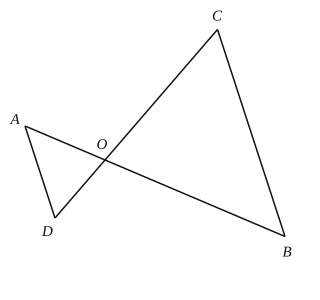
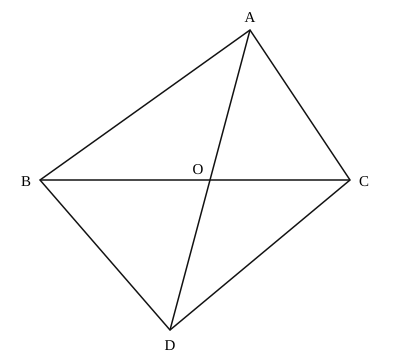
State the SAS criteria of similarity of two triangles. In the given figure, it is given that OA⋅OC=OB⋅OD. Use the SAS criteria to prove that AD ∥ CB.
Show answer & solution
Answer: Proved.
SAS similarity criterion: if one angle of a triangle is equal to one angle of another triangle and the sides including these angles are proportional, then the two triangles are similar.
Given OA⋅OC=OB⋅OD, so OBOA=OCOD.
In △AOD and △BOC: ∠AOD=∠BOC (vertically opposite angles) and OBOA=OCOD.
So △AOD∼△BOC (SAS similarity).
Hence ∠OAD=∠OBC, i.e. ∠DAB=∠CBA.
These are alternate angles made by the transversal AB with lines AD and CB, so AD ∥ CB.
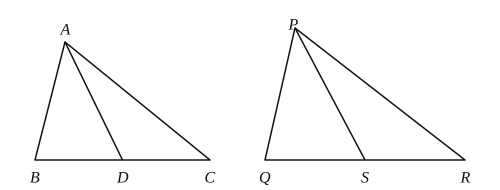
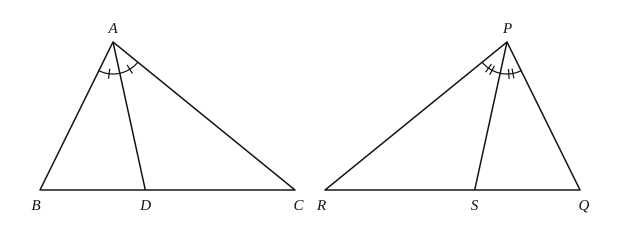
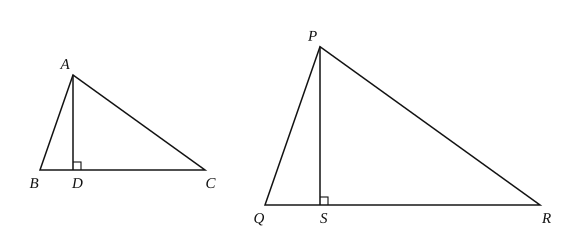
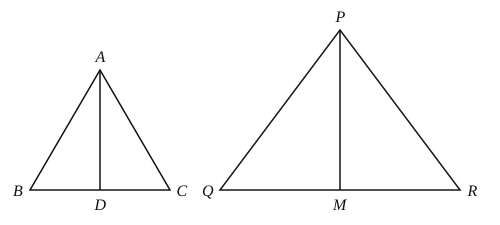
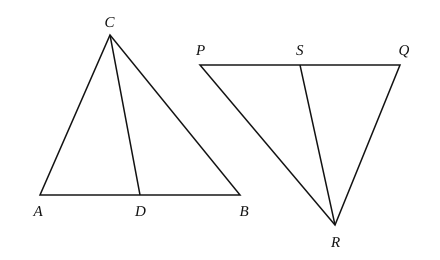
State AA criterion of similarity of two triangles and use it to prove the following. In the given figures of △ABC and △PQR, AD and PS are angle bisectors of ∠BAC and ∠RPQ respectively. If △ABC∼△PQR, prove that △ACD∼△PRS.
Show answer & solution
Answer: Proved.
AA criterion: if two angles of one triangle are respectively equal to two angles of another triangle, then the two triangles are similar.
Since △ABC∼△PQR: ∠A=∠P and ∠C=∠R.
AD and PS bisect ∠A and ∠P, so ∠CAD=21∠A=21∠P=∠RPS.
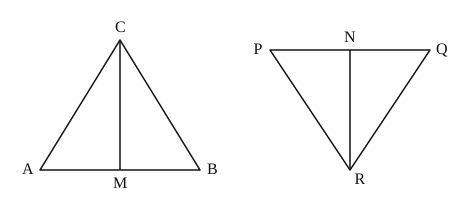
It is given that sides AB and AC and median AD of △ABC are respectively proportional to sides PQ and PR and median PM of another △PQR. Show that △ABC∼△PQR.
Show answer & solution
Answer: Proved.
Given PQAB=PRAC=PMAD.
Produce AD to E with DE = AD and PM to N with MN = PM; join CE and RN.
△ABD≅△ECD (BD = DC, AD = DE, vertically opposite angles), so CE = AB and ∠BAD=∠CED.
Similarly RN = PQ and ∠QPM=∠RNM.
Now RNCE=PQAB=PRAC=PMAD=2PM2AD=PNAE.
So △AEC∼△PNR (SSS), giving ∠CAE=∠RPN and ∠CEA=∠RNP.
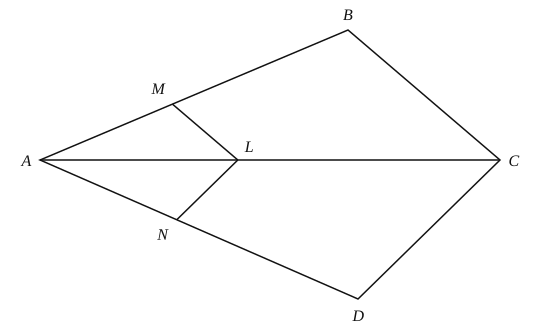
Prove that a line drawn parallel to one side of a triangle to intersect the other two sides in distinct points divides the other two sides in the same ratio. Hence, in the figure given below, prove that MBAM=NDAN where LM∥CB and LN∥CD.
Show answer & solution
Answer: Proved.
Theorem (BPT): In △PQR, let ST∥QR with S on PQ and T on PR. To prove SQPS=TRPT.
Join QT and RS. Draw TN⊥PQ and SM⊥PR.
ar(△PST)=21×PS×TN and ar(△QST)=21×SQ×TN, so ar(△QST)ar(△PST)=SQPS
Similarly ar(△RTS)ar(△PST)=TRPT
△QST and △RTS are on the same base ST and between the same parallels ST and QR, so ar(△QST)=ar(△RTS)
Hence SQPS=TRPT.
Application: In △ABC, LM∥CB, so by BPT MBAM=LCAL
The corresponding sides of △ABC and △PQR are in the ratio 3 : 5. AD⊥BC and PS⊥QR as shown in the following figures : (i) Prove that △ADC∼△PSR (ii) If AD=4 cm, find the length of PS. (iii) Using (ii) find ar(△ABC) : ar(△PQR)
Show answer & solution
Answer: (i) Proved. (ii) PS=320 cm (iii) 9:25
(i) △ABC∼△PQR (sides proportional), so ∠C=∠R.
In △ADC and △PSR: ∠ADC=∠PSR=90∘ and ∠C=∠R, so △ADC∼△PSR (AA).
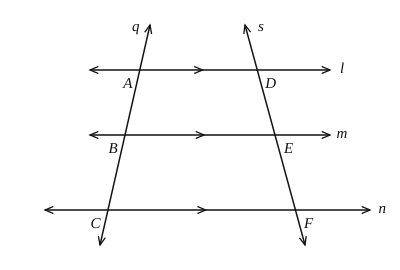
State basic proportionality theorem. Use it to prove the following : If three parallel lines l, m, n are intersected by transversals q and s as shown in the adjoining figure, then BCAB=EFDE.
Show answer & solution
Answer: Statement given; Proved.
BPT: If a line is drawn parallel to one side of a triangle to intersect the other two sides in distinct points, the other two sides are divided in the same ratio.
Proof of BPT: In △ABC let DE∥BC with D on AB, E on AC. Join BE and CD; draw EN⊥AB, DM⊥AC.
ar(BDE)ar(ADE)=21DB⋅EN21AD⋅EN=DBAD and ar(DEC)ar(ADE)=ECAE
△BDE and △DEC are on the same base DE between the same parallels DE and BC, so ar(BDE) = ar(DEC). Hence DBAD=ECAE.
Application: Join AF, cutting line m at G.
In △ACF, BG∥CF (as m∥n), so by BPT BCAB=GFAG ... (1)
In △FAD, GE∥AD (as m∥l), so by BPT GAFG=EDFE, i.e. GFAG=EFDE ... (2)
If a line is drawn parallel to one side of a triangle intersecting the other two sides in distinct points then it divides the two sides in the same ratio. Prove it. Also, state the converse of the above statement.
Show answer & solution
Answer: Proved. Converse: If a line divides any two sides of a triangle in the same ratio, then the line is parallel to the third side.
Given: In △ABC, DE∥BC, D on AB and E on AC. To prove: DBAD=ECAE.
Construction: Join BE and CD; draw EM⊥AB and DN⊥AC.
ar(ADE)=21AD⋅EM, ar(BDE)=21DB⋅EM, so ar(BDE)ar(ADE)=DBAD.
ar(ADE)=21AE⋅DN, ar(DEC)=21EC⋅DN, so ar(DEC)ar(ADE)=ECAE.
△BDE and △DEC are on the same base DE and between the same parallels DE and BC, so ar(BDE)=ar(DEC).
Hence DBAD=ECAE.
Converse: If a line divides any two sides of a triangle in the same ratio, then the line is parallel to the third side.
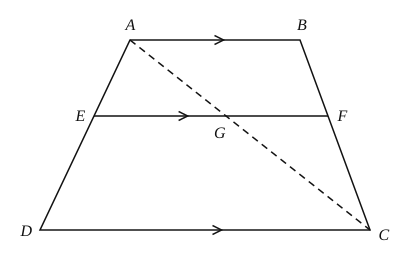
State the converse of basic proportionality theorem. Also find FCBF in the following figure, given that AB∥DC∥EF and EDAE=32. Also, find the length of EF if AB = 10 cm and DC = 15 cm.
Show answer & solution
Answer: Converse: If a line divides any two sides of a triangle in the same ratio, then the line is parallel to the third side. FCBF=32; EF = 12 cm
Converse of BPT: If a line divides any two sides of a triangle in the same ratio, then the line is parallel to the third side.
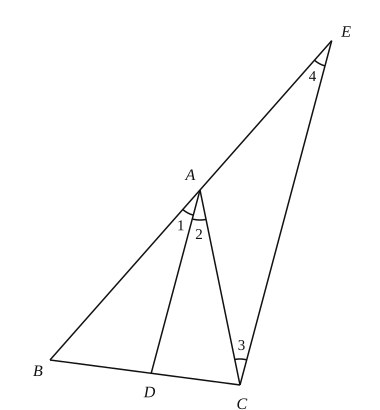
State the basic proportionality theorem. Use the theorem to do the following : In △ABC, AD is the angle bisector of angle A. BA is produced to E such that CE∥AD. Prove that DCBD=ACBA.
Show answer & solution
Answer: BPT: If a line is drawn parallel to one side of a triangle to intersect the other two sides in distinct points, the other two sides are divided in the same ratio. DCBD=ACBA proved.
BPT: If a line is drawn parallel to one side of a triangle to intersect the other two sides in distinct points, the other two sides are divided in the same ratio.
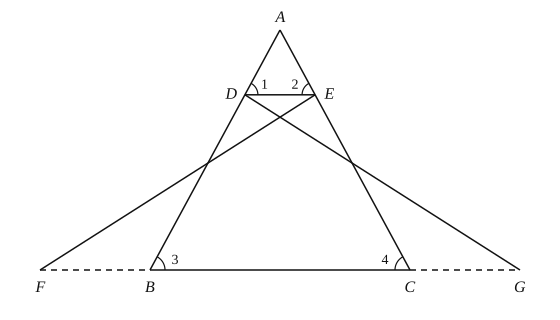
AD bisects ∠A: ∠1=∠2 (where ∠1=∠BAD, ∠2=∠DAC).
CE∥AD with transversal AC: ∠2=∠3 (alternate angles, ∠3=∠ACE).
CE∥AD with transversal BE: ∠1=∠4 (corresponding angles, ∠4=∠AEC).
So ∠3=∠4, hence AE=AC (sides opposite equal angles in △ACE).
If a line drawn parallel to one side of triangle intersecting the other two sides in distinct points divides the two sides in the same ratio, then it is parallel to third side. State and prove the converse of the above statement.
Show answer & solution
Answer: Statement: If a line is drawn parallel to one side of a triangle to intersect the other two sides in distinct points, the other two sides are divided in the same ratio (Basic Proportionality Theorem). Proved.
Statement (BPT): In △ABC, if DE∥BC with D on AB and E on AC, then DBAD=ECAE.
Construction: Join BE and CD; draw EN⊥AB and DM⊥AC.
ar(ADE)=21AD⋅EN, ar(BDE)=21DB⋅EN, so ar(BDE)ar(ADE)=DBAD
ar(ADE)=21AE⋅DM, ar(DEC)=21EC⋅DM, so ar(DEC)ar(ADE)=ECAE
△BDE and △DEC are on the same base DE between the parallels DE and BC, so ar(BDE)=ar(DEC).
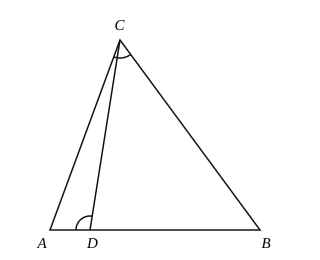
In the adjoining figure, △CAB is a right triangle, right angled at A and AD⊥BC. Prove that △ADB∼△CDA. Further, if BC=10 cm and CD=2 cm, find the length of AD.
Show answer & solution
Answer: Proved; AD = 4 cm
In △ADB and △CDA: ∠ADB=∠CDA=90∘
∠DAB=90∘−∠DAC and, in △ADC, ∠DCA=90∘−∠DAC, so ∠DAB=∠DCA
If a line is drawn parallel to one side of a triangle to intersect the other two sides in distinct points, then prove that other two sides are divided in the same ratio.
Show answer & solution
Answer: Proved.
Given: in △ABC, a line DE∥BC meets AB at D and AC at E. To prove: DBAD=ECAE.
Construction: join BE and CD; draw EN⊥AB and DM⊥AC.
ar(ADE) =21×AD×EN and ar(BDE) =21×DB×EN, so ar(BDE)ar(ADE)=DBAD.
Similarly ar(ADE) =21×AE×DM and ar(DEC) =21×EC×DM, so ar(DEC)ar(ADE)=ECAE.
△BDE and △DEC are on the same base DE and between the same parallels DE and BC, so ar(BDE) = ar(DEC).
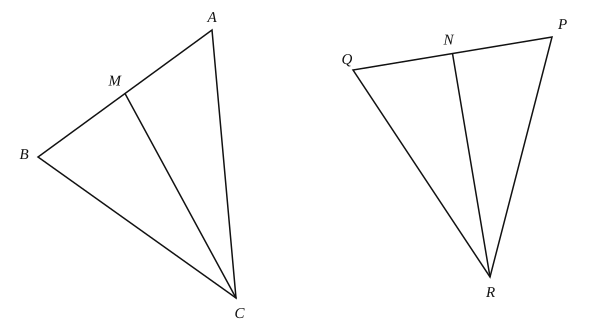
CD and GH are respectively the bisectors of ∠ACB and ∠EGF such that D and H lie on sides AB and FE of △ABC and △FEG respectively. If △ABC∼△FEG, show that : (i) GHCD=FGAC (ii) △DCB∼△HGE
Show answer & solution
Answer: Proved.
△ABC∼△FEG gives ∠A=∠F, ∠B=∠E, ∠ACB=∠FGE.
Halving, ∠ACD=∠FGH and ∠DCB=∠HGE.
(i) In △ACD and △FGH: ∠A=∠F, ∠ACD=∠FGH, so △ACD∼△FGH (AA).
Prove that if a line is drawn parallel to one side of a triangle to intersect the other two sides at distinct points, then the other two sides are divided in the same ratio.
Show answer & solution
Answer: Proved.
Let DE ∥ BC in △ABC with D on AB and E on AC. To prove DBAD=ECAE.
Join BE and CD; draw EN ⊥ AB and DM ⊥ AC.
ar(ADE) =21AD⋅EN and ar(BDE) =21DB⋅EN, so ar(BDE)ar(ADE)=DBAD.
Similarly ar(ADE) =21AE⋅DM and ar(DEC) =21EC⋅DM, so ar(DEC)ar(ADE)=ECAE.
Triangles BDE and DEC are on the same base DE and between the same parallels DE and BC, so ar(BDE) = ar(DEC).
Statement: If a line is drawn parallel to one side of a triangle to intersect the other two sides in distinct points, the other two sides are divided in the same ratio.
Given: In △ABC, DE ∥ BC, with D on AB and E on AC. To prove: DBAD=ECAE.
Construction: Join BE and CD; draw EM ⊥ AB and DN ⊥ AC.
ar(ADE) = 21×AD×EM and ar(BDE) = 21×DB×EM, so ar(BDE)ar(ADE)=DBAD.
ar(ADE) = 21×AE×DN and ar(DEC) = 21×EC×DN, so ar(DEC)ar(ADE)=ECAE.
Triangles BDE and DEC are on the same base DE and between the same parallels DE and BC, so ar(BDE) = ar(DEC).
If a line is drawn parallel to one side of a triangle to intersect the other two sides at distinct points, then prove that the other two sides are divided in the same ratio.
Show answer & solution
Answer: Proved.
Given: In △ABC, DE ∥ BC meets AB at D and AC at E. To prove: DBAD=ECAE.
Construction: Join BE and CD; draw EM ⊥ AB and DN ⊥ AC.
ar(ADE) =21×AD×EM and ar(BDE) =21×DB×EM, so ar(BDE)ar(ADE)=DBAD.
Similarly ar(ADE) =21×AE×DN and ar(DEC) =21×EC×DN, so ar(DEC)ar(ADE)=ECAE.
△BDE and △DEC are on the same base DE and between the same parallels DE and BC, so ar(BDE) = ar(DEC).
Prove that a line drawn parallel to one side of a triangle to intersect the other two sides in distinct points, divides the two sides in the same ratio.
Show answer & solution
Answer: Proved.
Given: In △ABC, a line DE ∥ BC meets AB at D and AC at E. To prove: DBAD=ECAE.
Construction: Join BE and CD; draw EN ⊥ AB and DM ⊥ AC.
ar(ADE) =21×AD×EN and ar(BDE) =21×DB×EN, so ar(BDE)ar(ADE)=DBAD.
Similarly ar(ADE) =21×AE×DM and ar(DEC) =21×EC×DM, so ar(DEC)ar(ADE)=ECAE.
Triangles BDE and DEC are on the same base DE and between the same parallels DE and BC, so ar(BDE) = ar(DEC).
If a line is drawn parallel to one side of a triangle to intersect the other two sides at distinct points, prove that the other two sides are divided in the same ratio.
Show answer & solution
Answer: Proved.
Given: In △ABC, DE∥BC with D on AB and E on AC. To prove: DBAD=ECAE.
Construction: join BE and CD; draw EN⊥AB and DM⊥AC.
ar(BDE)ar(ADE)=21DB⋅EN21AD⋅EN=DBAD.
ar(DEC)ar(ADE)=21EC⋅DM21AE⋅DM=ECAE.
△BDE and △DEC are on the same base DE and between the same parallels DE and BC, so ar(BDE) = ar(DEC).
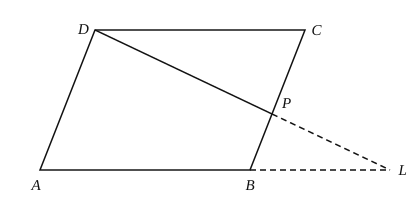
ABCD is a parallelogram, P is a point on side BC and DP when produced meets AB produced at L. Prove that (i) PLDP=BLDC (ii) DPDL=DCAL (iii) If LP : PD = 2 : 3 then find BP : BC.
Show answer & solution
Answer: (i) Proved. (ii) Proved. (iii) BP : BC = 2 : 5
(i) In △DPC and △LPB: ∠DPC=∠LPB (vertically opposite) and ∠DCP=∠LBP (alternate angles, DC∥AL). So △DPC∼△LPB (AA), giving PLDP=BLDC.
(ii) In △ALD and △CDP: ∠ALD=∠CDP (alternate angles, AL∥DC) and ∠DAL=∠PCD (opposite angles of a parallelogram). So △ALD∼△CDP (AA), giving DPDL=CDAL=DCAL.
(iii) From △DPC∼△LPB: PCBP=PDLP=32.
So BP = 2k, PC = 3k, BC = 5k, and BP : BC = 2 : 5.
If a line is drawn parallel to one side of a triangle to intersect the other two sides in distinct points, then prove that the other two sides are divided in the same ratio.
Show answer & solution
Answer: Proved.
Given: In △ABC, a line DE ∥ BC meets AB at D and AC at E. To prove: DBAD=ECAE.
Construction: join BE and CD; draw EM ⊥ AB and DN ⊥ AC.
ar(ADE) =21AD⋅EM, ar(BDE) =21DB⋅EM, so ar(BDE)ar(ADE)=DBAD.
ar(ADE) =21AE⋅DN, ar(DEC) =21EC⋅DN, so ar(DEC)ar(ADE)=ECAE.
△BDE and △DEC are on the same base DE and between the same parallels DE and BC, so ar(BDE) = ar(DEC).