CBSE Class 10 Maths Basic 2024 Question Paper 430/1/3 with Solutions
All 44 questions from the CBSE Class 10 Mathematics Basic board paper, Set 430/1/3 (2024),
with answers and step-by-step solutions. Total 80 marks. Tap “Show answer & solution” under any question.
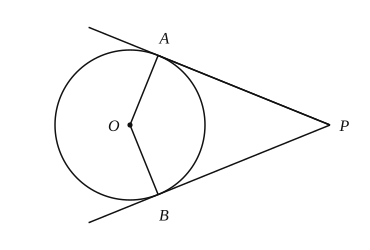
Assertion (A) : If the PA and PB are tangents drawn to a circle with centre O from an external point P, then the quadrilateral OAPB is a cyclic quadrilateral. Reason (R) : In a cyclic quadrilateral, opposite angles are equal.
(A)Both, Assertion (A) and Reason (R) are true. Reason (R) explains Assertion (A) completely.
(B)Both, Assertion (A) and Reason (R) are true. Reason (R) does not explain Assertion (A).
(C)Assertion (A) is true but Reason (R) is false.
(D)Assertion (A) is false but Reason (R) is true.
Show answer & solution
Answer: (C) Assertion (A) is true but Reason (R) is false.
The radius is perpendicular to the tangent, so ∠OAP=∠OBP=90∘.
Then ∠OAP+∠OBP=180∘, so the other pair also adds to 180∘ and OAPB is cyclic. A is true.
In a cyclic quadrilateral, opposite angles are supplementary, not equal in general. R is false.
Assertion (A) : Zeroes of a polynomial p(x)=x2−2x−3 are −1 and 3. Reason (R) : The graph of polynomial p(x)=x2−2x−3 intersects x-axis at (−1,0) and (3,0).
(A)Both, Assertion (A) and Reason (R) are true. Reason (R) explains Assertion (A) completely.
(B)Both, Assertion (A) and Reason (R) are true. Reason (R) does not explain Assertion (A).
(C)Assertion (A) is true but Reason (R) is false.
(D)Assertion (A) is false but Reason (R) is true.
Show answer & solution
Answer: (A) Both, Assertion (A) and Reason (R) are true. Reason (R) explains Assertion (A) completely.
x2−2x−3=(x−3)(x+1), so the zeroes are −1 and 3. A is true.
p(−1)=0 and p(3)=0, so the graph meets the x-axis at (−1,0) and (3,0). R is true.
The zeroes of a polynomial are exactly the x-coordinates of the points where its graph meets the x-axis, so R explains A.
A bag contains 4 red, 5 white and some yellow balls. If probability of drawing a red ball at random is 51, then find the probability of drawing a yellow ball at random.
Two alarm clocks ring their alarms at regular intervals of 20 minutes and 25 minutes respectively. If they first beep together at 12 noon, at what time will they beep again together next time ?
Show answer & solution
Answer: 1:40 p.m.
20=22×5 and 25=52.
LCM =22×52=100 minutes =1 hour 40 minutes.
They beep together next at 12 noon + 1 h 40 min = 1:40 p.m.
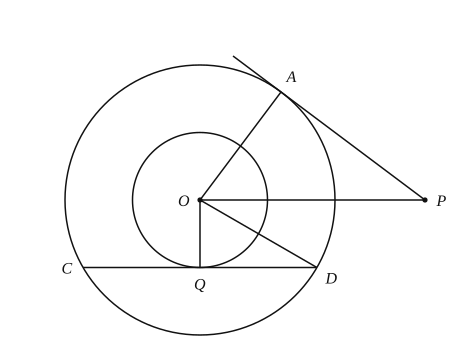
In two concentric circles, the radii are OA = r cm and OQ = 6 cm, as shown in the figure. Chord CD of larger circle is a tangent to smaller circle at Q. PA is tangent to larger circle. If PA = 16 cm and OP = 20 cm, find the length CD.
Show answer & solution
Answer: CD = 123 cm
OA⊥PA (radius is perpendicular to tangent), so OA2=OP2−PA2=400−256=144 and r=12 cm.
OQ⊥CD, and the perpendicular from the centre bisects the chord, so CQ=QD.
A solid is in the form of a cylinder with hemi–spherical ends of same radii. The total height of the solid is 20 cm and the diameter of the cylinder is 14 cm. Find the surface area of the solid.
Show answer & solution
Answer: 880 cm2
Radius r=7 cm; height of the cylindrical part h=20−2×7=6 cm.
A juice glass is cylindrical in shape with hemi–spherical raised up portion at the bottom. The inner diameter of glass is 10 cm and its height is 14 cm. Find the capacity of the glass. (use π=3.14)
Show answer & solution
Answer: 837.33 cm3 (approx.)
Radius r=5 cm, height h=14 cm.
Capacity = volume of cylinder − volume of hemisphere =πr2h−32πr3.
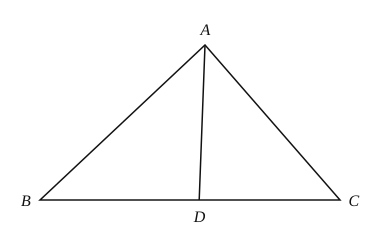
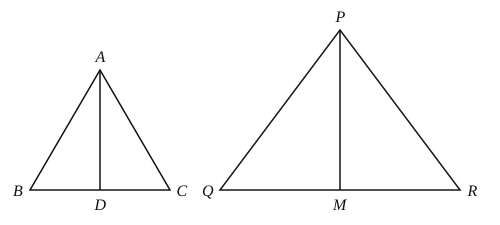
If a line is drawn parallel to one side of a triangle to intersect the other two sides in distinct points, then prove that other two sides are divided in the same ratio.
Show answer & solution
Answer: Proved.
Given: in △ABC, a line DE∥BC meets AB at D and AC at E. To prove: DBAD=ECAE.
Construction: join BE and CD; draw EN⊥AB and DM⊥AC.
ar(ADE) =21×AD×EN and ar(BDE) =21×DB×EN, so ar(BDE)ar(ADE)=DBAD.
Similarly ar(ADE) =21×AE×DM and ar(DEC) =21×EC×DM, so ar(DEC)ar(ADE)=ECAE.
△BDE and △DEC are on the same base DE and between the same parallels DE and BC, so ar(BDE) = ar(DEC).
The shadow of a tower standing on a level ground is found to be 40 m longer when the Sun's altitude is 30∘ than when it was 60∘. Find the height of the tower and the length of original shadow. (use 3=1.73)
Show answer & solution
Answer: Height =203=34.6 m; original shadow =20 m
Let the height be h and the original shadow (at 60∘) be x m.
The angles of depression of the top and the bottom of an 8 m tall building from the top of a multi–storeyed building are 30∘ and 45∘ respectively. Find the height of the multi–storeyed building and the distance between the two buildings. (use 3=1.73)
Show answer & solution
Answer: Height =4(3+3)=18.92 m; distance =18.92 m
Let the multi-storeyed building have height H m and let the distance between the buildings be d m.
Angle of depression of the bottom is 45∘: tan45∘=dH, so d=H.
Angle of depression of the top is 30∘: tan30∘=dH−8, so H−8=3H.
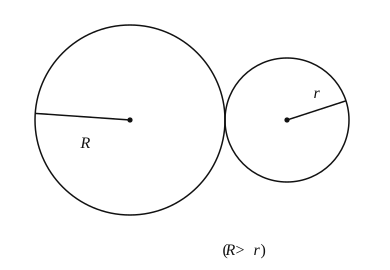
To keep the lawn green and cool, Sadhna uses water sprinklers which rotate in circular shape and cover a particular area. The diagram below shows the circular areas covered by two sprinklers : Two circles touch externally. The sum of their areas is 130π sq m and the distance between their centres is 14 m. Based on above information, answer the following questions : (i) Obtain a quadratic equation involving R and r from above. (1) (ii) Write a quadratic equation involving only r. (1) (iii) (a) Find the radius r and the corresponding area irrigated. (2) OR (b) Find the radius R and the corresponding area irrigated. (2)
Show answer & solution
Answer: (i) R2+r2=130 (with R+r=14) (ii) r2−14r+33=0 (iii) (a) r=3 m, area =9π sq m OR (b) R=11 m, area =121π sq m
(i) πR2+πr2=130π, so R2+r2=130; also R+r=14 (circles touch externally).
(ii) R=14−r: (14−r)2+r2=130, so 2r2−28r+66=0, i.e. r2−14r+33=0.
(iii) (a) (r−3)(r−11)=0, so r=3 or 11. Since R>r and R+r=14, r=3 m. Area =π×9=9π sq m (≈28.29 sq m).
(iii) (b) R=14−3=11 m. Area =π×121=121π sq m (≈380.29 sq m).
Gurpreet is very fond of doing research on plants. She collected some leaves from different plants and measured their lengths in mm. The data obtained is represented in the following table : Length (in mm) : 70-80, 80-90, 90-100, 100-110, 110-120, 120-130, 130-140 Number of leaves : 3, 5, 9, 12, 5, 4, 2 Based on the above information, answer the following questions : (i) Write the median class of the data. (1) (ii) How many leaves are of length equal to or more than 10 cm ? (1) (iii) (a) Find median of the data. (2) OR (b) Write the modal class and find the mode of the data. (2)
Show answer & solution
Answer: (i) 100-110 (ii) 23 (iii) (a) 102.5 mm OR (b) modal class 100-110, mode = 103 mm
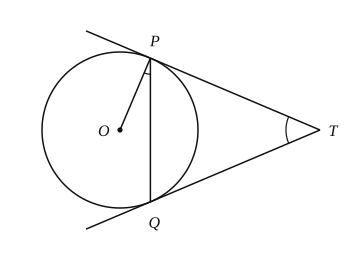
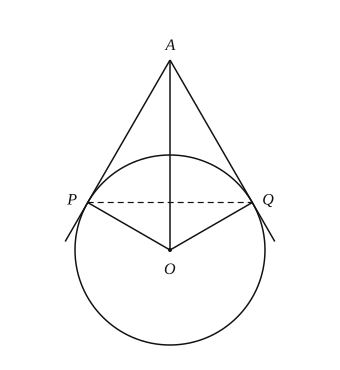
The picture given below shows a circular mirror hanging on the wall with a cord. The diagram represents the mirror as a circle with centre O. AP and AQ are tangents to the circle at P and Q respectively such that AP = 30 cm and ∠PAQ=60∘. Based on the above information; answer the following questions : (i) Find the length PQ. (1) (ii) Find m ∠POQ. (1) (iii) (a) Find the length OA. (2) OR (b) Find the radius of the mirror. (2)
Show answer & solution
Answer: (i) 30 cm (ii) 120∘ (iii) (a) 203 cm OR (b) 103 cm
(i) AP = AQ (tangents from A) and ∠PAQ=60∘, so △APQ is equilateral and PQ = 30 cm.
(ii) ∠OPA=∠OQA=90∘, so ∠POQ=360∘−90∘−90∘−60∘=120∘.
(iii) (a) OA bisects ∠PAQ, so ∠OAP=30∘. cos30∘=OAAP, so OA=2330=203 cm.