CBSE Class 10 Maths Basic 2024 Question Paper 430/5/3 with Solutions
All 44 questions from the CBSE Class 10 Mathematics Basic board paper, Set 430/5/3 (2024),
with answers and step-by-step solutions. Total 80 marks. Tap “Show answer & solution” under any question.
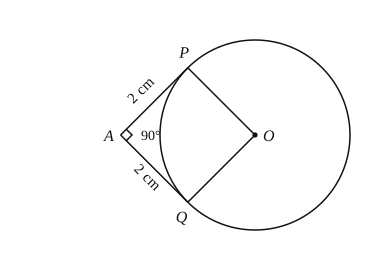
AP and AQ are tangents drawn from an external point A to a circle with centre O and inclined to each other at an angle of 90∘. If the length of each tangent is 2 cm, then the radius of the circle is :
(A)4 cm
(B)2 cm
(C)22 cm
(D)1 cm
Show answer & solution
Answer: (B) 2 cm
∠OPA=∠OQA=90∘ (radius ⊥ tangent) and ∠PAQ=90∘.
So ∠POQ=90∘ and APOQ is a rectangle with AP = AQ, i.e. a square.
Assertion (A) : Common difference of the A.P. 5,1,−3,−7 .... is 4. Reason (R) : Common difference of the A.P. a1,a2,a3 ...., an is obtained by d=an−an−1.
(A)Both Assertion (A) and Reason (R) are true and Reason (R) is the correct explanation of Assertion (A).
(B)Both Assertion (A) and Reason (R) are true, but Reason (R) is not the correct explanation of Assertion (A).
(C)Assertion (A) is true, but Reason (R) is false.
(D)Assertion (A) is false, but Reason (R) is true.
Show answer & solution
Answer: (D) Assertion (A) is false, but Reason (R) is true.
d=an−an−1 is the correct way to find the common difference, so R is true.
For 5, 1, −3, −7, ...: d=1−5=−4, not 4. So A is false.
The length of a tangent drawn to a circle from a point A, at a distance of 10 cm from the centre of the circle, is 6 cm. Find the radius of the circle.
Show answer & solution
Answer: 8 cm
Let O be the centre and T the point of contact. OT ⊥ AT.
A horse is tied with a 14 m long rope at one corner of an equilateral triangular field having side 20 m. Find the area of the field where the horse cannot graze.
Show answer & solution
Answer:(1003−3308) m2≈70.53 m2
Angle of an equilateral triangle =60∘, so the horse grazes a sector of radius 14 m and angle 60∘.
Area grazed =36060×722×14×14=3308≈102.67 m2.
Area of field =43×202=1003≈173.20 m2.
Area not grazed =173.20−102.67=70.53 m2 (approx.).
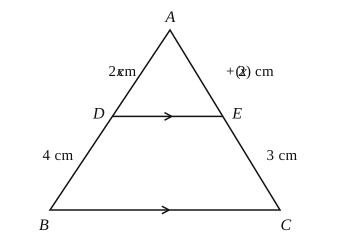
Prove that if a line is drawn parallel to one side of a triangle to intersect the other two sides at distinct points, then the other two sides are divided in the same ratio.
Show answer & solution
Answer: Proved.
Let DE ∥ BC in △ABC with D on AB and E on AC. To prove DBAD=ECAE.
Join BE and CD; draw EN ⊥ AB and DM ⊥ AC.
ar(ADE) =21AD⋅EN and ar(BDE) =21DB⋅EN, so ar(BDE)ar(ADE)=DBAD.
Similarly ar(ADE) =21AE⋅DM and ar(DEC) =21EC⋅DM, so ar(DEC)ar(ADE)=ECAE.
Triangles BDE and DEC are on the same base DE and between the same parallels DE and BC, so ar(BDE) = ar(DEC).
The following data gives the information about the lifetimes (in hours) of 225 neon lamps : Lifetime (in hours): 1500 – 2000, 2000 – 2500, 2500 – 3000, 3000 – 3500, 3500 – 4000, 4000 – 4500 Number of lamps: 10, 35, 52, 61, 38, 29 Find the median lifetime of a lamp.
A toy is in the form of a cone of radius 7 cm mounted on a hemisphere of same radius. The total height of the toy is 31 cm. Find the surface area of the toy.
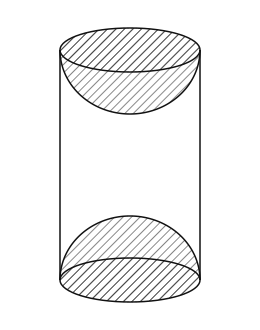
A wooden article was made by scooping out a hemisphere from each end of a solid cylinder. If the height of the cylinder is 15 cm and its base is of radius 4.2 cm, then find the total surface area of the article.
Show answer & solution
Answer: 617.76 cm2
TSA = CSA of cylinder + 2 × CSA of hemisphere.
CSA of cylinder =2πrh=2×722×4.2×15=396 cm2.
2 × CSA of hemisphere =2×2πr2=4×722×4.2×4.2=221.76 cm2.
The sum of the digits of a 2-digit number is 9. Also, nine times this number is twice the number obtained by reversing the order of the digits. Find the number.
Show answer & solution
Answer: 18
Let the tens digit be x and the units digit be y; the number is 10x+y.
x+y=9 ... (1).
9(10x+y)=2(10y+x), so 90x+9y=20y+2x, i.e. 88x=11y, so y=8x ... (2).
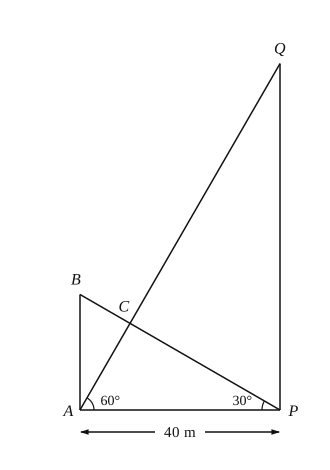
Two poles of different heights stand on level ground and at a distance of 40 m. Both poles are supported by wires attached from the top of each pole to the bottom of the other. A coupling is placed at point C, where the two wires cross (as shown in the figure). Based on the above information, answer the following questions : (i) Find the height of pole AB. (1) (ii) Find the height of pole PQ. (1) (iii) (a) If the angle of elevation of the top of the pole PQ from the top of the pole AB is 30∘, find the distance BQ. (2) OR (b) If the coupling is at a height of 20 m from the ground, how far down the wire from the smaller pole AB is the coupling ? (2)
Show answer & solution
Answer: (i) 3403 m (ii) 403 m (iii) (a) 3803 m OR (b) 3403 m (along wire AQ from A)
In the figure, ∠QAP=60∘, ∠BPA=30∘ and AP = 40 m.
(i) In right △BAP: tan30∘=40AB, so AB=340=3403 m.
(ii) In right △QPA: tan60∘=40PQ, so PQ=403 m.
(iii) (a) The horizontal distance from B to PQ is 40 m. With elevation 30∘, cos30∘=BQ40.
BQ=340×2=3803 m.
(iii) (b) C lies on wire AQ, which makes 60∘ with the ground at A (the foot of pole AB).
Family structure : In a recent survey of this year, 51% of the families in the United States of America had no children, 20% had one child, 19% had two children, 7% had three children and 3% had four or more children. A family is selected at random. Based on the above information, answer the following questions : (i) Find the probability that the selected family has two or three children. (1) (ii) Find the probability that the selected family has more than one child. (1) (iii) (a) Find the probability that the selected family has less than three children. (2) OR (b) Find the probability that the selected family has more than two children. (2)
Show answer & solution
Answer: (i) 5013 (ii) 10029 (iii) (a) 109 OR (b) 101
Take 100 families: 51 with no child, 20 with one, 19 with two, 7 with three, 3 with four or more.
(i) Two or three children: 19+7=26, P =10026=5013.
(ii) More than one child: 19+7+3=29, P =10029.
(iii) (a) Less than three children: 51+20+19=90, P =10090=109.
(iii) (b) More than two children: 7+3=10, P =10010=101.
Sumant's mother started a new shoe shop. To display the shoes, she put 3 pairs of shoes in the 1st row, 5 pairs in the 2nd row, 7 pairs in the 3rd row and so on. Based on the above information, answer the following questions : (i) How many pairs of shoes are displayed in the 6th row ? (1) (ii) What is the difference of pairs of shoes in the 1st row and the 6th row ? (1) (iii) (a) Find the total number of pairs of shoes displayed in the first 15 rows. (2) OR (b) If the pairs of shoes displayed in the 4th row are 'on sale' at price of ₹ 500 for each pair, then find the total amount (money) earned by Sumant's mother if all shoes displayed in the 4th row are sold out. (2)
Show answer & solution
Answer: (i) 13 (ii) 10 (iii) (a) 255 OR (b) ₹ 4,500