CBSE Class 10 Maths Basic 2024 Question Paper 430/4/3 with Solutions
All 44 questions from the CBSE Class 10 Mathematics Basic board paper, Set 430/4/3 (2024),
with answers and step-by-step solutions. Total 80 marks. Tap “Show answer & solution” under any question.
The following distribution gives the daily income of 50 workers of a factory : Income (in ₹): 400–424, 425–449, 450–474, 475–499, 500–524 Number of workers: 12, 14, 8, 6, 10 The lower limit of the modal class is :
(A)425
(B)449
(C)424.5
(D)425.5
Show answer & solution
Answer: (C) 424.5
The highest frequency is 14, so the modal class is 425–449.
The classes are not continuous (gap of 1), so subtract 0.5 from each lower limit and add 0.5 to each upper limit.
The modal class becomes 424.5–449.5, so its lower limit is 424.5.
Assertion (A): The pair of linear equations 5x+2y+6=0 and 7x+6y+18=0 have infinitely many solutions. Reason (R): The pair of linear equations a1x+b1y+c1=0 and a2x+b2y+c2=0 have infinitely many solutions, if a2a1=b2b1=c2c1.
(A)Both Assertion (A) and Reason (R) are true and Reason (R) is the correct explanation of Assertion (A).
(B)Both Assertion (A) and Reason (R) are true, but Reason (R) is not the correct explanation of Assertion (A).
(C)Assertion (A) is true, but Reason (R) is false.
(D)Assertion (A) is false, but Reason (R) is true.
Show answer & solution
Answer: (D) Assertion (A) is false, but Reason (R) is true.
a2a1=75, b2b1=62=31.
Since 75=31, the pair has a unique solution, so A is false.
R is the correct condition for infinitely many solutions, so R is true.
From a well-shuffled deck of 52 playing cards, all black queens and red kings are removed. One card is selected at random from the remaining cards. Find the probability that the selected card is : (i) an ace. (ii) a jack of red colour. (iii) a king of spade.
Show answer & solution
Answer: (i) 121 (ii) 241 (iii) 481
Removed cards: 2 black queens and 2 red kings, so 52 − 4 = 48 cards remain.
(i) All 4 aces remain: P=484=121.
(ii) Red jacks = 2: P=482=241.
(iii) The king of spades remains (only red kings were removed): P=481.
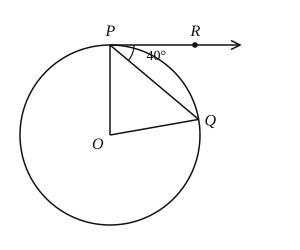
A chord of a circle of radius 10 cm subtends a right angle at the centre of the circle. Find the area of the corresponding (i) minor sector (ii) major sector. (Use π=3.14)
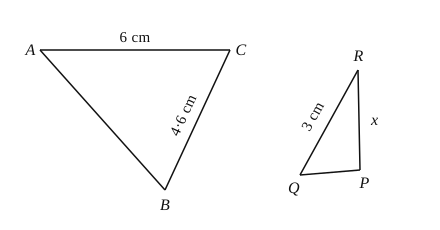
CD and GH are respectively the bisectors of ∠ACB and ∠EGF such that D and H lie on sides AB and FE of △ABC and △FEG respectively. If △ABC∼△FEG, show that : (i) GHCD=FGAC (ii) △DCB∼△HGE
Show answer & solution
Answer: Proved.
△ABC∼△FEG gives ∠A=∠F, ∠B=∠E, ∠ACB=∠FGE.
Halving, ∠ACD=∠FGH and ∠DCB=∠HGE.
(i) In △ACD and △FGH: ∠A=∠F, ∠ACD=∠FGH, so △ACD∼△FGH (AA).
A solid is in the shape of a cone surmounted on a hemisphere with both their diameters being equal to 7 cm and the height of the cone is equal to its radius. Find the volume of the solid.
If the sum of the first 7 terms of an A.P. is 91 and that of the first 17 terms is 561, then find the sum of the first n terms and hence find the nth term.
A statue, 1.6 m tall, stands on the top of a pedestal. From a point on the ground, the angle of elevation of the top of the statue is 60∘ and from the same point, the angle of elevation of the top of the pedestal is 45∘. Find the height of the pedestal. (Use 3=1.732)
Show answer & solution
Answer:0.8(3+1)≈2.19 m
Let the pedestal height be h m and the distance of the point from its foot be x m.
Deepankar bought 3 notebooks and 2 pens for ₹ 80 and his friend Suryansh bought 4 notebooks and 3 pens for ₹ 110 from the school bookshop. Based on the above information, answer the following questions. (i) If the price of one notebook be ₹ x and the price of one pen be ₹ y, write the given situation algebraically. (1) (ii) (a) What is the price of one notebook ? (2) OR (b) What is the price of one pen ? (2) (iii) What is the total amount to be paid by Suryansh, if he purchases 6 notebooks and 3 pens ? (1)
Show answer & solution
Answer: (i) 3x+2y=80, 4x+3y=110 (ii) (a) ₹20 OR (b) ₹10 (iii) ₹150
(i) 3x+2y=80 and 4x+3y=110.
(ii) Multiply the first equation by 3 and the second by 2: 9x+6y=240, 8x+6y=220.
Subtracting, x=20. Then 3(20)+2y=80⇒y=10.
(a) One notebook costs ₹20. (b) One pen costs ₹10.
Mutual Fund : A mutual fund is a type of investment vehicle that pools money from multiple investors to invest in securities like stocks, bonds or other securities. Mutual funds are operated by professional money managers, who allocate the fund’s assets and attempt to produce capital gains or income for the fund’s investors. Net Asset Value (NAV) represents a fund’s per share market value. It is the price at which the investors buy fund shares from a fund company and sell them to a fund company. The following table shows the Net Asset Value (NAV) per unit of mutual fund of ICICI mutual funds : NAV (in ₹): 0–5, 5–10, 10–15, 15–20, 20–25 Number of mutual funds: 13, 16, 22, 18, 11 Based on the above information, answer the following questions : (i) What is the upper limit of modal class of the data ? (1) (ii) What is the median class of the data ? (1) (iii) (a) What is the mode NAV of mutual funds ? (2) OR (b) What is the median NAV of mutual funds ? (2)
Show answer & solution
Answer: (i) 15 (ii) 10–15 (iii) (a) ₹13 OR (b) ₹12.5
(i) Highest frequency 22 is for 10–15, so the modal class is 10–15 and its upper limit is 15.
(ii) N=13+16+22+18+11=80, 2N=40. Cumulative frequencies: 13, 29, 51, 69, 80. The median class is 10–15.
(iii)(a) Mode =l+2f1−f0−f2f1−f0×h=10+44−16−1822−16×5=10+106×5=13. Mode NAV = ₹13.
(iii)(b) Median =l+f2N−cf×h=10+2240−29×5=10+2.5=12.5. Median NAV = ₹12.5.
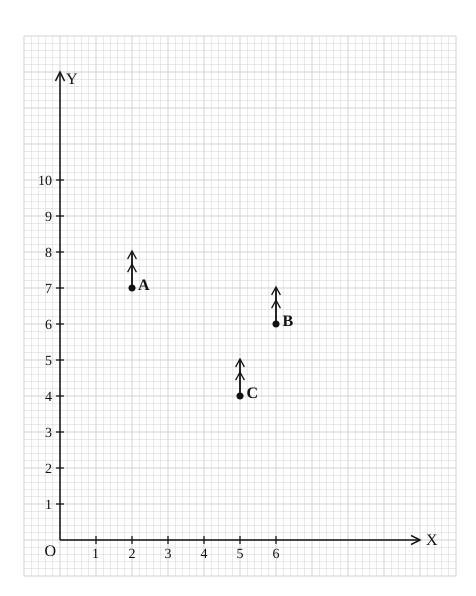
Resident Welfare Association (RWA) of Gulmohar Society in Delhi, have installed three electric poles A, B and C in the society’s common park. Despite these three poles, some parts of the park are still in the dark. So, RWA decides to have one more electric pole D in the park. The park can be modelled as a coordinate system given below. On the basis of the above information, answer the following questions : (i) What is the position of the pole C ? (1) (ii) What is the distance of the pole B from the corner O of the park ? (1) (iii) (a) Find the position of the fourth pole D so that the four points A, B, C and D form a parallelogram ABCD. (2) OR (b) Find the distance between poles A and C. (2)
Show answer & solution
Answer: (i) (5,4) (ii) 62 units (iii) (a) D(1,5) OR (b) 32 units
From the figure, A(2,7), B(6,6), C(5,4).
(i) Pole C is at (5,4).
(ii) OB=62+62=72=62 units.
(iii)(a) Diagonals of a parallelogram bisect each other, so mid-point of AC = mid-point of BD.
Mid-point of AC =(27,211). If D(x,y): 26+x=27, 26+y=211, so D=(1,5).