CBSE Class 10 Maths Basic 2023 Question Paper 430/1/3 with Solutions
All 44 questions from the CBSE Class 10 Mathematics Basic board paper, Set 430/1/3 (2023),
with answers and step-by-step solutions. Total 80 marks. Tap “Show answer & solution” under any question.
Assertion (A) : The system of linear equations 3x+5y−4=0 and 15x+25y−25=0 is inconsistent. Reason (R) : The pair of linear equations a1x+b1y+c1=0 and a2x+b2y+c2=0 is inconsistent if a2a1=b2b1=c2c1.
(A)Both Assertion (A) and Reason (R) are true and Reason (R) is the correct explanation of Assertion (A).
(B)Both Assertion (A) and Reason (R) are true but Reason (R) is not the correct explanation of Assertion (A).
(C)Assertion (A) is true, but Reason (R) is false.
(D)Assertion (A) is false, but Reason (R) is true.
Show answer & solution
Answer: (A) Both A and R are true and R is the correct explanation of A.
R is the standard condition for no solution, so R is true.
For A: a2a1=153=51, b2b1=255=51, c2c1=−25−4=254.
51=51=254, so the system is inconsistent; A is true.
A follows from the condition in R, so R correctly explains A.
Assertion (A) : A tangent to a circle is perpendicular to the radius through the point of contact. Reason (R) : The lengths of tangents drawn from the external point to a circle are equal.
(A)Both Assertion (A) and Reason (R) are true and Reason (R) is the correct explanation of Assertion (A).
(B)Both Assertion (A) and Reason (R) are true but Reason (R) is not the correct explanation of Assertion (A).
(C)Assertion (A) is true, but Reason (R) is false.
(D)Assertion (A) is false, but Reason (R) is true.
Show answer & solution
Answer: (B) Both A and R are true but R is not the correct explanation of A.
A is true: the tangent at any point of a circle is perpendicular to the radius through the point of contact.
R is true: tangents drawn from an external point to a circle are equal in length.
A survey conducted on 20 families in a locality by a group of students resulted in the following frequency table for the number of family members in a family. Family size: 1 – 3, 3 – 5, 5 – 7, 7 – 9, 9 – 11 Number of families: 7, 8, 2, 2, 1 Determine the mean and mode of the above data.
Show answer & solution
Answer: Mean = 4.2; Mode = 723 ≈ 3.29
Class marks xi: 2, 4, 6, 8, 10; fi: 7, 8, 2, 2, 1; ∑fi=20.
fixi: 14, 32, 12, 16, 10; ∑fixi=84.
Mean =∑fi∑fixi=2084=4.2
Modal class is 3 – 5 (highest frequency 8): l=3, f1=8, f0=7, f2=2, h=2.
A heap of rice is in the form of a cone of base diameter 24 m and height 27 m. Find the volume of rice. How much canvas cloth is required to just cover the heap ?
Show answer & solution
Answer: Volume = 528 m³; canvas required = 73300 m² ≈ 471.43 m²
Radius r=12 m, height h=27 m.
Volume =31πr2h=31×722×144×27=528 m³
Slant height l=r2+h2=144+449=4625=225 m
Canvas needed = curved surface area =πrl=722×12×225=73300≈471.43 m²
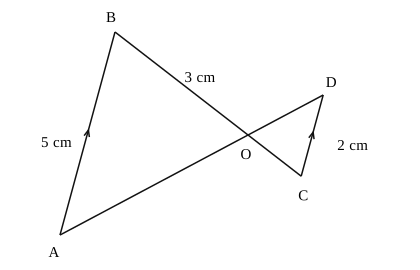
A TV tower stands vertically on the bank of a canal. From a point on the other bank directly opposite the tower, the angle of elevation of the top of the tower is 60∘. From another point 20 m away from the point on the line joining this point to the foot of the tower, the angle of elevation of the top of the tower is 30∘. Find the height of the tower.
Show answer & solution
Answer:103 m ≈ 17.32 m
Let the tower AB have height h m, and let the width of the canal be x m (point C opposite the tower).
In △ABC: tan60∘=xh, so h=3x.
Point D is 20 m beyond C. In △ABD: tan30∘=x+20h, so x+20=3h=3x.
An aeroplane when flying at a height of 4000 m from the ground passes vertically above another aeroplane at an instant when the angles of elevation of the two planes from the same point on the ground are 60∘ and 45∘ respectively. Find the vertical distance between the aeroplanes at that instant. (Use 3=1.73)
Show answer & solution
Answer:34000(3−3) m ≈ 1693.33 m
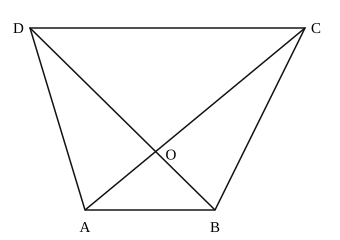
Let O be the point on the ground and C the point directly below both planes, with OC = x m.
Upper plane A (height 4000 m): tan60∘=x4000, so x=34000.
Lower plane B: tan45∘=xBC, so BC=x=34000=340003 m.
The diagonal of a rectangular field is 60 m more than the shorter side. If the longer side is 80 m more than the shorter side, find the length of the sides of the field.
Show answer & solution
Answer: No such field exists: the resulting equation x2+40x+2800=0 has no real roots.
Let the shorter side be x m. Then the longer side is (x+80) m and the diagonal is (x+60) m.
By Pythagoras: x2+(x+80)2=(x+60)2
x2+x2+160x+6400=x2+120x+3600
x2+40x+2800=0
D=402−4(1)(2800)=1600−11200=−9600<0
The equation has no real roots, so no rectangle has these measurements.
(With the NCERT data, longer side 30 m more than the shorter side, x2−60x−2700=0 gives sides 90 m and 120 m.)
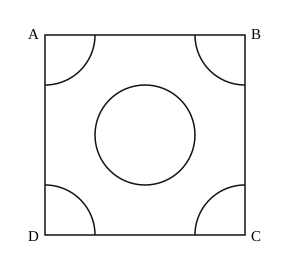
Interschool Rangoli Competition was organized by one of the reputed schools of Odissa. The theme of the Rangoli Competition was Diwali celebrations where students were supposed to make mathematical designs. Students from various schools participated and made beautiful Rangoli designs. One such design is given below. Rangoli is in the shape of square marked as ABCD, side of square being 40 cm. At each corner of a square, a quadrant of circle of radius 10 cm is drawn (in which diyas are kept). Also a circle of diameter 20 cm is drawn inside the square. (i) What is the area of square ABCD ? (1) (ii) Find the area of the circle. (1) (iii) If the circle and the four quadrants are cut off from the square ABCD and removed, then find the area of remaining portion of square ABCD. (2) OR (iii) Find the combined area of 4 quadrants and the circle, removed. (2)
Blood group describes the type of blood a person has. It is a classification of blood based on the presence or absence of inherited antigenic substances on the surface of red blood cells. Blood types predict whether a serious reaction will occur in a blood transfusion. In a sample of 50 people, 21 had type O blood, 22 had type A, 5 had type B and rest had type AB blood group. Based on the above, answer the following questions : (i) What is the probability that a person chosen at random had type O blood ? (1) (ii) What is the probability that a person chosen at random had type AB blood group ? (1) (iii) What is the probability that a person chosen at random had neither type A nor type B blood group ? (2) OR (iii) What is the probability that person chosen at random had either type A or type B or type O blood group ? (2)
Show answer & solution
Answer: (i) 5021 (ii) 251 (iii) 5023; OR (iii) 2524
Number with type AB = 50 − 21 − 22 − 5 = 2.
(i) P(O) =5021
(ii) P(AB) =502=251
(iii) Neither A nor B means O or AB: 5021+2=5023
Aahana being a plant lover decides to convert her balcony into beautiful garden full of plants. She bought few plants with pots for her balcony. She placed the pots in such a way that number of pots in the first row is 2, second row is 5, third row is 8 and so on. Based on the above information, answer the following questions : (i) Find the number of pots placed in the 10th row. (1) (ii) Find the difference in the number of pots placed in 5th row and 2nd row. (1) (iii) If Aahana wants to place 100 pots in total, then find the total number of rows formed in the arrangement. (2) OR (iii) If Aahana has sufficient space for 12 rows, then how many total number of pots are placed by her with the same arrangement ? (2)
Show answer & solution
Answer: (i) 29 (ii) 9 (iii) 8 rows; OR (iii) 222 pots
The numbers of pots 2, 5, 8, ... form an A.P. with a=2, d=3.