CBSE Class 10 Maths Basic 2023 Question Paper 430/2/1 with Solutions
All 44 questions from the CBSE Class 10 Mathematics Basic board paper, Set 430/2/1 (2023),
with answers and step-by-step solutions. Total 80 marks. Tap “Show answer & solution” under any question.
The string of a kite in air is 50 m long and it makes an angle of 60∘ with the horizontal. Assuming the string to be straight, the height of the kite from the ground is :
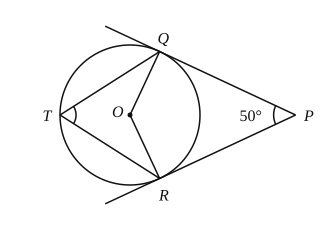
From a point P, two tangents PQ and PR are drawn to a circle with centre at O. T is a point on the major arc QR of the circle. If ∠QPR=50∘, then ∠QTR equals :
(A)50∘
(B)130∘
(C)65∘
(D)90∘
Show answer & solution
Answer: (c) 65∘
∠OQP=∠ORP=90∘ (radius ⊥ tangent).
In quadrilateral OQPR, ∠QOR=360∘−90∘−90∘−50∘=130∘
Angle at the circumference is half the angle at the centre: ∠QTR=2130∘=65∘
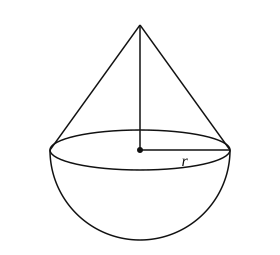
A solid is of the form of a cone of radius ‘r’ surmounted on a hemisphere of the same radius. If the height of the cone is the same as the diameter of its base, then the volume of the solid is :
Assertion (A) : The probability of getting a prime number, when a die is thrown once, is 32. Reason (R): On the faces of a die, prime numbers are 2, 3, 5.
(A)Both Assertion (A) and Reason (R) are true and Reason (R) is the correct explanation of the Assertion (A).
(B)Both Assertion (A) and Reason (R) are true, but Reason (R) is not the correct explanation of the Assertion (A).
(C)Assertion (A) is true, but Reason (R) is false.
(D)Assertion (A) is false, but Reason (R) is true.
Show answer & solution
Answer: (d) Assertion (A) is false, but Reason (R) is true.
From a well-shuffled deck of 52 playing cards, all diamond cards are removed. Now, a card is drawn from the remaining pack at random. Find the probability that the selected card is a king.
Show answer & solution
Answer:131
Cards left after removing 13 diamonds = 52 − 13 = 39
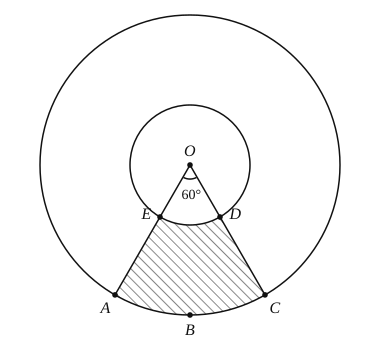
In the given figure, two concentric circles with centre O are shown. Radii of the circles are 2 cm and 5 cm respectively. Find the area of the shaded region.
Show answer & solution
Answer: 11 cm2
The shaded region lies between the outer sector OAC and the inner sector OED, both with central angle 60∘.
From the top of a building 60 m high, the angles of depression of the top and bottom of a tower are observed to be 30∘ and 60∘ respectively. Find the height of the tower. Also, find the distance between the building and the tower. (Use 3=1.732)
Show answer & solution
Answer: Height of tower = 40 m; distance = 203 m = 34.64 m
Let AB be the building (AB = 60 m), CD the tower of height h and BD = x the distance between them.
Angle of depression of the bottom D is 60∘: tan60∘=x60, so x=360=203 m
Angle of depression of the top C is 30∘: tan30∘=x60−h
The angle of elevation of the top of a building from a point A on the ground is 30∘. On moving a distance of 30 m towards its base to the point B, the angle of elevation changes to 45∘. Find the height of the building and the distance of its base from point A. (Use 3=1.732)
Show answer & solution
Answer: Height = 15(3+1) m = 40.98 m; distance from A = 70.98 m
Let PQ = h be the building with foot Q, and BQ = y.
Find the mean and the median of the following data : Marks: 0–10, 10–20, 20–30, 30–40, 40–50, 50–60, 60–70, 70–80 Number of Students: 3, 5, 16, 12, 13, 20, 6, 5
Show answer & solution
Answer: Mean = 42; Median = 43131 ≈ 43.08
Class marks xi: 5, 15, 25, 35, 45, 55, 65, 75; Σfi=80
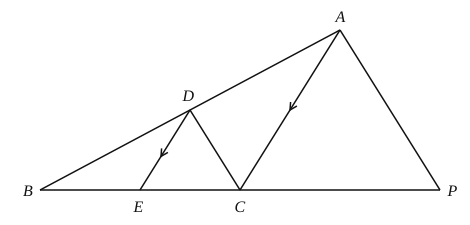
If a line is drawn parallel to one side of a triangle to intersect the other two sides in distinct points, then prove that the other two sides are divided in the same ratio.
Show answer & solution
Answer: Proved.
Given: In △ABC, a line DE ∥ BC meets AB at D and AC at E.
To prove: DBAD=ECAE.
Construction: Join BE and CD; draw EN⊥AB and DM⊥AC.
ar(ADE)=21×AD×EN and ar(BDE)=21×DB×EN, so ar(BDE)ar(ADE)=DBAD.
Similarly ar(ADE)=21×AE×DM and ar(DEC)=21×EC×DM, so ar(DEC)ar(ADE)=ECAE.
Triangles BDE and DEC are on the same base DE and between the same parallels DE and BC, so ar(BDE)=ar(DEC).
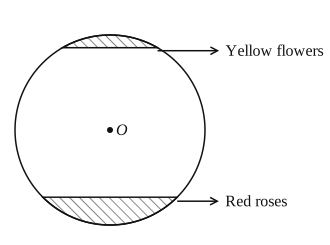
Flower beds look beautiful growing in gardens. One such circular park of radius ‘r’ m, has two segments with flowers. One segment which subtends an angle of 90∘ at the centre is full of red roses, while the other segment with central angle 60∘ is full of yellow coloured flowers. [See figure] It is given that the combined area of the two segments (of flowers) is 25632 sq m. Based on the above, answer the following questions : (i) Write an equation representing the total area of the two segments in terms of ‘r’. (1) (ii) Find the value of ‘r’. (1) (iii) (a) Find the area of the segment with red roses. (2) OR (iii) (b) Find the area of the segment with yellow flowers. (2)
Show answer & solution
Answer: (i) 36090πr2+36060πr2=25632 (ii) r = 14 m (iii) (a) 154 m2 OR (iii) (b) 10232 m2
The given total works out only if the flower regions are taken as the regions with central angles 90∘ and 60∘ (sector areas), which is the intended reading.
(i) 36090πr2+36060πr2=25632, i.e. 125πr2=3770
(ii) 125×722×r2=3770, so r2=3×110770×84=196 and r = 14 m
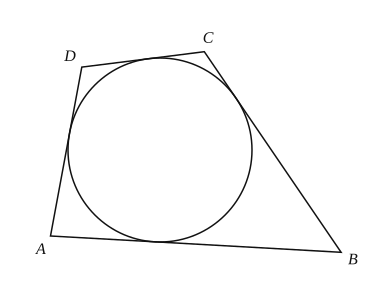
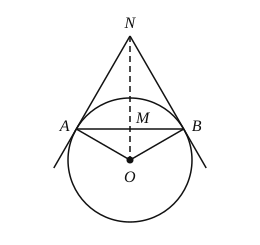
Circles play an important part in our life. When a circular object is hung on the wall with a cord at nail N, the cords NA and NB work like tangents. Observe the figure, given that ∠ANO=30∘ and OA = 5 cm. Based on the above, answer the following questions : (i) Find the distance AN. (1) (ii) Find the measure of ∠AOB. (1) (iii) (a) Find the total length of cords NA, NB and the chord AB. (2) OR (iii) (b) If ∠ANO is 45∘, then name the type of quadrilateral OANB. Justify your answer. (2)
Show answer & solution
Answer: (i) 53 cm (ii) 120∘ (iii) (a) 153 cm ≈ 25.98 cm OR (iii) (b) Square
(i) OA⊥AN (radius ⊥ tangent). In right △OAN, tan30∘=ANOA, so AN=53 cm
(ii) ∠ANB=2×30∘=60∘; in quadrilateral OANB, ∠AOB=360∘−90∘−90∘−60∘=120∘
(iii) (a) NA = NB = 53 cm and ∠ANB=60∘, so △ANB is equilateral and AB = 53 cm
Total length = 3×53=153 cm ≈ 25.98 cm
(iii) (b) If ∠ANO=45∘, then ∠ANB=90∘, ∠OAN=∠OBN=90∘, so ∠AOB=90∘
Also tan45∘=ANOA=1 gives AN = OA, and NA = NB, OA = OB, so all four sides are equal (5 cm).
All angles are right angles and all sides are equal, so OANB is a square.
A wooden toy is shown in the picture. This is a cuboidal wooden block of dimensions 14 cm × 17 cm × 4 cm. On its top there are seven cylindrical hollows for bees to fit in. Each cylindrical hollow is of height 3 cm and radius 2 cm. Based on the above, answer the following questions : (i) Find the volume of wood carved out to make one cylindrical hollow. (1) (ii) Find the lateral surface area of the cuboid to paint it with green colour. (1) (iii) (a) Find the volume of wood in the remaining cuboid after carving out seven cylindrical hollows. (2) OR (iii) (b) Find the surface area of the top surface of the cuboid to be painted yellow. (2)
Show answer & solution
Answer: (i) 7264 cm3 ≈ 37.71 cm3 (ii) 248 cm2 (iii) (a) 688 cm3 OR (iii) (b) 150 cm2
(i) Volume of one hollow =πr2h=722×22×3=7264≈37.71 cm3
(ii) Lateral surface area =2h(l+b)=2×4×(14+17)=248 cm2
(iii) (a) Volume of cuboid =14×17×4=952 cm3
Wood removed =7×7264=264 cm3, so remaining wood =952−264=688 cm3