CBSE Class 10 Maths Basic 2023 Question Paper 430/6/2 with Solutions
All 44 questions from the CBSE Class 10 Mathematics Basic board paper, Set 430/6/2 (2023),
with answers and step-by-step solutions. Total 80 marks. Tap “Show answer & solution” under any question.
The time, in seconds, taken by 150 athletes to run a 100 m hurdle race are tabulated below : Time (sec.): 13-14, 14-15, 15-16, 16-17, 17-18, 18-19 Number of Athletes: 2, 4, 5, 71, 48, 20 The number of athletes who completed the race in less than 17 seconds is
(A)11
(B)71
(C)82
(D)68
Show answer & solution
Answer: (C) 82
Athletes taking less than 17 s are those in the classes 13-14, 14-15, 15-16 and 16-17.
Assertion (A) : The probability that a leap year has 53 Sundays is 72. Reason (R) : The probability that a non-leap year has 53 Sundays is 71.
(A)Both Assertion (A) and Reason (R) are true; and Reason (R) is the correct explanation of Assertion (A).
(B)Both Assertion (A) and Reason (R) are true, but Reason (R) is not the correct explanation of Assertion (A).
(C)Assertion (A) is true, but Reason (R) is false.
(D)Assertion (A) is false, but Reason (R) is true.
Show answer & solution
Answer: (B) Both A and R are true, but R is not the correct explanation of A.
A leap year has 366 days = 52 weeks + 2 days. The 2 extra days can be (Sun, Mon), (Mon, Tue), ..., (Sat, Sun): 7 cases, 2 contain a Sunday. P =72, so A is true.
A non-leap year has 365 days = 52 weeks + 1 day; the extra day is Sunday in 1 of 7 cases. P =71, so R is true.
R is about a non-leap year, so it does not explain A.
A box contains 20 discs which are numbered from 1 to 20. If one disc is drawn at random from the box, then find the probability that the number on the drawn disc is a (i) 2-digit number (ii) number less than 10
Show answer & solution
Answer: (i) 2011 (ii) 209
Total outcomes = 20.
(i) 2-digit numbers: 10 to 20, i.e. 11 numbers. P =2011.
(ii) Numbers less than 10: 1 to 9, i.e. 9 numbers. P =209.
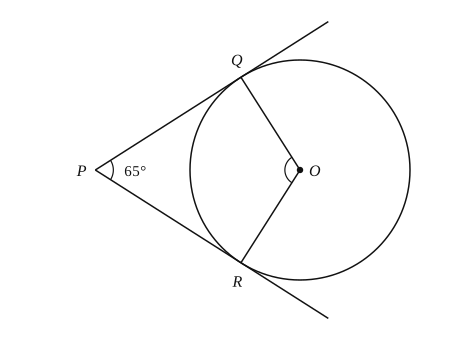
From a point P, the length of the tangent to a circle is 24 cm and the distance of P from the centre of the circle is 25 cm. Find the radius of the circle.
Show answer & solution
Answer: 7 cm
The radius is perpendicular to the tangent at the point of contact, so radius, tangent and OP form a right triangle with hypotenuse OP.
A survey conducted on 20 households in a locality by a group of students resulted in the following frequency table for the number of family members in a household : Family size: 1-3, 3-5, 5-7, 7-9, 9-11 Number of Families: 7, 8, 2, 2, 1 Find the median of this data.
The first term of an A.P. is 5, the last term is 45 and the sum of all the terms is 400. Find the number of terms and the common difference of the A.P.
Show answer & solution
Answer: Number of terms = 16; common difference = 38
A solid is in the shape of a cone standing on a hemisphere with both their diameters being equal to 1 cm and the height of the cone is equal to its radius. Find the volume of the solid. [Use π=3.14]
Show answer & solution
Answer: 0.3925 cm3 (about 0.39 cm3)
Radius r=21=0.5 cm; height of cone h=r=0.5 cm.
Volume of cone =31πr2h=31πr3; volume of hemisphere =32πr3.
Volume of solid =31πr3+32πr3=πr3=3.14×0.125=0.3925 cm3.
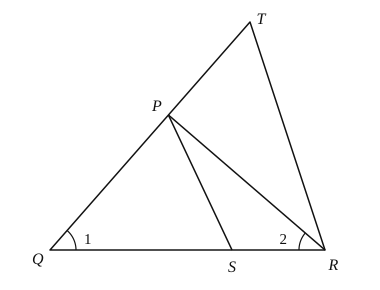
Prove that a line drawn parallel to one side of a triangle to intersect the other two sides in distinct points, divides the two sides in the same ratio.
Show answer & solution
Answer: Proved.
Given: In △ABC, a line DE ∥ BC meets AB at D and AC at E. To prove: DBAD=ECAE.
Construction: Join BE and CD; draw EN ⊥ AB and DM ⊥ AC.
ar(ADE) =21×AD×EN and ar(BDE) =21×DB×EN, so ar(BDE)ar(ADE)=DBAD.
Similarly ar(ADE) =21×AE×DM and ar(DEC) =21×EC×DM, so ar(DEC)ar(ADE)=ECAE.
Triangles BDE and DEC are on the same base DE and between the same parallels DE and BC, so ar(BDE) = ar(DEC).
From a point on a bridge across a river, the angles of depression of the banks on opposite sides of the river are 30∘ and 45∘ respectively. If the bridge is at a height of 3 m from the banks, find the width of the river. (Use 3=1.73)
Show answer & solution
Answer: 8.19 m
Let P be the point on the bridge, 3 m above the foot D on the line joining the banks A and B, with A and B on opposite sides of D.
Angle of depression of A is 30∘: tan30∘=AD3, so AD=33 m.
Angle of depression of B is 45∘: tan45∘=DB3, so DB=3 m.
From a point on the ground, the angle of elevation of the bottom and top of a transmission tower fixed at the top of a 20 m high building are 45∘ and 60∘ respectively. Find the height of the tower. (Use 3=1.73)
Show answer & solution
Answer: 14.6 m
Let P be the point on the ground at distance x m from the foot of the building, building height 20 m and tower height h m.
Lokesh, a production manager in Mumbai, hires a taxi everyday to go to his office. The taxi charges in Mumbai consists of a fixed charges together with the charges for the distance covered. His office is at a distance of 10 km from his home. For a distance of 10 km to his office, Lokesh paid ₹ 105. While coming back home, he took another route. He covered a distance of 15 km and the charges paid by him were ₹ 155. Based on the above information, answer the following questions : (i) What are the fixed charges ? (1) (ii) What are the charges per km ? (1) (iii) If fixed charges are ₹ 20 and charges per km are ₹ 10, then how much Lokesh have to pay for travelling a distance of 10 km ? (2) OR (iii) Find the total amount paid by Lokesh for travelling 10 km from home to office and 25 km from office to home. [Fixed charges and charges per km are as in (i) & (ii). (2)
Show answer & solution
Answer: (i) ₹ 5 (ii) ₹ 10 (iii) ₹ 120 OR (iii) ₹ 360
Let fixed charge = ₹ x and charge per km = ₹ y.
x+10y=105 and x+15y=155. Subtracting, 5y=50, so y=10 and x=5.
(i) Fixed charges = ₹ 5.
(ii) Charges per km = ₹ 10.
(iii) 20+10×10= ₹ 120.
OR (iii) Home to office: 5+10×10=105; office to home: 5+25×10=255. Total = ₹ 360.
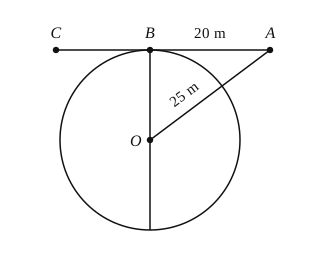
People of a circular village Dharamkot want to construct a road nearest to it. The road cannot pass through the village. But the people want the road at a shortest distance from the centre of the village. Suppose the road starts from A which is outside the circular village (as shown in the figure) and touch the boundary of the circular village at B such that AB = 20 m. Also the distance of the point A from the centre O of the village is 25 m. Based on the above information, answer the following questions : (i) If B is the mid-point of AC, then find the distance AC. (1) (ii) Find the shortest distance of the road from the centre of the village. (1) (iii) Find the circumference of the village. (2) OR (iii) Find the area of the village. (2)
Show answer & solution
Answer: (i) 40 m (ii) 15 m (iii) 7660 m ≈94.29 m OR (iii) 74950 m2≈707.14 m2
(i) AC=2×AB=40 m.
(ii) The road AC touches the circle at B, so OB ⊥ AC and OB is the shortest distance. OB=252−202=225=15 m.
(iii) Radius = 15 m. Circumference =2×722×15=7660≈94.29 m.
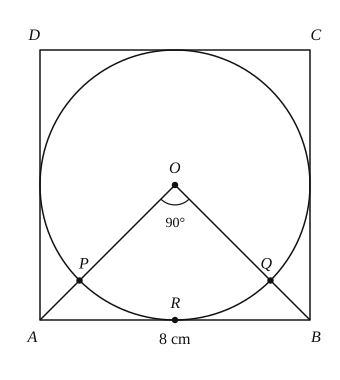
For the inauguration of ‘Earth day’ week in a school, badges were given to volunteers. Organisers purchased these badges from an NGO, who made these badges in the form of a circle inscribed in a square of side 8 cm. O is the centre of the circle and ∠AOB=90∘ : Based on the above information, answer the following questions : (i) What is the area of square ABCD ? (1) (ii) What is the length of diagonal AC of square ABCD ? (1) (iii) Find the area of sector OPRQO. (2) OR (iii) Find the area of remaining part of square ABCD when area of circle is excluded. (2)
Show answer & solution
Answer: (i) 64 cm2 (ii) 82 cm (iii) 788 cm2≈12.57 cm2 OR (iii) 796 cm2≈13.71 cm2
(i) Area =8×8=64 cm2.
(ii) AC=82+82=82 cm.
(iii) Radius of circle =28=4 cm, angle =90∘. Area of sector =36090×722×42=788≈12.57 cm2.
OR (iii) Area of circle =722×16=7352 cm2. Remaining area =64−7352=796≈13.71 cm2.