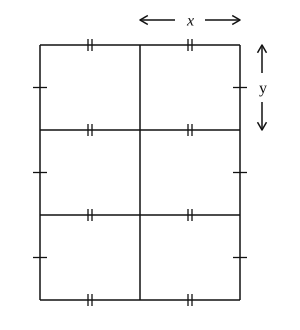
Observe the figure given above. It shows six identical rectangular enclosures made by using fencing wire mesh. These enclosures are used to protect baby animals in a zoo. Dimensions of each enclosure is x feet × y feet. The total length of fencing required is 152 feet and area of each enclosure is 80 square feet. Based on the above, answer the following questions : (i) Write an expression for length of fencing required in terms of x and y. (1) (ii) Write the area of each enclosure in terms of x. (1) (iii) (a) Write the above equation in quadratic equation form and thus find the dimensions of each enclosure using factorisation method. (2) OR (b) Using above equation in quadratic form, solve the equation and find the dimensions of each enclosure using quadratic formula. (2)
Show answer & solution
Answer: (i) 8x+9y=152 (ii) Area = x(9152−8x)=9152x−8x2 sq feet (iii) x2−19x+90=0; each enclosure is 10 feet × 8 feet (x = 9 feet, y = 980 feet also satisfies)
(i) The figure has 4 horizontal fences each of length 2x and 3 vertical fences each of length 3y.
Fencing = 8x+9y=152.
(ii) From (i), y=9152−8x, so area = xy=9152x−8x2.
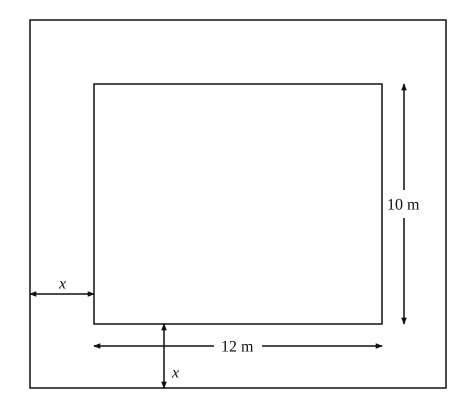
A garden designer is planning a rectangular lawn that is to be surrounded by a uniform walkway. The total area of the lawn and the walkway is 360 square metres. The width of the walkway is same on all sides. The dimensions of the lawn itself are 12 metres by 10 metres. Based on the information given above, answer the following questions : (i) Formulate the quadratic equation representing the total area of the lawn and the walkway, taking width of walkway = x m. (1) (ii) (a) Solve the quadratic equation to find the width of the walkway 'x'. (2) OR (b) If the cost of paving the walkway at the rate of ₹ 50 per square metre is ₹ 12,000, calculate the area of the walkway. (2) (iii) Find the perimeter of the lawn. (1)
Show answer & solution
Answer: (i) (12+2x)(10+2x)=360, i.e. x2+11x−60=0 (ii) (a) x=4 m OR (b) 240 m2 (iii) 44 m
(i) Outer dimensions are (12+2x) m and (10+2x) m, so (12+2x)(10+2x)=360.
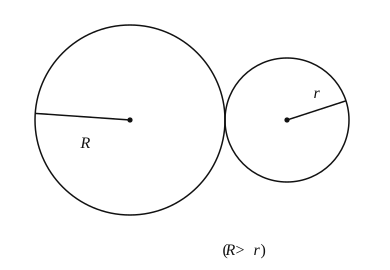
To keep the lawn green and cool, Sadhna uses water sprinklers which rotate in circular shape and cover a particular area. The diagram below shows the circular areas covered by two sprinklers : Two circles touch externally. The sum of their areas is 130π sq m and the distance between their centres is 14 m. Based on above information, answer the following questions : (i) Obtain a quadratic equation involving R and r from above. (1) (ii) Write a quadratic equation involving only r. (1) (iii) (a) Find the radius r and the corresponding area irrigated. (2) OR (b) Find the radius R and the corresponding area irrigated. (2)
Show answer & solution
Answer: (i) R2+r2=130 (with R+r=14) (ii) r2−14r+33=0 (iii) (a) r=3 m, area =9π sq m OR (b) R=11 m, area =121π sq m
(i) πR2+πr2=130π, so R2+r2=130; also R+r=14 (circles touch externally).
(ii) R=14−r: (14−r)2+r2=130, so 2r2−28r+66=0, i.e. r2−14r+33=0.
(iii) (a) (r−3)(r−11)=0, so r=3 or 11. Since R>r and R+r=14, r=3 m. Area =π×9=9π sq m (≈28.29 sq m).
(iii) (b) R=14−3=11 m. Area =π×121=121π sq m (≈380.29 sq m).
A rectangular floor area can be completely tiled with 200 square tiles. If the side length of each tile is increased by 1 unit, it would take only 128 tiles to cover the floor. (i) Assuming the original length of each side of a tile be x units, make a quadratic equation from the above information. (1) (ii) Write the corresponding quadratic equation in standard form. (1) (iii) (a) Find the value of x, the length of side of a tile by factorisation. (2) OR (b) Solve the quadratic equation for x, using quadratic formula. (2)
Show answer & solution
Answer: (i) 200x2=128(x+1)2 (ii) 9x2−32x−16=0 (iii) (a) x=4 units OR (b) x=4 (rejecting x=−94)
(i) Floor area is the same in both cases: 200x2=128(x+1)2.
(ii) 200x2=128x2+256x+128, so 72x2−256x−128=0. Dividing by 8: 9x2−32x−16=0.
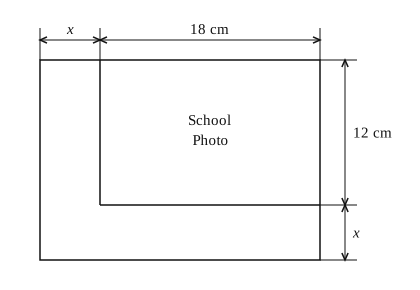
While designing the school year book, a teacher asked the student that the length and width of a particular photo is increased by x units each to double the area of the photo. The original photo is 18 cm long and 12 cm wide. Based on the above information, answer the following questions : (I) Write an algebraic equation depicting the above information. (1) (II) Write the corresponding quadratic equation in standard form. (1) (III) What should be the new dimensions of the enlarged photo ? (2) OR Can any rational value of x make the new area equal to 220 cm2 ?
Show answer & solution
Answer: (I) (18+x)(12+x)=2×18×12 (II) x2+30x−216=0 (III) 24 cm × 18 cm; OR: No, since x2+30x−4=0 has discriminant 916, not a perfect square, so x is irrational.
(I) Original area = 18 × 12 = 216 cm2. New area = (18+x)(12+x)=2×216=432.
(II) x2+30x+216=432, i.e. x2+30x−216=0.
(III) (x+36)(x−6)=0; x > 0, so x = 6. New dimensions: 18 + 6 = 24 cm by 12 + 6 = 18 cm.
OR: (18+x)(12+x)=220 gives x2+30x−4=0.
D=900+16=916, which is not a perfect square, so x is irrational. No rational x gives area 220 cm2.
The tradition of pottery making in India is very old. In fact, it is older than Indus Valley Civilization. The shaping and baking of clay articles has continued through the ages. The picture of a potter is shown below : A potter makes a certain number of pottery articles in a day. It was observed on a particular day the cost of production of each article (in ₹) was one more than twice the number of articles produced on that day. The total cost of production on that day was ₹ 210. (a) Taking number of articles produced on that day as x, form a quadratic equation in x. (2) (b) Find the number of articles produced and the cost of each article. (2)
Show answer & solution
Answer: (a) 2x2+x−210=0 (b) 10 articles; cost of each article ₹ 21
(a) Cost of each article =₹(2x+1), so x(2x+1)=210, i.e. 2x2+x−210=0.
A 2-digit number is such that the product of its digits is 24. If 18 is subtracted from the number, the digits interchange their places. Find the number.
Show answer & solution
Answer: 64
Let the tens digit be x and the units digit be y; the number is 10x+y.
The sum of two numbers is 34. If 3 is subtracted from one number and 2 is added to another, the product of these two numbers becomes 260. Find the numbers.
The hypotenuse (in cm) of a right angled triangle is 6 cm more than twice the length of the shortest side. If the length of third side is 6 cm less than thrice the length of shortest side, then find the dimensions of the triangle.
Show answer & solution
Answer: 10 cm, 24 cm and 26 cm
Let the shortest side be x cm. Hypotenuse =2x+6, third side =3x−6.
x2+(3x−6)2=(2x+6)2
10x2−36x+36=4x2+24x+36
6x2−60x=0⇒6x(x−10)=0⇒x=10 (x=0).
Sides: 10 cm, 24 cm, 26 cm. Check: 100+576=676=262.
In the picture given below, one can see a rectangular in-ground swimming pool installed by a family in their backyard. There is a concrete sidewalk around the pool of width x m. The outside edges of the sidewalk measure 7 m and 12 m. The area of the pool is 36 sq. m. (a) Based on the information given above, form a quadratic equation in terms of x. (2) (b) Find the width of the sidewalk around the pool. (2)
Show answer & solution
Answer: (a) (12−2x)(7−2x)=36, i.e. 2x2−19x+24=0 (b) 1.5 m