ABCD is a rectangle of dimensions 80 cm × 60 cm. Another rectangle PQRS is drawn inside ABCD leaving space of equal width x cm along the edges of ABCD. If area PQRS is half of the area ABCD, then find the value of x.
A train covers a distance of 90 km at a uniform speed. Had the speed been 15 km/h more, it would have taken 30 minutes less for the same journey. Find the original speed of the train.
A faster train takes one hour less than a slower train for a journey of 200 km. If the speed of the slower train is 10 km/hr less than that of the faster train, find the speeds of the two trains.
A person on a tour has ₹ 4,200 for expenses. If he extends his tour for 3 days, he has to cut down his daily expenses by ₹ 70. Find the original duration of the tour.
Show answer & solution
Answer: 12 days
Let the original duration be x days. Daily expense = x4200.
x4200−x+34200=70
4200×3=70x(x+3)
x2+3x−180=0
(x+15)(x−12)=0
x = 12 (x cannot be negative), so the tour was for 12 days.
The area of a right-angled triangle is 600 cm2. If the base of the triangle exceeds the altitude by 10 cm, find all the three dimensions of the triangle.
Show answer & solution
Answer: Altitude 30 cm, base 40 cm, hypotenuse 50 cm
In a flight of 600 km, an aircraft slowed down its speed due to bad weather. Its average speed for the trip reduced by 200 km/h from its usual speed and time of flight increased by 30 minutes. Find the scheduled duration of the flight.
Two pipes are used to fill a swimming pool. If the pipe of the larger diameter is used for 4 hours and the pipe of the smaller diameter for 9 hours, only half of the pool can be filled. Find how long it would take for each pipe to fill the pool, separately, if the pipe of smaller diameter takes 10 hours more than the pipe of larger diameter to fill the pool.
In a class test, the sum of Anamika's marks obtained in Maths and Science is 30. Had she got 2 marks more in Maths and 3 marks less in Science, the product of the marks would have been 210. Find the marks she got in the two subjects.
Show answer & solution
Answer: Maths 13, Science 17 or Maths 12, Science 18
The length of hypotenuse (in cm) of a right-angled triangle is 6 cm more than twice the length of its shortest side. If the length of its third side is 6 cm less than thrice the length of its shortest side, find the dimensions of the triangle.
Show answer & solution
Answer: 10 cm, 24 cm and 26 cm
Let the shortest side be x cm; hypotenuse = (2x + 6) cm; third side = (3x - 6) cm.
A person on tour has ₹ 5,400 for his expenses. If he extends his tour by 5 days, he has to cut down his daily expenses by ₹ 180. Find the original duration of the tour and daily expense.
Show answer & solution
Answer: 10 days; ₹ 540 per day
Let the original duration be x days. Daily expense =x5400.
The total cost of certain piece of cloth was ₹ 2,100. During special sale time, the shopkeeper offered 2 m extra cloth for free thus reducing the price of cloth per metre by ₹ 120. What was the original per metre price of cloth and its length ?
Show answer & solution
Answer: Length 5 m; original price ₹ 420 per metre
Let the original length be x m. Original price per metre =x2100.
Venkat can row a boat in still water at the speed of 12 km/h. He ferries tourists 15 km upstream and 18 km downstream in 3 hours. Find the speed of the stream.
Show answer & solution
Answer: 4 km/h
Let the speed of the stream be x km/h. Upstream speed =12−x, downstream speed =12+x.
By selling an article for ₹ 48, a trader loses as much percent as half of the cost price of the article. Calculate the cost price and loss amount of the article.
Show answer & solution
Answer: Cost price ₹ 80 with loss ₹ 32, or cost price ₹ 120 with loss ₹ 72
Let the cost price be ₹ x. Loss percent =2x.
Loss =x×100x/2=200x2
SP = CP − Loss: x−200x2=48
x2−200x+9600=0
(x−80)(x−120)=0, so x=80 or x=120.
If CP = ₹ 80: loss = 40%, loss amount = ₹ 32 (80 − 32 = 48).
If CP = ₹ 120: loss = 60%, loss amount = ₹ 72 (120 − 72 = 48).
Two water taps together can fill a tank in 898 hours. The tap of larger diameter takes 4 hours less than the smaller one to fill the tank separately. Find the time in which each tap can separately fill the tank.
A charity trust decides to build a rectangular hall having an area of 300 m2. The length of the hall is one metre more than twice its width. Find the length and breadth of the hall.
Show answer & solution
Answer: Length = 25 m, breadth = 12 m
Let the breadth be x m; then the length is (2x+1) m.
It is given that p2x2+(p2−q2)x−q2=0 ; (p=0) (i) Show that the discriminant (D) of above equation is a perfect square. (ii) Find the roots of the equation.
Show answer & solution
Answer: (i) D=(p2+q2)2 (ii) x=p2q2, x=−1
(i) a=p2, b=p2−q2, c=−q2.
D=(p2−q2)2−4p2(−q2)=p4−2p2q2+q4+4p2q2=(p2+q2)2, a perfect square.
Three consecutive positive integers are such that the sum of the square of smallest and product of other two is 67. Find the numbers, using quadratic equation.
Show answer & solution
Answer: 5, 6, 7
Let the integers be x, x+1, x+2.
x2+(x+1)(x+2)=67
2x2+3x+2=67, i.e. 2x2+3x−65=0.
(2x+13)(x−5)=0, so x=5 or x=−213.
x is a positive integer, so x=5; the numbers are 5, 6, 7.
A train travels a distance of 480 km at a uniform speed. If the speed had been 8 km/h less, then it would have taken 3 hours more to cover the same distance. Find the speed of the train.
Show answer & solution
Answer:40 km/h
Let the speed be x km/h.
x−8480−x480=3
x(x−8)480×8=3, so x(x−8)=1280
x2−8x−1280=0
(x−40)(x+32)=0, so x=40 or x=−32.
Speed cannot be negative, so the speed of the train is 40 km/h.
A two-digit number is such that the product of its digits is 12. When 36 is added to this number, the digits interchange their places. Find the number.
Show answer & solution
Answer:26
Let the tens digit be x and the units digit be y; the number is 10x+y.
(10y+x)−(10x+y)=36, so 9(y−x)=36 and y=x+4.
xy=12: x(x+4)=12, i.e. x2+4x−12=0.
(x+6)(x−2)=0, so x=2 (a digit cannot be negative) and y=6.
A student scored a total of 32 marks in class tests in Mathematics and Science. Had he scored 2 marks less in Science and 4 marks more in Mathematics, the product of his marks would have been 253. Find his marks in the two subjects.
Show answer & solution
Answer: Mathematics 19, Science 13; or Mathematics 7, Science 25
Let the marks in Mathematics be x; then Science =32−x.
(x+4)(32−x−2)=253, i.e. (x+4)(30−x)=253.
30x−x2+120−4x=253, so x2−26x+133=0.
(x−7)(x−19)=0, so x=7 or x=19.
If x=19: Mathematics 19, Science 13 (check: 23×11=253).
If x=7: Mathematics 7, Science 25 (check: 11×23=253).
The time taken by a person to travel an upward distance of 150 km was 221 hours more than the time taken in the downward return journey. If he returned at a speed of 10 km/h more than the speed while going up, find the speeds in each direction.
Show answer & solution
Answer: Upward speed 20 km/h; downward speed 30 km/h
Let the upward speed be x km/h; downward speed =x+10 km/h
x150−x+10150=25
x(x+10)1500=25, so x2+10x−600=0
(x+30)(x−20)=0, so x=20 (speed cannot be negative)
The numerator of a fraction is 3 less than its denominator. If 2 is added to both numerator and denominator, then the sum of the new fraction and the original fraction is 1209. Find the original fraction.
Show answer & solution
Answer:107
Let the numerator be x; denominator =x+3
x+3x+x+5x+2=2029
20[x(x+5)+(x+2)(x+3)]=29(x+3)(x+5)
40x2+200x+120=29x2+232x+435
11x2−32x−315=0
x=2232±1024+13860=2232±122, so x=7 or x=−1145 (rejected: negative and not an integer)
A train travelling at a uniform speed for 360 km would have taken 48 minutes less to travel the same distance if its speed were 5 km/h more. Find the original speed of the train.
Show answer & solution
Answer: 45 km/h
Let the original speed be x km/h
x360−x+5360=6048=54
x(x+5)1800=54, so x(x+5)=2250
x2+5x−2250=0, i.e. (x+50)(x−45)=0
x=45 (speed cannot be negative): original speed 45 km/h
The sides of a right triangle are such that the longest side is 4 m more than the shortest side and the third side is 2 m less than the longest side. Find the length of each side of the triangle. Also, find the difference between the numerical values of the area and the perimeter of the given triangle.
Show answer & solution
Answer: Sides 6 m, 8 m, 10 m; difference = 0 (area 24, perimeter 24)
Let shortest side =x m; longest =x+4; third side =x+2
Find the value(s) of p for which the quadratic equation given as (p+4)x2−(p+1)x+1=0 has real and equal roots. Also, find the roots of the equation(s) so obtained.
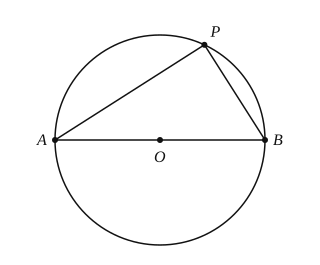
There is a circular park of diameter 65 m as shown in the following figure, where AB is a diameter. An entry gate is to be constructed at a point P on the boundary of the park such that distance of P from A is 35 m more than the distance of P from B. Find distance of point P from A and B respectively.
A cottage industry produces a certain number of toys in a day. The cost of production of each toy (in rupees) was found to be 55 minus the number of toys produced in a day. On a particular day, the total cost of production was ₹ 750. Find the total number of toys produced on that day.
Show answer & solution
Answer: 25 or 30 toys
Let the number of toys be x. Cost of each toy =₹(55−x).
A cottage industry produces a certain number of pottery articles in a day. It was observed that on a particular day that the cost of production of each article (in rupees) was 3 more than twice the number of articles produced on that day. If the total cost of production on that day was ₹ 90, find the number of articles produced and the cost of each article.
Show answer & solution
Answer: 6 articles; ₹ 15 each
Let the number of articles be x. Cost of each =₹(2x+3).
The area of a rectangular plot is 528 m2. The length of the plot (in metres) is one more than twice the breadth. Find the length and breadth of the plot. Also, find the cost of levelling the plot at the rate of ₹ 80 per square metre.
Show answer & solution
Answer: Length = 33 m, breadth = 16 m; cost = ₹ 42240
In a flight of 2800 km, an aircraft was slowed down due to bad weather. Its average speed is reduced by 100 km/h and by doing so, the time of flight is increased by 30 minutes. Find the original duration of the flight.
Show answer & solution
Answer:321 hours (3 h 30 min)
Let the original speed be x km/h.
x−1002800−x2800=21.
2800×x(x−100)100=21⇒x2−100x−560000=0.
(x−800)(x+700)=0⇒x=800 (speed cannot be negative).
Original duration = 8002800=3.5 hours = 3 hours 30 minutes.
A train travels a distance of 90 km at a constant speed. Had the speed been 15 km/h more, it would have taken 30 minutes less for the journey. Find the original speed of the train.
A 2-digit number is such that the product of its digits is 18. When 63 is subtracted from the number, the digits interchange their places. Find the number.
Show answer & solution
Answer: 92
Let the tens digit be x and the units digit y; the number is 10x+y.
10x+y−63=10y+x gives 9x−9y=63, so x−y=7, i.e. y=x−7.
xy=18: x(x−7)=18, so x2−7x−18=0.
(x−9)(x+2)=0, so x=9 (a digit cannot be negative) and y=2.
The age of a man is twice the square of the age of his son. Eight years hence, the age of the man will be 4 years more than three times the age of his son. Find their present ages.
Show answer & solution
Answer: Son: 4 years, man: 32 years
Let the son's present age be x years; the man's age is 2x2 years.
After 8 years: 2x2+8=3(x+8)+4.
2x2−3x−20=0⇒(2x+5)(x−4)=0.
Age cannot be negative, so x=4.
Son is 4 years old and the man is 2×16=32 years old. (Check: in 8 years, 40 = 3 × 12 + 4.)
The diagonal of a rectangular field is 60 m more than the shorter side. If the longer side is 80 m more than the shorter side, find the length of the sides of the field.
Show answer & solution
Answer: No such field exists: the resulting equation x2+40x+2800=0 has no real roots.
Let the shorter side be x m. Then the longer side is (x+80) m and the diagonal is (x+60) m.
By Pythagoras: x2+(x+80)2=(x+60)2
x2+x2+160x+6400=x2+120x+3600
x2+40x+2800=0
D=402−4(1)(2800)=1600−11200=−9600<0
The equation has no real roots, so no rectangle has these measurements.
(With the NCERT data, longer side 30 m more than the shorter side, x2−60x−2700=0 gives sides 90 m and 120 m.)
A train travels 360 km at a uniform speed. If the speed had been 5 km/hr more, it would have taken 1 hour less for the same journey. Find the speed of the train.
A motor boat whose speed is 18 km/h in still water takes 1 hour more to go 24 km upstream, than to return to the same point. Find the speed of the stream and total time of the journey.
Show answer & solution
Answer: Speed of the stream = 6 km/h; total time = 3 hours
Let the speed of the stream be x km/h. Upstream speed =18−x, downstream speed =18+x.
18−x24−18+x24=1, so 24×2x=324−x2.
x2+48x−324=0, i.e. (x+54)(x−6)=0, so x=6.
Upstream time =1224=2 h, downstream time =2424=1 h.
Speed of the stream = 6 km/h and total time of the journey = 3 hours.
A train travels at a certain average speed for a distance of 54 km and then travels a distance of 63 km at an average speed of 6 km/h more than the first speed. If it takes 3 hours to complete the journey, what was its first average speed ?
Two pipes together can fill a tank in 815 hours. The pipe with larger diameter takes 2 hours less than the pipe with smaller diameter to fill the tank separately. Find the time in which each pipe can fill the tank separately.