CBSE Class 10 Maths Standard 2024 Question Paper 30/1/2 with Solutions
All 44 questions from the CBSE Class 10 Mathematics Standard board paper, Set 30/1/2 (2024),
with answers and step-by-step solutions. Total 80 marks. Tap “Show answer & solution” under any question.
From the data 1, 4, 7, 9, 16, 21, 25, if all the even numbers are removed, then the probability of getting at random a prime number from the remaining is :
(A)52
(B)51
(C)71
(D)72
Show answer & solution
Answer: (B) 51
Removing the even numbers 4 and 16 leaves 1, 7, 9, 21, 25 (5 numbers).
Assertion (A) : If the graph of a polynomial touches x-axis at only one point, then the polynomial cannot be a quadratic polynomial. Reason (R) : A polynomial of degree n(n>1) can have at most n zeroes.
(A)Both, Assertion (A) and Reason (R) are true and Reason (R) is correct explanation of Assertion (A).
(B)Both, Assertion (A) and Reason (R) are true but Reason (R) is not correct explanation for Assertion (A).
(C)Assertion (A) is true but Reason (R) is false.
(D)Assertion (A) is false but Reason (R) is true.
Show answer & solution
Answer: (D) Assertion (A) is false but Reason (R) is true.
A: The graph of x2 touches the x-axis only at the origin, and x2 is quadratic. So A is false.
R: A polynomial of degree n has at most n zeroes. R is true.
In a pack of 52 playing cards one card is lost. From the remaining cards, a card is drawn at random. Find the probability that the drawn card is queen of heart, if the lost card is a black card.
Show answer & solution
Answer:511
After a black card is lost, 51 cards remain.
The queen of hearts is red, so it is still in the pack: 1 favourable outcome.
In a chemistry lab, there is some quantity of 50% acid solution and some quantity of 25% acid solution. How much of each should be mixed to make 10 litres of 40% acid solution ?
Show answer & solution
Answer: 6 litres of 50% solution and 4 litres of 25% solution
Let x litres of 50% solution and y litres of 25% solution be mixed.
x+y=10 ... (1)
Acid content: 0.5x+0.25y=0.4×10=4, i.e. 2x+y=16 ... (2)
(2) − (1): x=6; then y=4.
So 6 litres of 50% solution and 4 litres of 25% solution are needed.
ABCD is a rectangle formed by the points A(−1,−1), B(−1,6), C(3,6) and D(3,−1). P, Q, R and S are mid–points of sides AB, BC, CD and DA respectively. Show that diagonals of the quadrilateral PQRS bisect each other.
Show answer & solution
Answer: Mid-points of PR and QS are both (1,25), so the diagonals bisect each other.
P (mid-point of AB) =(−1,25), Q (mid-point of BC) =(1,6).
R (mid-point of CD) =(3,25), S (mid-point of DA) =(1,−1).
Mid-point of PR =(2−1+3,25)=(1,25).
Mid-point of QS =(21+1,26−1)=(1,25).
The diagonals PR and QS have the same mid-point, so they bisect each other.
A wooden toy is made by scooping out a hemisphere of same radius as of cylinder, from each end of a wooden solid cylinder. If the height of the cylinder is 20 cm and its base is of radius 7 cm, find the total surface area of the toy.
Show answer & solution
Answer: 1496 cm2
Total surface area = curved surface of cylinder + inner surfaces of the two hemispherical hollows.
In a teachers' workshop, the number of teachers teaching French, Hindi and English are 48, 80 and 144 respectively. Find the minimum number of rooms required if in each room the same number of teachers are seated and all of them are of the same subject.
Show answer & solution
Answer: 17 rooms
The number of teachers per room must divide 48, 80 and 144; for the fewest rooms it is their HCF.
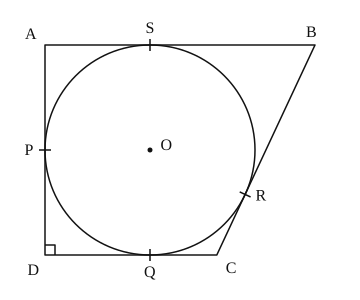
A circle with centre O and radius 8 cm is inscribed in a quadrilateral ABCD in which P, Q, R, S are the points of contact as shown. If AD is perpendicular to DC, BC = 30 cm and BS = 24 cm, then find the length DC.
Show answer & solution
Answer: DC = 14 cm
Tangents from an external point are equal: BR = BS = 24 cm.
CR = BC − BR = 30 − 24 = 6 cm, so CQ = CR = 6 cm.
In quadrilateral OPDQ, ∠D=90∘ and ∠OPD=∠OQD=90∘ (radius ⊥ tangent), and OP = OQ = 8 cm, so OPDQ is a square.
If a line is drawn parallel to one side of a triangle to intersect the other two sides in distinct points, then prove that the other two sides are divided in the same ratio.
Show answer & solution
Answer: Proved.
Given: In △ABC, DE ∥ BC meets AB at D and AC at E.
To prove: DBAD=ECAE.
Construction: Join BE and CD; draw EM ⊥ AB and DN ⊥ AC.
ar(BDE)ar(ADE)=21×DB×EM21×AD×EM=DBAD.
ar(DEC)ar(ADE)=21×EC×DN21×AE×DN=ECAE.
△BDE and △DEC are on the same base DE and between the same parallels DE and BC, so ar(BDE) = ar(DEC).
From the top of a building 60 m high, the angles of depression of the top and bottom of the vertical lamp post are observed to be 30∘ and 60∘ respectively. (i) Find the horizontal distance between the building and the lamp post. (ii) Find the distance between the tops of the building and the lamp post.
Show answer & solution
Answer: (i) 203 m ≈34.64 m (ii) 40 m
Let the building be AB = 60 m (top A) and the lamp post CD (top D, foot C), with BC = d m.
(i) Angle of depression of C is 60∘: tan60∘=d60, so d=360=203≈34.64 m.
(ii) Angle of depression of D is 30∘: the vertical drop from A to the level of D is dtan30∘=203×31=20 m (so the lamp post is 60−20=40 m high).
Distance AD =cos30∘d=3/2203=40 m (check: (203)2+202=1600=40).
The sum of first and eighth terms of an A.P. is 32 and their product is 60. Find the first term and common difference of the A.P. Hence, also find the sum of its first 20 terms.
Show answer & solution
Answer:a=2, d=4, S20=800; or a=30, d=−4, S20=−160
Let the first term be a and the eighth term a8=a+7d.
a+a8=32 and a⋅a8=60, so a and a8 are roots of t2−32t+60=0, i.e. (t−2)(t−30)=0.
Case 1: a=2, a8=30: 7d=28, d=4. S20=220[2(2)+19(4)]=10×80=800.
Case 2: a=30, a8=2: 7d=−28, d=−4. S20=10[60+19(−4)]=10×(−16)=−160.
In an A.P. of 40 terms, the sum of first 9 terms is 153 and the sum of last 6 terms is 687. Determine the first term and common difference of A.P. Also, find the sum of all the terms of the A.P.
Show answer & solution
Answer: First term = 5, common difference = 3, sum of all 40 terms = 2540
S9=29(2a+8d)=153, so a+4d=17 ... (1)
The last 6 terms are the 35th to 40th terms: sum =26(a35+a40)=3(2a+73d)=687, so 2a+73d=229 ... (2)
From (1), a=17−4d. Substituting: 34−8d+73d=229, so 65d=195, d=3, a=5.
A vessel is in the form of a hollow hemisphere mounted by a hollow cylinder. The diameter of the hemisphere is 14 cm and the total height of the vessel is 13 cm. Find the inner surface area and the volume of the vessel.
Show answer & solution
Answer: Inner surface area = 572 cm2; volume =34928≈1642.67cm3
Radius r=7 cm; height of cylinder h=13−7=6 cm.
Inner surface area =2πr2+2πrh=2πr(r+h)=2×722×7×13=572cm2.
BINGO is game of chance. The host has 75 balls numbered 1 through 75. Each player has a BINGO card with some numbers written on it. The participant cancels the number on the card when called out a number written on the ball selected at random. Whosoever cancels all the numbers on his/her card, says BINGO and wins the game. The table given below, shows the data of one such game where 48 balls were used before Tara said 'BINGO'. Numbers announced: 0-15, 15-30, 30-45, 45-60, 60-75 Number of times: 8, 9, 10, 12, 9 Based on the above information, answer the following : (i) Write the median class. (1) (ii) When first ball was picked up, what was the probability of calling out an even number ? (1) (iii) (a) Find median of the given data. (2) OR (b) Find mode of the given data. (2)
Show answer & solution
Answer: (i) 30-45 (ii) 7537 (iii) (a) 40.5 OR (b) 51
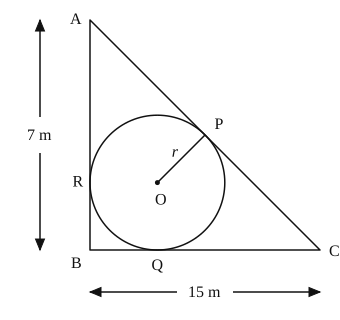
A backyard is in the shape of a triangle ABC with right angle at B. AB = 7 m and BC = 15 m. A circular pit was dug inside it such that it touches the walls AC, BC and AB at P, Q and R respectively such that AP = x m. Based on the above information, answer the following questions : (i) Find the length of AR in terms of x. (1) (ii) Write the type of quadrilateral BQOR. (1) (iii) (a) Find the length PC in terms of x and hence find the value of x. (2) OR (b) Find x and hence find the radius r of circle. (2)
Show answer & solution
Answer: (i) AR = x m (ii) Square (iii) (a) PC = (8+x) m, x=2274−8≈4.28 m OR (b) x≈4.28 m, r=222−274≈2.72 m
(i) Tangents from A are equal: AR = AP = x m.
(ii) ∠B=90∘, ∠ORB=∠OQB=90∘ (radius ⊥ tangent) and OR = OQ = r, so BQOR is a square.
(iii) (a) BR = AB − AR = 7−x, so BQ = BR = 7−x and CQ = 15−(7−x)=8+x. Hence PC = CQ = (8+x) m.
AC = AP + PC = 2x+8, and AC =72+152=274.
2x+8=274, so x=2274−8≈216.55−8≈4.28 m.
OR (b) As above, x=2274−8≈4.28 m.
Since BQOR is a square, r = BR = 7−x=222−274≈2.72 m.
A rectangular floor area can be completely tiled with 200 square tiles. If the side length of each tile is increased by 1 unit, it would take only 128 tiles to cover the floor. (i) Assuming the original length of each side of a tile be x units, make a quadratic equation from the above information. (1) (ii) Write the corresponding quadratic equation in standard form. (1) (iii) (a) Find the value of x, the length of side of a tile by factorisation. (2) OR (b) Solve the quadratic equation for x, using quadratic formula. (2)
Show answer & solution
Answer: (i) 200x2=128(x+1)2 (ii) 9x2−32x−16=0 (iii) (a) x=4 units OR (b) x=4 (rejecting x=−94)
(i) Floor area is the same in both cases: 200x2=128(x+1)2.
(ii) 200x2=128x2+256x+128, so 72x2−256x−128=0. Dividing by 8: 9x2−32x−16=0.